Crespi: "Studiate Mussolini, è stato il più grande comunicatore del '900"


Luigi Crespi, political communication coach and more, during the two days in Rome entitled "The leaders' factory" he spoke about the art of knowing how to communicate, to measure persuasiveness and authority, of knowing how to empathize with the needs and expectations of the public. And he indicated a model: Benito Mussolini. Already: Crespi has no doubts, Mussolini was the greatest communicator of the twentieth century and should be studied. This – warns Crespi – does not mean re-evaluating, but go deeper yes, it is necessary.
Read More

Share

Memories of an era – Fra' Ginepro, the Franciscan who brought Mussolini back to the Faith

Of Luciano Garibaldi

fgnpr

Fra' Ginepro from Pompeiana (photo from the Ragazzi del Manfrei website)

He was a priest, Don Ennio Innocenti, theologian and historian, famous radio preacher (his broadcasts entitled “Listen, it's evening"), as well as founder of the “Sacra Fraternitas Aurigarum in Urbe”, to reconstruct Mussolini's path towards faith. He did it with a book, “Dispute over the conversion of Benito Mussolini”, published in Rome in the mid-nineties, precisely from the Fraternitas (via Capitan Bavastro 136, 00154 Roma). Don Ennio Innocenti had dedicated twelve years of research and personal investigations to this unusual story. At first, had revealed what Father Eusebio OFM had confided to him, born Sigfrido Zappaterreni, chief chaplain of the Black Brigades, moved to Argentina after the war and died in Buenos Aires. Several times - this was revealed by Father Eusebio to his brother - he received the sacramental confession of Benito Mussolini. Afterwards, it was another Franciscan who administered it to the Duce, after confessing it himself, the Eucharist. His name was Fra' Ginepro. Read More

Share

You again, Benito

Of Marcello Veneziani

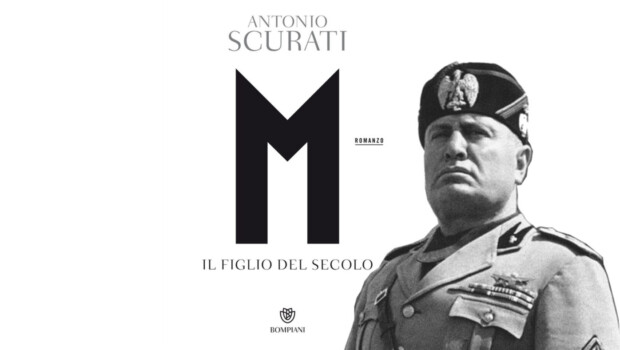
Like today seventy-five years ago Mussolini he was freed from imprisonment in Campo Imperatore. Today the first volume of a monumental work dedicated to the leader tries to free him from the damnatio memoriae Antonio Scurati which goes to the bookshop today, M. the son of the century (ed. Bompiani, 840 pages, 22 euro). It seems strange but in the river of books dedicated to fascism and the Duce there is not a biographical novel entirely focused on his figure. Mussolini appears there a thousand and a thousand times as an evil demiurge, as a menacing shadow or as an ogre in individual stories, even private ones. But a fictionalized biography about him, in multiple volumes, without an apologetic or denigrating tone, something of a narrative equivalent of the monumental historical biography of Renzo De Felice, it wasn't there yet. Curious to see it, especially given the author's premises/promises of equidistance and the confession of having been subjugated by the character, and perhaps fascinated. It also happened to De Felice, who also came from an anti-fascist culture, left. Furthermore, Scurati does not lack narrative talent and a free gaze.
I would like to object something to the title because Mussolini may have been the son of his century but above all he was its father because he generated events, followers, imitations, works and curses like few others. He was the father of fascism and stepfather of anti-fascism. Some even considered that Mussolini invented an eternal category, Urfascism (Umberto Eco). Son of a century but father of an eternity, nice paradox, Benito.
In truth, Scurati's fictional biography renounces too large and significant a part of Mussolini's life: the one that precedes the foundation of fascism, il 1919, that is, the life of an anarchist, as a revolutionary socialist, as leader of the most radical left, as a master, journalist and writer, exile and prisoner, and then director of Avanti and other effervescent magazines, until the foundation of the Popolo d'Italia. But also Mussolini fighting in the First World War. Scurati's Mussolini is already the founder of fascism, much of his life has already passed. Read More

Share

Ponti fascisti opere d'arte resistenti a tutto

Fascist bridges works of art resistant to everythingExamples of engineering and architecture that not even Anti-Fascism throws down
Of Angela Di Pietro
When He was there, not only did the trains arrive on time, but the bridges never came down and even today they resist everything, also two point zero for Anti-Fascism, all carelessness, to the absence of maintenance. For the bridges built in Italy during the twenty years of fascism, designed by eminent professionals of the time, the toponym “littorio” was frequently used, or “of the lictor”. The war conflict ended and the Republic was established, In the 1946, the viaducts lost the name "Littoria" and changed names (don't do it). Everyone. They were well made, they were resistant, but they were destined to oblivion because they were linked to the figure of the Duce.
One of the most important is without a doubt the littorio bridge in Venice, today known as the “Freedom Bridge”. The Brescia engineer Eugenio Giuseppe Miozzi was in charge of the design work, example of honesty and ability, who doesn't even have a registered street because men like him are considered "to be forgotten", like Mussolini. The most important work entrusted to him was that of the littorio bridge (today Liberty Bridge) which connects Venice with the mainland by car. A highway on water. The construction, long 22 meters, it was made of reinforced concrete and stone, from “Ferrobeton” with great rapidity, alone 18 months. The bridge was inaugurated in 1933 with the name of “Littorio bridge” by Umberto II of Savoy together with his wife Maria José of Belgium, Benito Mussolini was also present. Still in Veneto", in the municipality of Verona, there is the “Vittoria bridge. It was the 1925 when…

IF YOU WANT TO CONTINUE READING CLICK HERE Read More

Share

Liberation from rhetoric

Of Marcello Veneziani
Liberation from rhetoric
Source: Marcello Veneziani
What would you say if we made a TV show called the Gulag Archipelago? That we went crazy, the gulag has been closed for several decades. It's an old story. And instead there is a brand new program, titled The defense of the Race, Of Gad Lerner, dedicated to a magazine and the terrible events of eighty years ago. Events evoked three times a day after meals.
The program has the obvious function to fan the flames of anti-racism and to establish an infamous bridge between the racists of the past and the centre-right press of today. Starting right from Il Tempo, to whom Lerner wanted to dedicate the incipit of the program, sticking to the fact that that infamous magazine, very read (and sometimes even written) by many who later become communists, socialists, lay people, Christian Democrats, had its headquarters in the same building as Il Tempo. If the blame also falls on the tenants of the buildings, Imagine the blame that should fall on those who participated in movements that decreed the killing, for example, of Commissioner Calabresi. Read More

Share

25 April, Mussolini's puppet whose head should be smashed: when the dead still scare the cowardly

Here is the civilization of democrats, pluralists, egalitarians, anti-racists, pro-gender, liberal, anti-fascists:

Written and reported by Antonio Amorsi
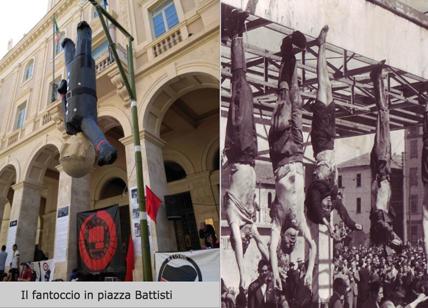
25 April Piazzale Loreto in Macerata. Mussolini hung to have his head smashed
Macerata, 25 April anti-fascist groups display Mussolini mannequin hanging upside down as in Piazzale Loreto. The kids have to hit him for candy

25 April Piazzale Loreto in Macerata. Mussolini hung to have his head smashed

Read More

Share

Puppet of the Duce in Macerata, usual tragicomedy of the infamous

The cowardice of grandparents, fathers, children, stepchildren of traitors, ambushes and companions is always the same. But Mussolini should not be left alone, because his is a battle of civilization, which must finally be brought to completion: “the dogs from Piazzale Loreto in cages!” (Matthew Castagna, “Christ the King”)

Written and reported by Antonio Amorosi
Macerata, clash between Alessandra Mussolini and the mayor over the Duce's puppet
After the Duce's puppet in the square in Macerata, clash bordering on physical impact between Alessandra Mussolini and the Democratic Party mayor Romano Carancini

Macerata, clash between Alessandra Mussolini and the mayor over the Duce's puppet

Read More

Share

Book news: "Fascisti prima di Mussolini" (Ed. Seventh Seal)

Report Seventh Seal Editions
New Seventh Seal

Seventh Seal

Sideri Rodolfo Culture
pag. 266

EURO 22,00
ISBN 978-88-61481-97-8

PAPERBACK

Fascism between history and revolution.

Among the kaleidoscopic images of fascism, the autobiography that the Mussolini movement wanted to offer about itself has often been underestimated. Through the analysis of “precursors” it is instead possible to read against the light what fascism deemed itself to embody and represent in the construction not only of a new social order, but also of a lifestyle inspired by a peculiar vision of the world.
During the twenty years of the regime, the debate developed in the contrast between those who believed that in these constructions fascism was in continuity with national history and that only in this continuity would the achievements that were carried out have the necessary solidity to last and those who instead believed that fascism should present itself as a radical revolution that constituted a clear break with the historical past of the nation.
If fascism did not clearly choose one of the two positions it is because it was still looking for its own ideological definition, but the necklaces dedicated to the pre-fascists and the forerunners, the parliamentary debate and even some statements by Mussolini himself, although reluctant to recognize precursors for his creation, lead us to lean towards the continuity thesis.
An inevitable propensity in a movement that considered the historical dimension of the individual and the State to be indispensable.

Read More

Share