Available numbers 163 Give Up Hearts

The. is available on the site number 163 (of the day 2 June 2019) Of Hearts Up®. The weekly can be downloaded for free in download section dedicated to Members and Supporters only.

Click here for the latest articles readable for free on the site:
– Press release number 163. The ten lepers;
– The parousia of the glorious Christ;
– Prayer to Saint Erasmus, Martyr (2.6);
– Saint Cyprian tells of the punishment of a sacrilegious woman;
– Prayer to Saints Marcellinus and Peter, Martyrs (2.6);
– A famous thief who dies hugging the column of San Simeon;
– Month of June. Litany of the Sacred Heart of Jesus;
– Prayer at the Ascension of Our Lord Jesus Christ;
– Dictionary of dogmatic theology. Sacramental Satisfaction;
– Prayer to Saint Augustine of Canterbury, Bishop (28.5);
– Prayer to Saint Joan of Arc, Virgin (30.5);
– Dictionary of dogmatic theology. Satisfaction (of Christ);
– Prayer to Santa Maria Maddalena de Pazzi (29.5);
– Video by Abbot Ricciotti: Euthanasia is a commissioned suicide;
– Prayer to Santa Petronilla, Virgin (31.5).
source – https://www.sursumcorda.cloud/tags/numero-163.html
Share

The unjust steward. The rich man

Esteemed Associates and kind Supporters, We are truly grateful for the large number, devoted and fervent participation in the last «Pilgrimage of Tradition», procession of 22 km from Osimo to Loreto in honor of Virgo Lauretana. An appointment of true friendship, of friends of the Church, friends of the Papacy, friends of the Clergy, friends of the Saints and Martyrs, friends of Our Lord Jesus Christ and the Blessed Virgin Mary. We take this opportunity to point out the relationship about true friendship, drawn mainly from the studies of Cornelio ALapide, published on our Youtube channel. We come to the usual study of the Holy Scripture using the precious "Life of Jesus Christ" by Abbot Ricciotti, who today talks to us about the unfaithful farmer and the rich man.
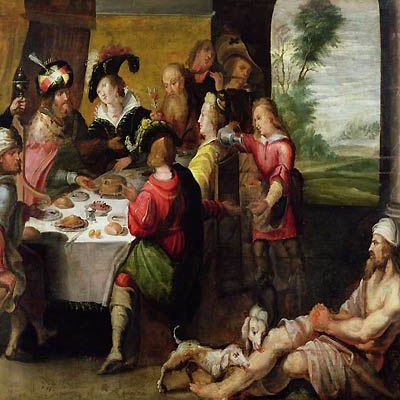
• § 470. As well as being the scribe of mercy, Saint Luke is also the Evangelist of poverty (§145): so here is the series of parables we are examining, pearls on divine mercy are followed by others on human poverty, these too are preserved only in Luca's chest. That giving up wealth was an act of foresight on the part of the follower of Jesus, it was shown by him with the following parable. There was a rich man who had a farmer, and he was accused by the master of squandering his assets; therefore he was called by the master, which he told him dryly: «I have heard bad rumors about you; present me with the accounts of your administration as soon as possible!». – Gone out of there, the farmer thought about his own cases, and he saw himself lost if he did not find some way to survive in his old age. He then began to think: «Now that the administration will be taken away from me, how will I be able to support myself? I am no longer capable of working in the fields; I'm ashamed to ask for alms". After thinking about it for a long time, he decided to make the burden of his livelihood fall on the master by means of a cunning scam. It was a question of falsely reducing the debt that each colonist had with the master, so that those fraudulently benefited debtors would then show their gratitude to the factor by rewarding him. He therefore called a settler and asked him: «How much you owe my master?» – He replied: «One hundred barrels of oil». – The factor then: «No, take the receipt here and write fifty!». – So this first debtor was forgiven half of the debt. Then called another, he asked him the same question; and he answered: «I owe a hundred measures of wheat».
Read More
Share

L'eresia antiliturgica e la riforma protestante (by Dom Prosper Guéranger)

[…] It is only within the true Church that anti-liturgical heresy can ferment, that is to say that heresy which presents itself as an enemy of the forms of worship. Only where there is something to destroy will the genius of destruction try to introduce this deleterious poison. The East has only tried it once, but violently, the shots, and this happened at the time of unity. In the eighth century a furious sect arose which, under the pretext of freeing the spirit from the yoke of form, broke, torn, burned the symbols of Christian faith and love. Blood was shed for the defense of the image of the Son of God as it had been shed four centuries earlier for the triumph of the true God over idols. But it was reserved for Western Christianity to see the longest war organized within its midst, more stubborn, which still continues, against all liturgical acts. Two things contribute to keeping the churches of the West in this state of trial: first of all, as has been said, the vitality of Roman Christianity, the only one worthy of the name of Christianity, and consequently the one against which all the forces of error had to turn. Secondly, the rationally material character of Western peoples, which, devoid of the agility of the Greek spirit as well as of Eastern mysticism, in terms of beliefs, they don't know what to deny, rather than rejecting what disturbs or humiliates them, incapable for this twofold reason, of following the same heresy like the Semitic peoples for long centuries. Here's the reason why you come to us, if certain isolated facts are overlooked, heresy has never proceeded except through denial and destruction. In this direction, as we will now see, all the efforts of the immense anti-liturgist sect must be made.
Read More
Share

Dictionary of dogmatic theology. The religious feeling

Valid ancient and modern psychologists discuss the nature of feeling without arriving at an agreed definition. Some believe that feeling derives from an affective or emotional faculty that is distinct from both the volitional faculty (motivates) both from the perceptive-intellectual faculty. Others reduce feelings to psychological movements and phenomena; others instead make them representative or intellectual functions. The scholastic theory formulated by Saint Thomas (d’Aquino) in the footsteps of Aristotle, despite its antiquity, presents the best guarantees of truth. According to this doctrine, there are only two psychic faculties in man: the cognitive and the appetitive, each of which is distinguished into sensitive and supersensible or spiritual. We therefore have the sensitive area with the sensory organs, sensations and passions, which belong together to the body and the soul that informs it. From there we move on to the spiritual zone, in which intellect and will function, which are immaterial faculties. Sensation is typical of the sensitive faculties, That, by passive impression of the external world on the senses, it becomes perception of the object and its representation (ghost – image), which corresponds in the appetitive faculty to the movement towards the perceived object, that is, that impulse accompanied by physical emotion, which is usually called passion (amore, hatred, gioia, sadness etc.).
Read More
Share

Available numbers 162 Give Up Hearts – Anti-liturgical heresy

The. is available on the site number 162 (of the day 26 maggio 2019) Of Hearts Up®. The weekly can be downloaded for free in download section dedicated to Members and Supporters only.
Click here for the latest articles readable for free on the site:
– Press release number 162. The unjust steward. The rich man;
– Prayer to San Bernardino of Siena (20.5);
– The Holy Scripture thrown into a fiery furnace in Russia;
– Prayer of Pope Pius XII in the Missions (21.5);
– A sinner dying of pain at the Confessor's feet;
– Prayer to Saint Rita of Cascia, Widow (22.5);
– Dictionary of dogmatic theology. Subjectivism;
– Oration at San Desiderio, Martyr (23.5);
– The anti-liturgical heresy and the Protestant Reformation (by Dom Prosper Guéranger);
– Prayer to Our Lady of Suffrage
SOURCE – https://www.sursumcorda.cloud/tags/numero-162.html
 

Share

Prayer to San Bernardino of Siena (20.5)

+ Admirable San Bernardino, That, sent by your Superiors and evangelize the tower of the East, then called back to sanctify the central countries of Europe, you infinitely multiplied the followers of Christian piety, you spread devotion to the Holy Name everywhere. of Jesus, always showing him portrayed in the most beautiful picture, always repeating it appropriately in all your sermons, in all your prayers, or sparkling with divine fire, and shedding tears of tenderness every time you treated the consecrated species at the Altar, obtain for us all the grace to always profess very special devotion to the ever sweet Name of our divine Savior, since in this alone we must hope for the remission of the guilt, the preservation of grace, the attainment of glory and every consolation, every good in the present century and in the future. So be it. +
[20 maggio, Saint Bernardino of Siena, Confessor (Massa Marittima, 8 September 1380 – L'Aquila, 20 maggio 1444). He was an apostle of the SS. Name of Jesus and stood out for opposing the usury practiced by the Jews].

source – https://www.sursumcorda.cloud/preghiere/2193-preghiera-a-san-bernardino-da-siena-20-5.html

Share

THE LIMBO OF THE UNBAPTIZED

The Limbo of unbaptized children, or those who died without baptism and before having the use of reason, or of all the unborn. We are talking about those who have not received baptism nor have been able to do so (blamelessly) desire. I have discussed this topic a lot in the past, so today it's just a matter of summarizing. I had already written:
The penalty for original sin is the lack of vision of God (1. Denz. 184 219; 2. Denz. 780); there is no intermediate place in the Pelagian sense between the kingdom of God and damnation (3. Denz. 184; 4. Denz. 224; 5. Denz. 2626); the proposition is condemned: [the souls of children who are born to Christian parents and who die without baptism reach an earthly paradise, the souls of children who were born to non-Christian parents and who die without baptism arrive in the place where the souls of their parents are] (6. Denz. 1008).
The souls of those who die only with original sin descend into hell where they are punished with penalties and in different places (7. Denz. 858; 8. Denz. 926; 9. Denz. 1306), we will delve deeper later; they are punished with the penalty of damnation without the penalty of fire (10. Denz. 2626); the place where they are found is commonly called Limbo (11. Denz. 2626); the proposition is condemned: [a child who dies without baptism will hate God] (12. Denz. 1949). Read More

Share

Numbers available 160 e 161 Give Up Hearts – 5×1000

The numbers 160 e 161 (dal 12 al 19 maggio 2019) Of Hearts Up®. The weekly can be downloaded for free in download section dedicated to Members only.
We have also uploaded the issue to the site and already sent it to print 161 Of Hearts Up® because Saturday 18 and Sunday 19 May we will be in Loreto for the Pilgrimage of Tradition . We invite all members and supporters to participate.
To donate on 5×1000 to our small Association follow the instructions published in this PDF .
source – https://www.sursumcorda.cloud/settimanale/indici-sursum-corda.html

Share

Life and sayings of the Desert Fathers: John the Persian

A man said to his father Giovanni: «We have suffered so much for the kingdom of heaven; we will inherit it eventually?». And the old man said: «I trust that I will inherit the Jerusalem of above inscribed in heaven. He who promised is faithful; why should I doubt? I was as hospitable as Abraham, gentle like Moses, holy like Aaron, patient like Job, humble like David, a hermit like Giovanni, contrite like Jeremiah, doctor like Paolo, faithful like Peter, wise like Solomon. And I believe like the thief that he who out of his goodness has given me all this, he will also give me the kingdom of heaven" (237d-240a).
Taken from Life and sayings of the Desert Fathers, edition New City, 1999.
source – https://www.sursumcorda.cloud/articoli/padri-del-deserto/2174-vita-e-detti-dei-padri-del-deserto-giovanni-il-persiano-parte-2-ed-ultima.html
Share

Dictionary of dogmatic theology. The Holiness of the Church

Holiness is the second property that the Nicene-Constantinopolitan Symbol attributes to the Church and which emanates from the intimate nature of the same. In fact, if the Church is "the union of Christ with man in a social form" it must be holy, like everything that is in contact with God. The Bible presents holiness as the characteristic attribute of the Church: «Christ loved the Church and gave himself for her, in order to sanctify it (…), to prepare her as an immaculate bride, without wrinkles and without moles" (Ephesus. 5, 26); «Christ chose us so that we might be holy and immaculate before him» (Ephesus. 1, 4): "He gave himself for us in order to redeem us from all iniquity and to purify himself into an acceptable and zealous people for good works" (Tit. 2, 14). The holiness of the Church is threefold: sanctity of principles, of the limbs, of charismas. The sanctity of principles consists in the fact that the Church is endowed with means that are suitable for producing sanctity in men (active sanctity). Really the dogmatic and moral doctrine of the Church (Magisterium) it is the ferment that lifts the human mass from the darkness of the earth to the splendors of the sky; his Sacraments (Ministry) they are the channels that transmit sanctifying grace; his authority (Empire) it tends only to guide the faithful along the path of perfection. The sanctity of the limbs results from the spectacle that has constantly occurred in the history of Christianity of many faithful living according to the precepts of the Gospel (common holiness) and many others who, also following the evangelical advice, they have reached the arduous heights of heroism (eminent sanctity), which is usually sanctioned by canonization. All the centuries of the history of Christian peoples, from San Paolo to San Benedetto, from Saint Francis of Assisi to Saint Teresa of Jesus, from San Vincenzo de' Paoli to San Giovanni Bosco are intersected by the luminous trail of heroic sanctity (passive sanctity). The sanctity of charisms emerges from the gift of miracles, with which the Holy Spirit usually manifests his presence throughout the mystical Body (they are in fact the miracles thanks gratis datae for the building of the Church) as in some member endowed with singular virtue, because God, ordinarily he uses the souls dearest to him to work his wonders (signs of holiness).
dal Dictionary of dogmatic theology, Piolanti, Relative, Garofalo – peace to their souls! – Studies, Roma, 1952.

Source – https://www.sursumcorda.cloud/articoli/dizionario-di-teologia-dommatica/2171-dizionario-di-teologia-dommatica-la-santita-della-chiesa.html

Share
1 2 3 4 9