Italy's problem is not debt but interest


by Paolo Becchi and Giovanni Zibordi on Libero, 27/12/2018


The purpose of this article is to compare the much ado about nothing of current economic maneuvers, with those of the past, when the Italian government allowed the economy to really function, thanks to the fact that he kept taxes low and made public investments.
The current financial maneuver is perplexing from an economic point of view because in the end the result from that point of view is practically irrelevant. That is to say, it is not built with the growth of the country in mind. Over the last ten years, the Italian economy has lost 9% of GDP, with the recession of 2008/9 and then that of 2012, a loss that he only recovered in a small part. And the new maneuver, in its latest formulation, it does not indicate a concrete change of direction. In short, it was supposed to be an expansive maneuver and instead it isn't.
Read More

Share

Has Salvini decided to abandon the fight against the euro or is it just a tactical move?

by Paolo Becchi
In May we vote for the renewal of the European Parliament. Salvini has recently toned down the controversy against the EU and the radical criticism of the euro from five years ago, today there is not much left, actually nothing. Right, when you are in government you need to be cautious and especially in this phase of discussion with the European Commission it is better to avoid talking about the single currency so as not to give the mainstream the excuse of a possible surge in the spread.

For the European elections, however, Salvini should not campaign as deputy prime minister or minister, but rather as the leader of the political party that could even establish itself as the country's main force. And regarding the European elections we want to ask the question: Salvini has definitively decided to abandon the issue of Italy's exit from the euro, leaving the fight for the recovery of monetary sovereignty to the Brothers of Italy, CasaPound and various sovereignists on the verge of a nervous breakdown? Or is it just a mere and temporary tactical retreat? Read More

Share

Salvini reminds Juncker that the EU treaties are based on growth


by Paolo Becchi on Libero, 09/12/2018


Salvini said many things and touched on various topics, but the heart of the political discourse was Europe and our place in the Union. In fact, he has already started the long electoral campaign for the next European elections, which for Salvini will no longer be characterized, like the previous ones, by a radical criticism of the single currency. You may like it or not but this is the direction taken.
Changing Italy but also changing the Union from within; this is the message of a politician who in this way wanted to show that he lives not only on tactics, but also of a broader political vision. Whether he will succeed in changing the EU as Italy is trying to change is difficult to say today. We will have to wait for the result, however not taken for granted, of the next European elections. But let's think about today. Read More

Share

Let's go back to the lira, S. also says it&P

Of Paolo Becchi e Giovanni Zibordi
Let's go back to the lira, S. also says it&P
Source: Paolo Becchi
We want to say it clearly: the Italian State is a victim of usury. Interest accumulates on interest and increases the debt even if you no longer go into debt. And 25 years the State has not or rather would not need to go into debt because it collects more taxes than it spends: in the last year or so 30 billions in taxes more than expenses, but it results in a deficit of approx 40 billion a year because it pays approximately 70 billion per year in interest. This has been happening since the early 1990s: the state has since paid 2.500 billions in interest, more than the debt. The State has a debt of approximately 2.360 billion even if from 25 years he has not gone into debt because he has paid well 2.500 billions in interest since the early 1990s. This is a classic case of wear and tear, the increase in debt due only to the accumulation of interest over time and which becomes impossible to repay because the interest is too high.
The increase in the spread is a phenomenon of usury to the detriment of the State. Here's why. Read More

Share

Seizure of Lega funds, Becchi: "Salvini ha tre strade. I rule out Berlusconi's help"

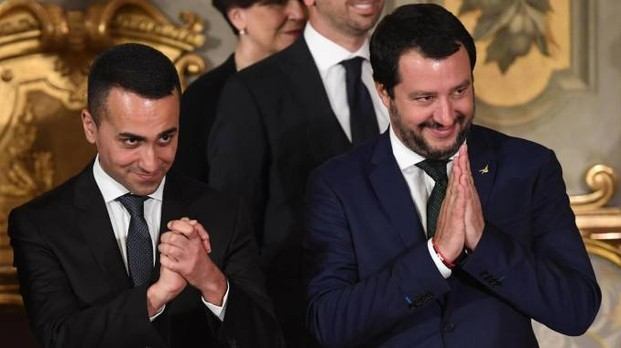
“It is clear that they are trying to put a spoke in our wheels. And the accusation of kidnapping, and abuse of office, and the seizure of accounts... it seems to me that this is going too far. It is clear that someone is not resigned to the fact that Salvini is in government". The Minister of the Interior and Deputy Prime Minister Matteo Salvini says this in an interview with The Press after the ruling of the Review which authorizes the seizure of 49 millions from the Northern League for electoral reimbursements presumably not due since 2008 al 2010. What will the League do now?? How will it be able to remain standing without a euro of financing given that the sentence orders the seizure of present and future accounts and therefore also of the sums that will be received? The philosopher Paolo Becchi He has an idea of ​​his own and he exposes it to The Special.
READ THE SPECIAL INTERVIEW WITH THE MOLINARI PARENT

Salvini speaks of a political attack, claiming that some would be annoyed by the fact that the League is in government. Share? Read More

Share

Becchi: «E invece io dico attenti a quei due che resteranno alleati a lungo»

THE OPINION
Luciano Tirinnanzi intervista Paolo Becchi su Panorama N. 34, 09/08/2018
«According to the authors, è in atto un passaggio dalla Seconda alla Terza Repubblica basato su un dato che – credo anch’io – non può essere contestato. The inability of the so-called "progressive" forces to serve the interests of workers and small and medium-sized businesses, in short, of the majority of Italians. […] I believe Becchi is right when in one of his articles on the "sovereignist revolution", collected now in this book, maintains that the opposition between "right" and "left" has now been overcome by that which in my opinion sees people and elites opposed. […] I want to give new impetus to popular sovereignty. “Italians first” means nothing more than this. They left us a country with little hope for the future and with few smiles. Rebuilding it won't be easy. But I promise you that I will give it my all".
It is an extract from the preface signed by the Minister of the Interior and Deputy Prime Minister Matteo Salvini, which baptizes the political essay by Paolo Becchi and Giuseppe Palma, From the Second to the Third Republic, appena uscito per Paesi edizioni (304 pp., 12 euro). A book that, first, recounts the birth of the Lega-M5s government and frames it as a definitive overcoming of the political past. Ma è davvero così? We asked Professor Becchi, first ideologist of the Cinquestelle and now closer to the positions of the League.
«Il passaggio dalla Seconda alla Terza Repubblica è avvenuto senza coinvolgere la Costituzione, therefore it is partly an improper definition, but which nevertheless tells of the exhaustion of a political process that began in the 1990s. As I write in the book, il suo aspetto innovatore è nella sintesi tra sovranismo identitario, that of Salvini's League, and social sovereignty, proposed instead by Di Maio and the Cinquestelle. Non a caso l’uno si è preso il dicastero dell’Interno e l’altro quello del Lavoro. Terza Repubblica significa avere un governo che sta facendo nascere qualcosa di nuovo, without throwing the constitutional rules to the wind". Read More

Share

Sovereignists at the crossroads between "light" Europe and the Trump option

of the Prof. Paolo Becchi on Libero, 20/07/2018
Juncker's image, President of the European Commission, visibly altered and staggering during the last NATO summit, it represents what Europe currently is better than anything else. The Franco-German axis, of which Juncker is the expression, he's in a coma, non-ethyl, but still in a coma.
The Visegrad Group of countries interacts with the United States,and the United States has openly declared support for Brexit, war on the EU and support for all those countries like ours that have taken on a Eurosceptic orientation with the new government. Let's say it clearly: Trump's policy is not at all "isolationist", as it seemed from the election campaign. American foreign policy is completely back under neocon control. Trump now clearly aims to disaggregate Europe, because it fears not only the economic but also the political growth of Germany. Perhaps it is no coincidence that Bannon is in Italy so often in recent months, on Trump's "exploratory mandate" or in his own interest, it doesn't matter. Trump is revealing the true face of his current administration: to all intents and purposes it continues to exercise that imperial role that the United States has had since the post-war period and which after the fall of the Berlin Wall, for a few years, they practiced on their own. Right, now there is Putin's Russia again, and also China, that move on the international stage, but Europe?
Ecco, Trump's strategy is evident: aim for the disintegration of Europe by helping all those populist movements, sovereignists who are succeeding in Europe. Here a big problem arises for Europe and for our country in Europe. Italy is faced with two possible paths: deal a heavy blow to the now weakened Franco-German hegemony, taking advantage of Trump's support, but in this case running the risk of becoming the "Atlantic bridgehead" on the old continent. Free from European constraints, but subjects once again of the American Empire? Read More

Share

If he made the pact on migrants, Renzi should be put on trial

Of Paolo Becchi and Giuseppe Palma are Libero, 12/07/2017

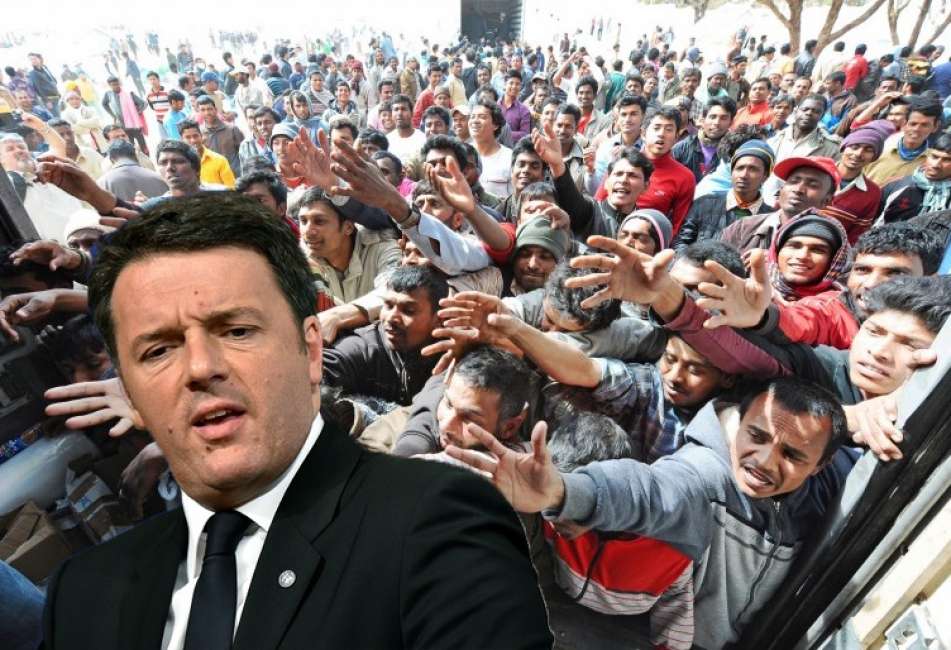
According to the former Foreign Minister of the Letta government, Emma Bonino, dal 2014 al 2016 the Renzi government would have committed itself on behalf of Italy, in agreement with other European governments, to welcome all migrants arriving in Europe. And so far nothing new, given that this is written in black and white on the agreements relating to the Triton operation. The problem arises if, come the former Defense Minister of the Letta government veiledly implied, Mario Mauro, this had happened in exchange for greater flexibility on the part of the EU on our public finances, circumstance evidently not written anywhere, but everything about a possible secret agreement between the Renzi government and the EU. In exchange for flexibility, which served him for political purposes, it is possible that Renzi betrayed the country, allowing migratory invasion, addressed solely to our territory? The statements of Bonino and Mauro, if read together, they would lead to that much. Many have talked about it, making even harsh criticisms, but no one made a decisive point: if there was an agreement of that type, come the secret exchange agreement between oil and migrants in Malta (of which above Libero news has already been given), this would even have criminal implications.
In fact, there would be criminal liability, as well as political, held by the former Prime Minister and any ministers competing with him. Art. 243 of the penal code states: «Whoever holds intelligence with the foreigner so that a foreign state wages war or carries out acts of hostility against the Italian state, or commits other acts aimed at the same purpose, is punished with imprisonment of not less than ten minutes. If war ensues or hostilities occur, life imprisonment applies". Read More

Share

L'Africa siamo noi

by Paolo Becchi
Africa is us
Source: Paolo Becchi
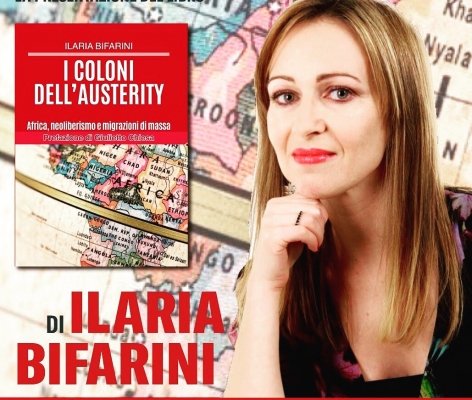
To understand something about what is happening in Africa and the mass emigration from that continent, we must first detoxify ourselves from what the newspapers write every day or what the mainstream publishing houses publish, and maybe start by reading a book recently published by Amazon and Youcanprint (both as an ebook and in paperback).
The author, Ilaria Bifarini, she is a young scholar, who presents herself as a "redeemed Bocconian", already known for a volume, Neoliberalism and mass manipulation (2017), which has sold thousands of copies online. His new book, titled The settlers of austerity. Africa, neoliberalism mass emigration (2018) continues the same critical theoretical path towards the neoliberal doctrine, tackling the topic from a counter-current perspective, very relevant today, of mass migrations. The fundamental thesis is soon stated: let's get out of our heads the convenient narrative that traces current African underdevelopment to the colonial past. This thesis is often supported today to justify uncontrolled reception. But it's false.
The disintegration of colonial empires starting from the 1950s led to the formation of independent national states, who however did not have the opportunity to develop their economies independently because they were prevented from doing so: colonialism was thus replaced by something even worse, a form of postcolonialism, focused on economic control, which prevented local economies from growing and developing. Read More

Share

On immigration, Italian populists are the future. Merkel is the past

Of Niall Ferguson
On immigration, Italian populists are the future. Merkel is the past
Source: Paolo Becchi

One hundred and ten years ago the British author Israel Zangwill completed the play The Melting Pot. First performed in Washington in October 1908 — where it was enthusiastically applauded by President Theodore Roosevelt — it celebrates the United States as a gigantic melting pot that fuses together “Celts and Latins, Slavs and Teutons, Greeks and Syrians — blacks and yellows — Jews and Gentiles” to form a single people.

"Yes", declares the hero of the play (like Zangwill's father, a Jewish immigrant from Russia), “Est e Ovest, and North and South, the palm and the pine, the pole and the equator, the crescent and the cross... Here everyone will unite to build the Republic of Man and the Kingdom of God".

It is rather difficult to imagine a similar play written about the European Union at the beginning of the 21st century. Or rather, one could easily imagine a very different one. In it, the influx of migrants from all over the world would have exactly the opposite effect to that imagined by Zangwill. Far from leading to fusion, the European migration crisis is leading to fission. The play could be called The Meltdown Pot.

I believe more and more that the issue of migration will be seen by future historians as the fatal solvent of the European Union. In their considerations, Brexit will simply appear as the first symptom of the crisis. Their thesis will be that a massive Migration of peoples [migration of peoples, NdT] overwhelmed the project of European integration, revealing the weakness of the European Union as an institution and bringing voters back to national politics to find solutions. Read More

Share
1 2 3