

Of Roberto Pecchioli
Source: Heretically
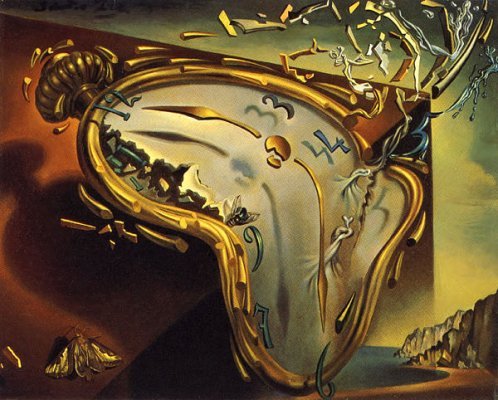
Ours is an era of false democracy, abstract freedoms and concrete dictatorships. One of these, the most surprising, it is the supremacy of the present, a real dictatorship of the present time. The sole materialist thought knows and idolizes exclusively what belongs to today, and is therefore modern. On other occasions, we have noted that the word modernity means nothing other than "in today's way". It is a term that has always been used with reference to the present, but without emphasis, the positive and idolatrous charge by which he has been surrounded for half a century now. Today's programmatic superiority over yesterday, postulated and implied as evident, it is in fact one of the thousand poisoned fruits of the toxic season that we call Sixty-Eight. Since then, everything boiled down to current events, at the moment, dragging every culture, dresser, costume, history before the grotesque tribunal of the Eternal Present. Strange court indeed, devoid of spatial or territorial jurisdiction, but exclusively temporal with a pre-established deadline at the end of the current day. The next day inevitably drags the present into the past, depriving it of importance; a spell that dissolves at the stroke of midnight, like Cinderella's. A dictatorship that is continually reborn with the new day, a Phoenix that regenerates from its own ashes: fast girl resurgo, since what is valid today is modern and the sun rises every morning. The most obvious victim is the past, burdened by negative prejudice, accused of obscurity and backwardness, but the present, despite the other current myth, that of progress, it also destroys the future.
We can see every day the disinterest in every major project, for ideas, actions, creations that transcend time. This applies to architecture and art, but also for the economy, unique theater of modern representation. Not only is nothing being built for posterity – the Colosseum and the Eiffel Tower itself do not have their modern-day counterparts, but we are no longer thinking in the long term. Policies do not go beyond today, finance and neo-capitalism work for the immediate profit of shareholders. For an overwhelming majority, the world of yesterday and the day before yesterday is an embarrassing childhood of humanity, memory is engaged exclusively in the short term. It happens to those who are over fifty to be asked how things were before the advent of the mobile phone. Our answer, invariably, is that Homer, Michelangelo and Einstein became what they were anyway. Today it would not even be imaginable the dispute between desanciens et des modernis which involved the best minds between the seventeenth and eighteenth centuries due to the manifest inferiority of the ancients. The only future allowed is the caged one, presented by the forecast. A peculiar trait of modernity is its eagerness to anticipate, foresee, rationalize and neutralize the future through calculation, the probabilities, statistics and now algorithmic mathematical models. From meteorology to demography, from production to growth, another equivocal myth of the present, nothing escapes the patterns destined to remove the future from its uncertainty, dethrone it in favor of today, or reduce it to a sort of inflated present, augmented reality or an infinite tightrope.
The fate that has befallen art is incredible. In the great Anglo-Saxon universities, incubators of what has happened in the last half century, we have come to put red marks on Shakespeare's works, guilty, according to the criterion of political correctness, alternatively of sexism, racism and we don't know what else. The supreme court has pronounced its sentence, even Dante is suspect, the Bible itself is at great risk. In the near future, music lovers will have to resign themselves to a Rigoletto censored of at least two arias, Courtiers, vile damned race (discrimination and use of prohibited words, race) and The woman is mobile, so long as, “what a feather in the wind, change of tone and thought” is misogynistic sexism of the worst kind! The only consolation is the changing nature of the present court, tomorrow he could in turn change his accent and thoughts. The second-hand moralism that devalues everything in the name of the criterion of current affairs is worrying, without even wondering whether his judgments will not be questioned or derided by the next jury. Today the totems of tolerance are in force, of the identical, of the One. Tomorrow, maybe. But the categorical imperative, emptied of Kant's morality, it is that of a voracious Carpe Diem in the name of a mythical youth – the Renaissance of Lorenzo the Magnificent, how beautiful youth is, without any more doubt (there is no certainty about tomorrow) – since the future is almost as discredited as the past, despite the myth of progress. The idea of consumption dominates: burn experiences quickly, emphasize emotions, queen dell'Homo Consumens. In the language of motorsport, a life in the Indianapolis formula, endless laps at maximum speed in a circuit similar to a hamster cage.
Obviously, all disciplines not centered on the present lose importance, starting from history, but also geography, metaphysics, politics itself tries to interpret and direct the world according to ideas and projects. Sociology is strong, due to its predictive nature, and scientific knowledge, Dilthey's natural sciences for their cumulative nature. We have become giants for the past work of dwarfs. The idea spreads that man is a blank slate to be filled at will. The only criterion becomes current events, altered by the distorted lenses of the current values, among which removal excels, which indirectly denies the future. Understanding today to live in it as protagonists, as winners, it therefore becomes basic. All knowledge must be condensed into Bignami-knowledge, ever faster, superficial and instrumental to the doing that has replaced action. Hence the widespread mass ignorance, fueled by an increasingly narrow specialism, the sectoral knowledge with blinders that made George Bernard Shaw write that a specialist is he who knows more and more about less and less, until you know everything about nothing. The dictatorship of the present is both arrogant, since it judges with today's criteria in the name of "what is needed" and ignorant as it discards on principle what does not agree with itself. In this sense it is childish, he doesn't want to grow up, Peter Pan is its eponymous hero, irresponsible like any child. He also has the sense of omnipotence and egocentrism from childhood. The idolatry of the new recalls the child's rapid disinterest in the toy he was playing with until the moment before the arrival of a new toy. New is synonymous with better exactly as today is superior to yesterday. The point is that the consumption-based system, author and beneficiary of the presentist revolution, it needs to hide what is most obvious in the linear pattern, that is, tomorrow will be better than today. You have to stop on the threshold, so as not to get in the way of a path that, inevitably, it will transform into waste what does not correspond to the present.
The enthusiasm and frantic anticipation surrounding the placing on the market of new technological devices equipped with one more functionality compared to the previous model are curious, the kilometre-long queues, the exhausted joy of those who have conquered the object of desire at great cost and with physical effort. Strangely, very few wonder why they had waited so eagerly for the previous model, so outdated, not very effective, now considered downright ugly. But in the dictatorship of the present one of the fundamental laws is that we only like what we are pleased with (Today). Another element of the contemporary age is its totalitarian nature in the legal sense. The concept of right has been abolished or greatly weakened, we are left with what is legal. Based on the dominant criteria of the moment, the spirit of the times, what the current law imposes or allows applies. Anyone who opposes is out of time, a dangerous condition, since philistine conformism is another element of dictatorship. The present is a gentleman full of pretensions, it demands a life of rushing, he hates silence. His subjects have a horror of emptiness (the horror of the void), they always have to do something to fill the time (it is said to pass the time, but it's the opposite), having everything under control, predicting, On the contrary, as they say now, managing situations. The horror of fate, terror of fate, of the unpredictable, of what goes beyond everyday life and exceeds statistical models. Everything must flow, in can remain stable. Heraclitus, the Greek philosopher of Panta Rei, everything flows, he is the true ideologist of the running pace dictatorship. We identify with the water that flows and is never the same. The man of the eternal present accepts being a drop, carefully avoiding asking meaningful questions. Where that drop will go and where it comes from are idle questions for him. We become molecules of a link in a chain without even the dignity of feeling alienated anymore. The only questions admitted are those to which scientific rationality can provide an answer in terms of validity, which is a category distinct from truth. What counts is what works. The subject of the present is behind Heidegger's Dasein. He is content with a presenteeism in which it is the backdrop of the representation, a figurine that appears for a moment in the proscenium and then disappears.
It is essential to have and do everything immediately. Dionysus defeats Apollo, order and form, in a crescendo that recalls a poetic work from the late seventeenth century, Bacchus in Tuscany by Francesco Redi “It is wrapped up and consumed, and down here it's called Time; and by drinking and drinking again we banish the thought". The ancient maxim is being vulgarised, fill the glass that is empty, empty the glass that is full. Whoever stops is lost, whoever runs will enter the frame, in the frame, will enjoy the joyful present moment, caught in motion like the rope of a chair lift. But it is a desperate race to escape the Nothingness that looms. Anglo-Saxons consider Ludwig Wittgenstein, logical, engineer by training, the greatest philosopher of the twentieth century. The Viennese thinker provided an extraordinary cover for the discredit of unscientific thought. No speculation is allowed by its system: it is the end not only of metaphysics, but of the homo viator, the traveler of existence in search of truth, greedier for questions than answers. His capital work was significantly titled Tractatus Logico Philosophicus. The most famous song is the following: “the correct method of philosophy would be precisely this: nothing to say except what can be said. Therefore propositions of natural science, therefore something that has nothing to do with philosophy; and then, whenever others want to say something metaphysical, show him that he has not given any meaning to certain signs in his propositions. This method would be (…) the only strictly correct one. What cannot be talked about, one must remain silent.” That is to say, keep quiet about the essentials, invisible to the eyes, for no question of meaning can be satisfied. A great reductionism, an elegant blinder for a humanity devoted to the immediate, to the measurable, running on a single track: It is mandatory to stick to what can be treated with the tools of calculating reason. The price is the reduction of man to God's ape, who lives the present as a surrogate eternity. But the present must necessarily be filled, enlarged, filled so that the big issues are evaded, in linear time, a sequence of dots, expelling the cyclical sense, imitation of the eternal, Jacques Le Goff's peasant time is incompatible with haste, the speed, the anxious compression that envelops us. Cyclic time evokes return, (after one harvest comes another), but also the deferral, the ability to wait, the effort, respect for the rhythm of nature. It's not suitable for us, forced to live and experience everything, right away, hating the effort, gradualness, the rough road. It is obligatory to bite life at all times, without letting a drop of the fruit fall. Far away is the era of Ruzante "for every pleasure, it takes suffering". All you need is a credit card and a fast connection.
The fast and compressed life resembles the gesture of chi on the computer, “zip” the files to take up less memory space. The zipped present (the icon is a crushing press) imposes haste, conciseness, the systematic renunciation of depth. In the time of electronic devices, even the managers of the in-depth sites recommend it: write little, people are in a hurry, it doesn't read more than one folder. On television, even important guests are interrupted if they go over time, with that word, mandatory, which announces sovereign publicity. Advertising, the factory of desire and the present that breaks down the frontiers of the past, invites us to hurry in consumption, satisfy the new craving induced by the message. Even when it comes to consumption, we need to act quickly. The new is about to get old and cannot be postponed. Nevertheless, the characteristic of man is to be the only creature capable of differing, procrastinate, keep instinct under control. The dictatorship of the present does not want it, we must regress to the infantile stage, desires and impulses are pushed to manifest themselves without limit, accelerated and consumed outside of any moral judgment. Unlike the animal, man is never truly satisfied, but by will of the Creator he cannot give up attributing meaning to his actions, sense, direction. The founder of philosophical anthropology, Arnold Gehlen defined man as being almost devoid of instincts, but possessing an extraordinary quality that makes it unique, the exemption, that is, the ability to know and recognize, exempting oneself from the immediate. The man, experiencing the world, concentrates it in symbols, until you acquire a panoramic vision and the ability to dispose. In this process he gains control over a multiplicity of actions, exempting himself from material instinctuality. The world is for him a field of infinite surprises, a warp where passed, present and future integrate organically. Human interiority is open to the world. This means invested with experiences, impressions, intuitions, each of which increases a tension, an upward aspiration. On the other hand, it means that the life of human drives and needs contains distant values, images of the past, a tending towards what is absent, yearn for future situations and circumstances. The reduction of man to his present is one of the ways in which he is reduced to a slave to the ephemeral, no longer a creature called to the eternal, but a lump of matter destined to exhaust itself in the compulsive gesture of doing without acting, exist without being, look without seeing. An animal without history, soulless, stranger to God, a stranger even to himself.
Similar Posts
