

Of Marcello Veneziani
Source: Marcello Veneziani
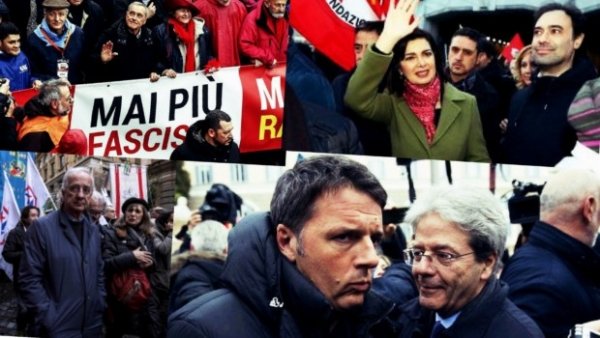
The left finds its unity again when it splits from the Italians. It happened the other day with the anti-fascist demonstrations, when everyone – Renzi and D'Alema, Gentiloni and the social centers, Grasso and the Anpi – found themselves together to celebrate a surreal ritual, a séance in the square, looking for the Dead Enemy to revive the unit.
But in this way they separated themselves from reality, from the present and from the Italians who consider the anti-fascist challenge to an alleged reborn fascism truly grotesque and anachronistic.
In reality neo-fascism accompanies our democracy since his birth, in the double version of neo-fascism intramoenia, or represented in parliament, and neo-fascism extramoenia, that is, spread outside parliament. The alarm has been raised surreptitiously for seventy years, with cyclical sharp points and ridiculous alarmism.
But let's leave aside the anti-fascist soap in bad faith.
Let's see what the left is today. Apart from the confetti of the widespread left, there is a government left and a left wing. The latter took the name of Liberi e Uguali.
It is the undifferentiated collection of a mass of wrecks. There are the presidents of result, advanced by the institutions, namely Grasso and Boldrini, two characters in search of an author. And there are two veterans of all the inglorious defeats of the left, from communism to government, Bersani and D'Alema. More offal less significant.
Of the four they chose the worst to act as a guide and spokesperson for LeU: Pietro Grasso, a magistrate in the odor of Forza Italia until a few years ago, friend of Dell'Utri at the time, then became, out of vanity, the foreign pope of the Italian left.
It would have been better to bet on the historical leaders of the left, Bersani and D'Alema, who at least have the dignity of a leader and a coherence of profile. Or at least it would have made sense to focus on Boldrini, a woman, indeed the Madonna of anti-fascism and anti-sexism, what a message to that world, to that sect, at least he sends it.
Grasso, however, is unlikely and unsuitable as a leader, clumsy, unconvincing because unconvinced in that role, you can tell he's a fish out of water. Plus boiled fish. It has only one advantage: works better in case of a mess.
On the other hand there is the strange case of the Renzian Party, formerly the Democratic Party. Renzi's monocratic management has produced an unprecedented flight from the left and the PD.
And not only that: what remains within the Democratic Party, it is despite Renzi. I am referring not only to the Orlandos and the Emilianos who headed the branch, and to the Napolitanos, the Fassino and the Veltroni who are the war remnants of the old PCI. But to the bulk of the electorate who votes for the Democratic Party with Gentiloni in mind, and therefore votes for the Democratic Party despite Renzi.
It's the paradox of a crazy year, in which Gentiloni was born as Renzi's prosthesis, as a pure hat to mark the place, momentarily left by Matteo; and instead today we tolerate the positions of the new Vannamarchi of the post-left but we vote for Gentiloni. Or for Minniti, in short, for everyone except for Renzi and his Arezzo-sub-Florentine magic circle.
Renzi has destroyed the left like no one else had managed, he reduced it to the third force after the centre-right and the Grillini, it divided and tore it apart, Berlusconi even called it. And now his anti-fascist fiction is grotesque, his frantic recovery of the black box of leftism: hatred towards someone.
Anti-fascism, today like yesterday, with the parenthesis of anti-Berlusconism in the middle.
But the Democratic Party takes action as has never happened in the past, of a power machine, of an unprecedented media-institutional consensus factory. It's impressive, for example, the assembly line set up.
In principle it is the State which churns out with impressive frequency, euphoric data on the glorious Italian recovery, as if it were the electoral propaganda office of the Democratic Party, or the government's new minculpop.
The news is picked up with great emphasis at the opening by the regime news, Rai used as the Istituto Luce, accompanied by triumphant declarations from Gentiloni and his ministers. Which is followed by Renzi's show on a stage where the Florentine salesman clings to the data and news from the news, after the showgirls of the PD and the government, to narrate the miracle and galvanize the voting troops. I
the problem, in anti-fascism as in government euphoria, it's only one: reality.
People listen of the fascist danger and of Italy's triumph under the Democratic Party and then he sees the reality, hears what really happens, sees Nigerian rapists and anti-fascist attackers, released after a few hours, feels the pangs of the crisis, of ruin and unemployment, the more indignant he becomes.
He understands that the narrative of the left it stands on a double fiction: anti-fascist horror and Renzian happy endings. And he gets even more indignant. Thus the Democratic Party's smoky war machine has the opposite effect: fuels anti-politics, populism and abstentionism.
He sees a country in collapse, with the extreme unction of Mattarella.
Similar Posts
