

Of Michela Mercuri
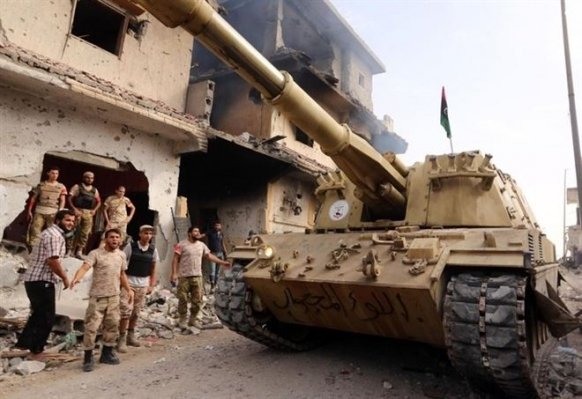
Source: The Subsidiary
For about five days some areas of the Libyan capital have been the scene of serious clashes between militias, despite some attempts at a truce, they don't seem to want to stop. Yesterday a mortar shell hit a hotel near our embassy. Internal settlement of accounts, as has already happened other times in the last year, or something more serious that could jeopardize the stability of the Government of National Accord (Gna) by Fayez al-Serraj, historical ally of Italy? And what our government's options might be?
First of all, it is necessary to shed light on the possible causes of this resurgence.
The tension between the various groups present in Tripoli can be attributed to various reasons. First of all, the decline in migratory flows from the Tripoli coasts - which guaranteed income to some groups present in the area - has cut a good slice of the cake from which many militias ate, satiating theirs “economic appetites”. Put another way, keeping armed groups under control with the proceeds of illegal trafficking is now much more difficult and this could constitute a risk for the stability of the UN-branded government. Proof either way, prima, the Seventh Brigade, a militia stationed in the cities of Tarhuna, south of the capital, it moved against formations loyal to Serraj, accusing them of being corrupt; Then, as reported by some agencies, Wrong Badi, controversial figure of the Libyan Dawn operation - who in 2014 forced the newly elected government to take refuge in Tobruk - he spread a message on Facebook saying he was ready to enter Tripoli at the head of the al Samoud brigade. As an old popular saying goes “hunger drives the wolf out of its den” and so it was.
Secondly, it should not be forgotten that last July the French Foreign Minister Le Drian undertook an intense Libyan tour to plead the cause of Macron who wants elections in the country in December. The French emissary met with Libyan representatives present at the Paris summit of 29 last May: Haftar, strongman of Cyrenaica, Serraj, al-Metri, President of the Council of State and Aguila Saleh, president of the Tobruk parliament. The agenda was also extended to some exponents of the powerful Misrata militias, and probably also to other local actors, who had publicly condemned the French summit. To make more “compelling” his proposal, the Elysée announced a contribution of one million dollars for the organization of the polls. A figure capable of convincing the undecided but also of whetting the appetites of the various power groups. E’ it is clear that the chaos in Tripoli can only benefit France which seems to prefer a destabilized West to a possible one “Italian pax”.
A difficult position for our government which from the beginning has shown great trust in Serraj and in the men close to him. However, Italy still has cards to play both domestically and internationally.
From an internal point of view it is necessary to support the authorities in Tripoli (whose holding is essential to maintain a position in the country) and above all work with the international community for an inclusive dialogue capable of bringing together as many militias as possible around a common stabilization project. Our knowledge of local actors could be useful in creating an agreement with groups willing to dialogue and exclude, Like this, the most extremist instances.
It will then be essential to broaden our gaze to the east also towards Haftar. It could be argued that the general from Cyrenaica is a historic ally of France and is unlikely to loosen ties with Paris, especially at such a favorable time. However, the renewed partnership between Rome and Cairo, another historic sponsor of Haftar, it can be a good viaticum. Here Italy should continue to play the economic card: as well as Zhor, the offshore megafield, Eni has just announced a new gas discovery in the Egyptian western desert which could deliver up to 700 thousand cubic meters of gas per day. Furthermore, Italian tourism in Egypt recorded a +94% In the 2017, with a further increase in the first two months of 2018, so much so that the Air Cairo company has opened new routes with Italy. E’ It is clear that economic interests can also be a useful argument in the political sphere. The side with Egypt, Then, it is also functional for starting a conversation with Putin, which supports and finances the strongman of Cyrenaica and has consolidated ties with the Egyptian president.
Then there would be the USA. Libya is certainly not at the top of the Trump administration's priorities, but the fight against terrorism does and the destabilization of the Libyan capital could reopen the west coast to the jihadist groups that await “their moment” in the south of the country. Not only that, continuing instability would allow extremist forces to “radiate” also in neighboring countries. A good argument for having Washington on our side too.
