

Of Maurizio Blondet
Source: Maurizio Blondet
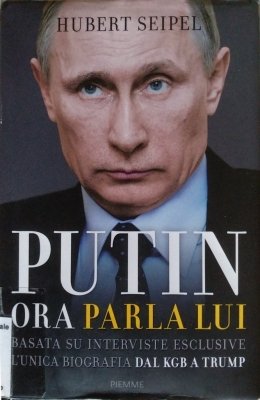
It is a biography written by Hubert Seipel, long-time journalist. He was a foreign correspondent for Stern and Der Spiegel, before dedicating himself to television.
It was the first interview with Edward Snowden broadcast worldwide.
After dedicating a documentary to him broadcast by ARD, the most important German public TV, Seipel has interviewed Putin several times.
The book is the result of years of interviews, analyses, conversations, knowledge.
In Italy it was published by Piemme.

“I've never read books about myself. I already know everything"
The book is compelling. It describes all the various stages in the history of the last 30 approximately years. Painful tragedies like that of the Kursk submarine, and then continue with the various colored revolutions, starting from that of Georgia and ending with that of Ukraine. On the topic of revolts in the east The mirror dedicated two issues entitled “SRL DELLE RIVOLUZIONI”. The involvement of American public institutions stands out, and private individuals like Soros, in these subversion operations.
Putin, political figure who knows how to listen, he immediately reveals an ability to read history, of the West's strategy and geopolitical aims on Russia. After the fall of the Berlin Wall and the subsequent disintegration of the USSR there were words of cooperation between the West and Russia. They were verbal speeches in which Westerners stated that NATO would never expand to the East to incorporate into its organization the countries that had belonged to the Warsaw Pact. All these speeches were given credibility by Russia's leaders at the time, such as Yeltsin and Gorbachev. “They were superficial and now all that remains are words in the wind”, says Putin of the last leaders of the USSR. “Unfortunately, public speeches do not have the value of a written agreement”.
THE GREAT CHESSBOARD
By Vladimir, but, it is clear that the West has never had any intention of starting an effective collaboration. “You can find the rest of the story in a book,” the President tells the interviewer. "Legga Zbigniew Brzezinski".
Son of a Polish diplomat who fled to the USA during World War II, Brzezinski served as an advisor to Democratic Presidents Lyndon Johnson and Jimmy Carter, continuing to play the same role with Bill Clinton and Barack Obama. In his book THE GREAT CHESSBOARD of the 1997, Brzezinski described NATO's expansion plan to Eastern Europe in great detail. ”
Even the timetable foreseen for future geopolitical moves surprisingly corresponds to real events. The process that the US democratic government had started with the presidency of Bill Clinton in the 1990s was continued by his Republican successor George W.. Bush and then Barack Obama. Here's what Brzezinski writes in his book: “In the meantime, the EU will start negotiations for the accession of the Baltic countries and NATO will do the same – also in the case of Romania – in view of their probable full entry into the 2005. And at this stage it is not excluded that sooner or later the other Balkan states will also be able to satisfy the required requirements. (…) Between the 2005 and the 2010, Ukraine, especially if it has made significant progress on the path of reforms, increasingly assuming the character of a central European state, should be ready to enter into serious negotiations with both the EU and NATO”. A 20 years after the publication of the book, the corresponding current European reality is shocking.
A European politician who questioned this project was the German Frank - Walter Steinmeier, foreign minister of the Grosse Koalition: “We have to ask ourselves if we have underestimated how much this country is (Ukraine) is indeed divided and weak. If we didn't expect too much from him, asking him to choose between Europe and Russia; if we have not underestimated Russia's resolve, which is linked to Ukraine by ties that are not only economic, but also historical and sentimental".
In the 2014 former chancellor Helmut Schmidt attacked Barroso's European commission, above all by claiming that it had "involved too much in world politics, although most European commissioners understand nothing about it", as emerged from the “attempt to annex Ukraine”, adding that the conflict reminded him of the situation of 1914, on the eve of the First World War. The two moments were becoming "more and more similar" and Schmidt had no intention of paving the way for a new global conflict. “But the danger that the situation will worsen as it did in August 1914 increases with each passing day".
The divorce act between Ukraine and Russia, published by the Official Journal of the European Union at the end of May 2014, it is over two thousand pages long.
In December 2015 the outcome of the separation process between Ukraine and Russia is catastrophic: beyond 9000 people lost their lives. Ukraine is divided and bankrupt and will remain so for years to come. In Europa, starting from the Kiev coup in February 2014, the frost has fallen again. Evidently the Cold War took only a short break. This enlargement to the East is being done at the expense of the Europeans. Putin also pays a high price. Russian nationalism is growing. The country's economy is entering the most serious crisis since 2008, not only because of the sanctions, but also due to the collapse in oil prices. However, after the annexation of Crimea the head of the Kremlin enjoys great popularity among his citizens.
“The history of Crimea is our history, our pride” says Putin on the occasion of the ceremony, visibly moved, illustrating the national motivations for the annexation of the peninsula and the city of Sevastopol to Russia.
It is not only the Russian political elite that celebrates his speech in the Kremlin's St. George's Hall with great ovations. The president touches on a topic that is dear to all Russian people, who loves to spend holidays on the Black Sea.
"In Crimea, or Sevastopol, a legendary city with an extraordinary destiny, the home of the Black Sea Fleet”. And naturally he started from the premise that "Ukrainians will be good neighbors for us", and then add: "However, the situation is taking an unexpected course” and “both Russians and other inhabitants of Ukraine are suffering from the constant political crisis that has been shaking the country for more than twenty years now”.
The Europeans did not expect such a reaction and after acting like guilty idiots they say they are innocent. They even acted for the best.
“No one could have predicted how quickly this would turn into the most serious crisis since the Cold War,” German Foreign Minister Steinmeier said in April 2014 to justify the failure of his working group. Made sentences, typical of politicians who will end up in history books for their impotence and of the inevitability of certain political developments.
Even if she is forced to surrender to the inescapable logic of political necessity, “There are no alternatives”, says Angela Merkel every time she decides to impose her vision. As if the conflict had arisen from one moment to the next and, above all, after two world wars, the fundamental task of politics was not to defuse clashes of this magnitude in time.
One hundred years after the outbreak of the First World War, the justification that it could not have been done otherwise has not gained credibility. It remained as false as it always was. By virtue of the role they hold, politicians are automatically actively involved in creating conflicts. “If it comes to a fight”, the then chancellor Moritz August von Bethmann-Hollweg had written shortly before the Great War in a telegram to the German ambassador in Vienna Heinrich Von Tchirschky "we must ensure that the Russians are blamed for the attack". The Reich had pushed the Habsburgs to attack Serbia, knowing full well that at that point Russia would also enter the war. In his book of 1961 – ASSAULT ON WORLD POWER. Germany in the war 1914 / 1918 – the German historian Fritz Fischer had demolished the myth according to which Germany took part in the First World War without bad intentions, triggering one of the most heated historiographical debates in the Federal Republic of Germany. Since then, politicians' standard excuse has lost its validity. The strategy of blaming others for the explosion of a conflict is as old as the profession of a politician.
Although the current crisis is very different from the one that led to the First World War, Germany in recent years has not been an innocent intermediary between the West and Russia but a party to the conflict between Ukraine and Moscow.. the attempt to extend NATO's area of influence to Crimea, despite protests from Moscow, it was a bad decision made by Angela Merkel and carried out by her.
Vladimir Putin had already given warnings in his speech to the German parliament in 2001 and it was repeated at the Munich Security Conference in 2007. In front of the deputies in the Reichtag building in Berlin, President for a year, he had exposed the problem in relations with NATO and the West in completely explicit terms. “Nowadays it happens that decisions are made without us. Only afterwards are we asked, with a certain insistence, to express our agreement. (…) It is even said that without Russia it would be impossible to implement them. We should all ask ourselves if this is a normal situation, if this relationship of ours is real. (…) We continue to live based on an old value system. Let's talk about alliance, but the truth is that we have not yet learned to trust each other".
Seventeen years later, nothing has changed.
Putin and the role of foreign NGOs in Russia. Spies or agents of civil society?
A new law passed in November of 2012 provides that all non-governmental organizations with political purposes must register and declare the source of their funding. The new law should prevent, in the years to come, the interference of foreign states in Russian internal politics. NGOs with political aims that receive subsidies from other countries are in fact required to register as "foreign agents" and undergo rigorous checks on their activities and accounting.
The political intent behind this new order is clear. Many Russian NGOs receive funding from abroad. Those affected by the legislation, but, they declare themselves indignant. So far, no organization has registered as a foreign agent. In March 2013 the authorities began carrying out their checks and the prosecutor paid a visit, as well as Russian NGOs, also at the Konrad Adenauer foundation in St. Petersburg near Angela Merkel's CDU and at the Friedrich Ebert foundation (SPD) of Moscow.
The heated debate on the role of foreign humanitarian organizations in Russia is certainly nothing new. These would do nothing but good, they would worry about children in difficulty, they would carry forward the battle against AIDS and safeguard nature. They are a sort of missionaries. At the same time they illustrate the social market economy, they fight for freedom of the press, and help transform Putin's "guided" democracy into a Western-style civil society. The West as a universal project, to be done anywhere and anyway. A battle to win which billions of dollars are allocated every year.
The USA has been financing for a long time, with clear strategic purposes, Russian ong like Golos, that during the elections of 2011 and of 2012 mobilized election observers and spread a series of fake news. Golos does not act alone. Hundreds of NGOs organize seminars on civil disobedience or alternative communication techniques for opponents. Washington supports real or perceived lawsuits. These are the reasons that pushed the Russian government to approve the law on the registration of humanitarian organizations sponsored by foreign countries.
The legislation also affects Memorial, the most important Russian NGO, which receives most of its donations from abroad, from the Heinrich Boll foundation, or that of the American billionaire George Soros. The association was founded in 1989 by dissident and Nobel Peace Prize winner Andrei Sakharov, with the aim of restoring the memory of the victims of Soviet repression. Since then, However, under this banner various groups are raging that act in the name of human rights, a circumstance that pushed the Ministry of Justice to try to dissolve the organization completely. The authorities lost the case before the Russian constitutional court, and now Memorial is trying to find more funding at home.
Vladimir Putin has repeatedly reiterated the need for some form of restriction. It's about introducing a rule that constitutes normality elsewhere. The rigid choice resulted from the interference of foreign countries in the Russian elections 2011 and of 2012 of foreign countries through these pseudo NGOs. The “moral indignation” of Western countries that followed is evidence of the double standard that characterizes Western assessments. “In the United States a similar law has been in force since 1938. I imagine that the government in Washington knows the reasons why it was introduced".
Il Foreign Agents Registration Act (GO), to which Putin refers, it was issued to defend against National Socialist infiltrators. It goes back a long time, but it is still implemented and is aimed against any "anti-American intrigue" and against the infiltration of foreign forces and secret services. The US Department of Defense describes the rule in these terms: “The law requires that every natural person or organization acting on behalf of a foreign client must be registered and declare who they work for”. Among the "foreign clients" FARA includes "governments, political parties, individuals or organizations outside the United States and any type of business that complies with the laws of another state".
October 1st 2012 The USAID headquarters was closed following a communication made by Lavrov to then Secretary of State Hillary Clinton. Washington has been exploiting USAID for years (United States Agency for International Development), particular instrument of development aid to meddle in Russian internal politics.
Putin's decision ends the activity in Russia of one of the American government agencies that most effectively pursues overseas interests. It was founded in 1961 by the US government to promote “democracy, human rights and public health” in the world.
USAID is active in over one hundred countries and has collaborated with American secret services in the past. A possible reason for his sudden end, reports the New York Times, it would be “the very history of the agency, which served as a cover for American espionage during the Cold War. His role is still fresh in the memories of foreign representatives, many of whom have not yet completely put aside their distrust.".
Starting from 1992, USAID invested 2,7 billion dollars for projects in Russia. In past years that money has served to replenish, much more than the public health coffers, those of over fifty NGOs "who are committed to democracy, of human rights and a more stable civil society” stated Victoria Nuland, spokesperson for the US State Department, il 18 September 2012, during a USAID press conference. He stated that the work will continue with other means. “Right, USAID is no longer physically present in Russia, but we will continue to promote democracy, human rights and the development of Russian civil society". Finally, the State Department communicates the names of the agency's heirs: Il National Democratic Institute (IS), l’International Republican Institute (IRI) e il National Endowment for Democracy (NED).
The announcement marks the continuation of the political struggle with similar means. In fact, the new institutes are old acquaintances who have been operating abroad for years and are financed by the State Department and USAID. They all have the objective of spreading democratic values and human rights. At the top we find people like Madeleine Albright, former Secretary of State, or former NATO commander Wesley Clark, or former CIA chief James Woosley.
One of the fathers of the NED, founded in 1983 under the presidency of Ronald Reagan, was Allen Weintein professor at Georgetown University, who clearly and concisely described the organization's purpose in an interview with Washington Post In the 1991: “A lot of what we do today, until 25 years ago it was done secretly by the CIA".
The expulsion of USAID from Russia caused strong resentment in Angela Merkel who openly criticized the actions of the Russian president. Putin, without mincing words,accuses the chancellor of exacerbating an anti-Russian climate.
The rediscovery of Russia's Christian roots contrasts with the homosexual "morality" of the West.
“Why should the problem of homosexuality be treated as a state problem? I have nothing against gays, but the state should focus on the important things. Homosexuals, for example, they don't have children. And it is not the job of rulers to discuss or address sexual preferences. And not even try to impose your own vision on these foreign policy topics.". This is what Putin tells the interviewer. “It is a decision that is up to our company alone. I have nothing against Mr. Westerwelle,” he adds with a touch of irony. The trigger for this stance was generated by the fact that the new law on homosexuality approved by the Russian parliament had fueled both a public and political debate in Europe.
The homosexual German Foreign Minister Guido Westerwelle published a notice on his ministry's website advising against travel to the Federation: “Homosexuality in Russia is not prosecutable, however, the degree of acceptance of same-sex couples in Russian society is very low. Il 30 June 2013 The federal law against the 'Propaganda of non-traditional relationships among minors' came into force. The law also punishes foreigners, in case of dissemination of information and public demonstration in support of homosexuality, with fines of up to a maximum of one hundred thousand rubles or with fifteen days of detention and expulsion from the Russian Federation".
Obviously on the same site there is no warning for those intending to travel to Saudi Arabia or other Arab countries, where showing a clear propensity for the same sex can have much more serious consequences. The approval of laws in favor of LGBT groups in Germany triggers media debate and pressure on Russia which responds in spades.
“The West has its own vision of the world, whether we like it or not” comments Father Tichon, spiritual guide and confessor of the Russian president. “And we will always have divergent opinions on some points”. Right, admits that gay marriage is a private matter, but underlines that for the Russian Orthodox Church they remain excluded in the most categorical way. And if the state decided to accept them it would take the "first step towards destruction". On this point the religious is in perfect agreement with the Catholic Church (we are still in the 2013).
The abbot tells Seipel an episode to clarify the president's pragmatic attitude towards the issue. During a dinner, on the news they had broadcast the news of Putin's future visit to Berlin, during which the president would have had the opportunity to meet the then mayor Klaus Worwereit. The news report did not fail to underline that the mayor was openly homosexual. As his spiritual guide, Father Tichon had taken the opportunity to advise the president against shaking his hand in public. Putin was against it. Firstly because it was a private matter and secondly because the politician represented the city of Berlin. When Putin's wife, Lyudmila, she had intervened to support Tikhon's position, the president had limited himself to answering her with an amused expression: “Tesoro, you have no reason to be jealous". This is Putin. When circumstances require it, he is totally flexible but his fundamental political beliefs do not change.
“Vladimir Putin is Christian, not only in words but also in deeds. He confesses, participates in the sacrament of the Eucharist and is perfectly aware of his responsibilities" says Tichon, who usually celebrates Mass in the presidential chapel. The abbot is the superior of the Sretensky monastery which is located in the heart of Moscow, sulla strada Bolsaja Lubyanka. The headquarters of the secret services is located nearby, dove, under the Soviet period tens of thousands of clergymen were massacred. Since then the Orthodox Church has built a reputation as the only institution that managed to survive the tragedy of the Bolshevik revolution, thanks to his divine mandate.
“We were here first. The monastery was founded 560 years before the KGB, not by the KGB”, needs Tichon. Under the Soviet regime the monastery was closed and the KGB used the building for its own purposes. A stone cross in the garden reminds us of this dark page from the past: “In memory of the Orthodox Christians who were tortured and killed here during the years of madness”.
Father Tichon remembers the first years of his mission with little enthusiasm: “When I arrived here it was as if they had sent me to the front. The monastery was completely destroyed and had to be rebuilt. In the 1992 I was the only monk".
Al secolo Georgi Aleksandrovich Sevkunov, former film student, he had his conversion in the 1980s. After reading Marx, Lenin and Trotsky and having studied yoga and Sanskrit, he devoted himself to Dostoevsky, Tolstoy and Kant. He was baptized in 24 years and took vows in the Pskov Cave Monastery, in northwestern Russia, not far from the border with Estonia, one of the few religious buildings that survived the Soviet era. Tikhon's spiritual guide was the prior of Pskov, padre Ioann Krestiankin, who had spent five years in a prison camp in the 1950s. Father Tikhon has become a well-known figure throughout the Russian Federation for his religious activities. Si attiene al principio evangelico secondo cui la fede può spostare le montagne. In the 2008 produced a documentary, broadcast several times on Russian television in prime time, in which he recounts “the ancient splendor of the Byzantine kingdom, who recklessly allowed himself to be influenced by the harmful influence of foreign business partners and advisors". A warning to Russia in the face of Western decadence. His site, pravoslavie.ru, it is one of the most followed portals in all of Russia. His autobiography, entitled Everyday saints, (also published in Italy by Rubettino in 2015) it is a tribute to the lovable and imperturbable churchmen of the opposition era. He skilfully glosses over the fact that the state Church had close collaboration with the regime. The book is a bestseller, he sold 1,2 million copies.
Tikhon is not only a friend but also Putin's greatest ally in the effort to revive in the collective memory the idea of the Church as an integral part of Russian history. Church and state have been on the same wavelength for some time. The monk and the politician met in 1998. Putin was appointed head of the FSB, role which he held for thirteen months. “When he worked a few meters from here, he often came to the monastery incognito” says Tichon recalling their decades-long friendship. From then on the abbot was a kind of mediator between State and Church for matters of faith.
Putin and Tikhon share the same worldview, of traditional values, of morality and history. “An immense country like ours can only be governed from solid historical foundations. The history that preceded the revolution and the best of the Soviet Union. We have a common experience and without history we have no future. Marxism didn't work, nor democracy, at least not in the terrible form that was proposed to us in the nineties. Russia must find its own form of government”.
The abbot combines his skills as a shepherd well with those of a highly successful communicator. In the 2014 a monumental exhibition on Rurikids was inaugurated in Moscow, ancient dynasty which only specialists had dealt with. It then became a traveling exhibition, it toured the country fascinating hundreds of thousands of people, interested in learning more about their noble ancestors. The dynasty that governed the territory of the then empire from the 9th to the 16th century. One of the culminating episodes of this search for one's origins is the baptism of Prince Vladimir I in the territory of present-day Ukraine, a sort of founding myth of the nation. The exhibition follows Putin's strategy of connecting historical periods “to bring out the simple truth, that is, Russia has a history as rich as that of other countries, and it must be based on this to rediscover its potential and form a national identity.".
The very end of the Rurikids saga makes the last descendants of the dynasty appear in a better light than had previously been done. Lo zar Ivan IV, Known by the nickname “Ivan the Terrible” because he was said to have had his son killed, suffering from a mental illness, he would instead have distinguished himself from his predecessors for having committed himself to the cohesion of the Russian empire. Some time before, Father Tikhon had organized a national exhibition on the Romanov dynasty, with sound effects and interactive screens, which had achieved great success with the public.
It should be emphasized that Putin, he has worked since his first term, successfully, to mend the rift between the Orthodox Church that re-emerged on Russian territory after the collapse of the USSR and the one in exile, which had its bases throughout the Western world and predominantly in the United States.
MIDDLE EAST
On Syria the chapter is not closed but thanks to Putin's direct intervention, Assad is still in power and ISIS, instrument in the hands of Westerners and Gulf countries has fared the worst.
Similar Posts

All this love for Putin is not understandable given that Russia , it is strangely forgotten, it has always been imperialist. The continuity of his policies can be verified by facts. The much vaunted liberation of Palmyra, for example, claimed by them is a hoax, thus demonstrating their crafty opportunist cynicism.
So for her Putin is an enemy?
Carlo Maria e’ always here to speak with stubborn dissonance…and without appropriate knowledge.