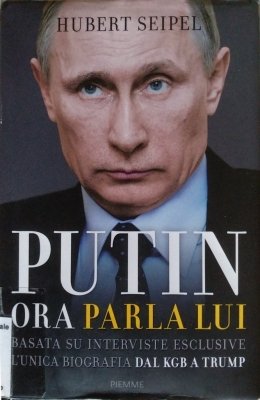
Putin: Now I'll talk

Of Maurizio Blondet
Putin: Now I'll talk
 
Source: Maurizio Blondet
It is a biography written by Hubert Seipel, long-time journalist. He was a foreign correspondent for Stern and Der Spiegel, before dedicating himself to television.
It was the first interview with Edward Snowden broadcast worldwide.
After dedicating a documentary to him broadcast by ARD, the most important German public TV, Seipel has interviewed Putin several times.
The book is the result of years of interviews, analyses, conversations, knowledge.
In Italy it was published by Piemme. Read More

Share

Book-complaint by an anthropologist: Political correctness kills freedom

Of Lisa Turri
Book-complaint by an anthropologist: Political correctness kills freedom
Source: Century of Italy
In civilized and advanced Sweden, if you say that integration policies have been a failure, you are branded a racist and fascist. It happened in 1997 to the wife of the American anthropologist Jonathan Friedman who drew inspiration from it for an essay of his that will cause discussion, Politically correct. Moral conformism as a regime (Meltemi), now available in Italian. Friedman teaches at Lund University and, like his wife before him, he is in turn considered a dangerous reactionary.
Interviewed by Elisabetta Rosaspina for The Reading, the cultural insert of Evening courier, Friedman observed: "I know, they accuse me of being a fascist. I can assure you that this is absolutely not the case: on the contrary. But this confirms the basic thesis of my book: political correctness emerges in historical periods of great sensitivity, when transformations of society are underway according to the plans of some elites, like the bourgeois left, unsure of their own positions". Friedman denounces the fact that precisely in the academic world the situation is becoming unsustainable, and cites the case of a Harvard professor accused of sexism in the 1990s for having quoted a line from the poem in his textbook Don Juan in Byron. In the end the risk is to censor the research because "if you want to be politically correct you end up imposing limits on the questions". Read More

Share

The good Catholic press

The Revolution according to Mons. from Segur (text donated to the Civic Library of Verona by the City Councilor Andrea Bacciga, n.d.r.)
To unmask and counter the revolt of the Satanists against God, the homeland, the family, humanity. Defender of the infallibility of the Pope and the Church, Mons. de Ségur addresses The Revolution in this book, in an attempt to reveal and eliminate errors and fallacies, deceptions and slander, with which sectarian conspiracies attempt to alienate peoples. A compendium of anti-revolutionary Catholic doctrine and political theology.
Who is Maria? Marian Catechism
Marian Catechism composed of 235 articles, simple but erudite. A clear exposition, orderly and concise of everything related to the story, dogma and Marian worship, according to the classic form of questions and answers.

Read More

Share

Fairy tales and the fear of not being loved

Reporting of BastaBugie editorial team
Fairy tales are where we keep monsters (ad es.: resentment because others seem to be loved more than us)
Of Silvana De Mari

Fairy tales arise by themselves, no one knows where, choral and anonymous; they evolve bit by bit, they travel through centuries and across places, undergoing all possible modifications, but always remaining the same. Fairy tales have fantastic and magical protagonists and must not exceed the space of an afternoon spent by the fire and, above all, that of one evening, because their main job is to fill the “before going to bed”, so that the child can drift off to sleep lulled by the adult's voice, without the monsters that live inside the darkness being able to disturb him. Monsters are the fear of not being loved, the resentment of not being loved, jealousy because others are or seem to be loved more than us. Fairy tales are where we keep monsters. As Kafka intuits, fairy tales are the gold and silver boxes where we keep monsters.
The monsters are unspeakable. Negative emotions are not always allowed for children, especially to those who would have the most reason to have it: therefore it is appropriate to hide them inside a fairy tale and try them out through a third party, identifying with the main character. Read More

Share
1 2 3