Letter to a boy from the class of 2000

FIFTH COLUMN
by Marcello Veneziani
Dear Boy born in 2000, I thought of you in the twentieth century as a mythological figure, a kind of Martian who would have inhabited other worlds, it would have fed itself in other ways, it would have traveled to other galaxies. This was the euphoric promise that circulated in the sixties of the last century, at the turn of space conquests and beyond. It was the dream of escaping from the ideological and bellicose twentieth century to enter a millennium that was neither red nor black, but milky like the street of the same name, and glassy, as befits transparent video.
Father of two children born in the last millennium, I dreamed of having a third child in the third millennium and to joke with immortality, I also promised a fourth child in the fourth millennium... But then life took another turn.
Now I'll meet you around, I touch you on the street, I pass you while you're leaving school or going to university, and I see you all too much like me, ours, brontosaurs of the past millennium. But under the skin of a resemblance, if I then look into your life, in your lexicon, in your imagination, in your knowledge, I find an abyss of differences. Some are definitely to your advantage: the ability to inhabit technology and the globe, with a mastery that we didn't have, the ability to navigate the mathematical universe, your refractoriness to collective dreams, except for environmentalist flare-ups in the name of Gretology, the new planetary sect. But the feeling that comes over me is exactly the opposite of what the average person makes you perceive, school & global agencies: they made you believe you had a longer view, wider, global, compared to previous generations. Read More

Share

The Anti-Christ curtains and the anti-fascist God

FIFTH COLUMN
by Marcello Veneziani
I still haven't recovered from Alessandra Moretti's video, telegenic exponent of the Democratic Party, which justifies the decision of the mayor of the Democratic Party of Pieve di Cento, Sergio Maccagnani, to cover with curtains i Christian symbols which appear in the cemetery so as not to disturb the sensitivity of those who are not believers. The project, explains the mayor, “plans to install a motorized darkening system with fabric sheets that will allow the sacred images and family tombs to be temporarily covered, so as to allow the celebration of secular rites". I thought it was a fake, a gag, a caricature made against the PD, of the left and the secular. Instead, the national representative of the Democratic Party takes it seriously and favorably, in Paolo Del Debbio's television program, underlining that these are “removable” tendons. I can't believe it.
I'm afraid an immovable curtain, lasts like a cataract of dementia, has descended to darken those minds. Let's try to reason even in the presence of unreason. A civilization that has existed for centuries, for millennia, follows religious rites, adopts religious symbols, lives among signs of Christianity everywhere (he asked, squares, hospitals, schools, civic buildings, municipal cemeteries, ecc.), at a certain point he should hide his symbols so as not to disturb those who do not believe. Given that everyone is free to believe or not, but what a nuisance, what a shock, what problem can a Christian symbol cause to those who are not Christian? If it doesn't attach any meaning to those symbols, they are declassified to pure funeral decor, what torment or affront he suffers? What suffering can he have if he was born and raised in a country, in a civilization, in a story, in which those symbols are and remain prevalent over the centuries? I understand that at Notre-Dame the brave Micron, Macron's more realistic surname, you forget the "business name" of the cathedral and treat it as a secular monument, state and republican. I understand that Christians for Obama and Clinton are reduced to a primitive sect of "Easter worshippers". But with the AntiChrist curtains we have reached Perfect Idiocy, unattainable, that secularists and anti-Christians all over the world will envy us, from Sri Lanka to Canada, to touch all the degrees of the rainbow. Read More

Share

When the proletarians massacred the ladies

FIFTH COLUMN

by Marcello Veneziani
At every May Day parade my old aunts remembered with horror themassacre of the Porro sisters in Andria in their family palace. In reality it had happened on the occasion of the first Women's Day - which therefore began with a double "progressive" femicide - but the workers' march, Peppino Di Vittorio's CGIL, the communists, they aroused that frightened memory in the homes of the lords and owners. I remember a slogan I heard as a child in Piazza Catuma, ad Andria: “Not even a master will be saved”. Nicola Porro will have a more direct family memory than the two young ladies murdered by the "blind perverted plebs", as it was written in the funeral manifesto. It must also be said that after the war the conditions of the laborers in Puglia were infamous, exploited and treated like slaves by the corporals, sometimes forced to muzzle themselves so as not to eat the harvested fruits...
For decades that massacre was removed or considered an inevitable tribute to social progress or an example of class struggle, appetizer of the revolution. Luciana Castellina and Milena Agus dedicated a book to that massacre – Beware of hunger – understanding both towards the two sisters, who considered social injustice as a natural fact, a fate, both towards the angry crowd that killed them. The world has changed, the new gentlemen are now radical chic and the new hungry are the migrants who disembark. And in any case the poor are with Salvini or with the 5 stars. But killing two defenseless and devoted women, just because they represented the hated class, it remains a vile barbarity and a communist crime. It is worth using the definition of feminicide even if the two ladies were not emancipated feminists but old-fashioned old landowners?
MV
Share

Misery and Freedom


FIFTH COLUMN

by Marcello Veneziani

The echo of the 25 April, with Mattarella's warning not to trade freedom for order. The only true one rings in my ears, sensible objection to the opinions expressed here on the 25 April: as the anti-fascist Vittorio Foa reminded the fascist Giorgio Pisanò, today you are free to speak because we won the 25 April. Even more true in the mouth of Vittorio Foa who was an anti-fascist against the prevailing regime, ended up in prison, he was not a posthumous anti-fascist, when it was easy and advantageous to be so.
But I would like to understand what happens to freedom now, how it is conceived and experienced today by ordinary people. That is, I would like to test drive Mattarella's declamations on freedom or in the name of Foa. I try to put the noise about the Resistance and anti-fascism on silent mode and focus on present and current freedom. But what is this absolute value today, Freedom, which should not be exchanged either for order or for any other good or principle? How the vaunted freedom is actually understood and practiced by ordinary people, come on guys, from the opinion factories of today?
I walked around alone among the people on holidays, il 25 April, I could hear the conversations in the bars or the kids perched on their scooters, I smoked a cigar in a secluded corner where the kids were smoking joints and there was a coming and going of immigrants. I listened to their chatter and it reminded me of other conversations I had already heard elsewhere. Languages ​​change, but not the horizons. And in the end I feel like I can answer the question this way, what is it freedom for the people, for young people, for current opinion? It's the freedom to do whatever I feel like doing, that goes around in my head; freedom is having no limits, except the cheap ones, get rid of rules, moral obligations and boundaries, free your desires, live as I like, I am what I want to be; without following any prescription, no tradition, no rules. Even if then, in fact, follow fashion, i trend, conditioned reflexes, the consumption conveyed, prefabricated opinions. And then, nothing to think about, only things to buy. Read More

Share

Vegan Easter according to Greta

Obviously, we ate a fantastic lamb and then a Florentine steak of rare goodness. Because God has made certain animals available to us to feed on their flesh. Some, also for religious custom.
FIFTH COLUMN
by Marcello Veneziani
How does it translate? Greta in Easter version? Vegan lunch, as she herself said. Gretism has moved from the squares to the Easter tables and is fueling the civil war of the Lamb. On the one hand, the carnivorous lovers of tradition according to whom there is no Easter without lamb, kid or similar to eat; on the other, the followers of the planetary sect of Gretology, in the vegan name of animalism and lambs' rights. Total exemption of lambs from Easter banquets, sacramental immunity of the kid. That a lamb should die of old age or disease and not of the Passover feast, it is one of the achievements due to the humanization of animals and the parallel animalization of humanity. I can understand someone choosing the vegetarian route; I respect them, anyway it's their business. I understand them less when they want to overturn traditions and put religions on trial, generate collective feelings of guilt, propagate fanaticism that breaks the natural cycle and the food chain. Personally I lean towards a compromise solution: consume the Easter lamb but with royal pasta. Thus the lamb in flesh and blood is saved, and the rite of the Paschal lamb as well. Although I find it frustrating for the lamb to no longer be the center of Easter attention, miss his day of glory, even if it ended up in the pan, and return to banal marginality. Unless he feels like some kind of political refugee, albeit exploited by political correctness. With the added annoyance of having herbivorous competitors in vegan converts.
But beyond Easter a mystery remains unsolved, which is an injustice. Because if you go to the bar you will find the vegan croissant, if you go to the supermarket you will find the line for vegans, if you go to restaurants you will find vegan foods, and instead if you are diabetic you can't find a blessed fig? Why a dietary choice, a belief, sometimes a trend, find ample space in our shops and instead a disease, a state of necessity, which affects millions of people, has no place in our society? Don't put forward market reasons because they would also apply to the wider target of diabetics. It's an ideological choice, it is an extension of the global ideology of Gretology. It is dietary correct, It's food bergogism, it is animalism as the religion of humanity. Read More
Share

La Chiesa brucia nell'odio


FIFTH COLUMN

by Marcello Veneziani

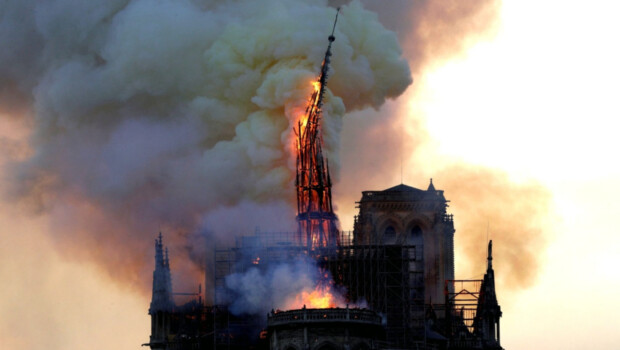
The spire looked like a missile from antiquity Notre Dame which came loose in the fire, falling back onto the same launch pad from which it started. It looked like a rocket from a lost technology, called faith, which was aiming for the sky to return to the Father and which instead now fell to the ground, like a burning ember towards hell. Rockets was the title of Baudelaire's flashing aphorisms dedicated to the ruins of modernity, to the short circuit of progress, to the fire of tradition.

The Churches, the cathedrals, they are symbolic places, liturgical, rituals. And so they should be considered. If a Church burns, if the most famous cathedral in Europe burns, it will mean something in the allusive realm of symbols. E the silence of the Pope falls within the symbolism of the event. As soon as I saw the fire, I thought about Dominique Vennier's suicide in Notre-Dame, the spring of six years ago, to witness the suicide of our civilization. Certain profane acts unleash negative energies, they summon demons, a religious man would say at the time Notre-Dame was built.
Sixty churches burned in the space of a few years in France, perhaps during restorations, they are a worrying balance that we can deal with like a case, a statistical data on 45 thousand sacred buildings, such as accidents at work. But it then comes back into our imagination, between myth and superstition, the connection between the suicide of Christianity and the destruction of the churches, between the abandonment of faith and the carelessness that leads to the fire, between hatred towards Christianity and the fire that envelops it, between the papal complaint that the churches are empty of faithful and priests and therefore their intended use must be redefined and the havoc before our eyes... Read More

Share

A bridge between old and young

FIFTH COLUMN
by Marcello Veneziani

But you can't fix it along the way citizenship income, make it more socially useful, ethically more worthy, more economically sustainable, linked to an asset rather than a liability? I'm not saying abolish it, at this point, I say at least correct it, bringing him back to reality. I'll try to explain myself.
First of all, what's wrong with citizen's income? Which is assigned by practically leaving the beneficiary at home or allowing him to work illegally. An income assigned regardless of commitment, by merits and abilities. The first signs of its perverse functioning are not lacking and the so-called navigators or coaches who should evaluate the requests and access to income of citizens remain shrouded in parastatal mythology.
It shouldn't be an unproductive income, a heavy burden borne by the community, and that it is entrusted to a vague job placement path, on the basis of which job offers will gradually be presented to the beneficiary (come from where, generated by whom?). All very smoky, even if paved with good intentions. Instead let's try to have another discussion, starting from the society we live in.
So, we live in a society of old people, increasingly older and lonely, abandoned to their fate and to the TV. Young people in turn abandon the cities, especially the southern countries, they go away in search of fortune. A terrible age-related racism is created in our societies whereby the old can only be with the old and the young can only be with the young, there is no longer active communication between generations, a chasm has opened between the ages. Families fall apart between the elderly who need to be cared for and the children who "divorce" their parents because they have to go and look for work far away. What will become of many centers where children leave, reduced to chronic hospitals or shelters for jobless migrants? It is a serious emergency but there is no political and social discourse that tries to address the issue. Read More

Share

Mom the right!

FIFTH COLUMN

by Marcello Veneziani
“Whoever is looking for the next earthquake must go to the bottom, To the right. It is the political area most affected by the spirit of the times, a rebellious spirit that blows in her sails pushing her almost everywhere towards electoral success, after the conquest of cultural hegemony, with competing thoughts in retreat”. Oh mama, who is this right-wing prose writer in the throes of enthusiasm and the delirium of omnipotence? AND Ezio Mauro, former director of la Repubblica in an editorial the other day in the same newspaper. We omitted only one word from that passage – “ferocious” – which gives a negative connotation to the text, but otherwise it seems written by a euphoric announcer of the rampant right. Instead, to quote Ungaretti, it's just the joy of shipwrecks. But seismograph Mauro is right, this earthquake is really in the air, this powerful and global wind, this right-handed cultural hegemony?

May there be a turnaround in the world, of a populist nature, identity, sometimes conservative and sovereignist, to use current jargon, we've been writing it for a long time. And that is explained in this context the success of Salvini's League it is equally evident. But it makes sense to still talk about the right if the forces that represent this wave almost never define themselves as such and if the old twentieth-century language can barely survive in a residual way? Read More

Share

Spain between Franco, the reds and José Antonio

FIFTH COLUMN

by Marcello Veneziani

Eighty years ago in April, the bloody civil war ended in Spain. The Caudillo Francisco Franco came to power. Conservative Spain, Catholic, military and nationalist eradicated republican Spain, communist, secular and anti-fascist. Francoism was the ideal target to concentrate the Absolute Enemy of modernity and the left in a single image: scammer, militaristic, fascist, clerical, servant of the Americans. An ideal summary of the Enemy and the military representation of God, Homeland and Family. Then in Italy, with the Francoist paradigm you killed two birds with one stone: fascism and the DC, with respect to which Franco was considered the link, the living demonstration of clerical-fascism, reactionary synthesis between military, clerical and dictator. The clerical-fascist is the opposite cousin of the catho-communist. This was confirmed by the support given by the Church, then Opus dei, the agrarians gave in to Francoism.

Actually, Franco's victory marked a double defeat: a greater one than communism and the republican secularism that was its ally; and a minor one, but no less significant than fascism. Here the key figure of Spanish “fascism” comes into play: the Marquis José Antonio Primo de Rivera, founder of the Phalangist movement. A convenient reading tells that the Falange became a pillar of the Franco regime which established the cult of José Antonio in Spain. In reality, things went differently. The Falange wanted to carry out a further revolution, that starting from socialism and trade unionism it turned to a national and spiritual perspective. Against the restoration of the order dreamed of by conservatives and the military, José Antonio in the Falange manifesto dreamed of a new order: “No one exceeds us in anger and disgust towards the conservative order, hungry for enormous masses and tolerant of the golden idleness of a few". And he added: “After the clashes, any collaboration with the elements of the order is expressly prohibited". Read More
Share

Children shield themselves

Of Marcello Veneziani
Source: Marcello Veneziani
Ramy is Adam, Greta, Nora, the ten year old girl used as a testimonial against the Pillon law, Marius, the child protagonist of the film C'è tempo by Walter Veltroni (who had already made a children's film called Children Know); and The Children's Paranza, the film-book by Roberto Saviano, but above all the children exhibited in congresses, in the street demonstrations of the Democratic Party, used in schools or in programs at Fazio for anti-mafia campaigns, anti-racism marches, anti-homophobia, anti-pollution, better if black, rom, migrants or disabled people. The utopia of a better world has ended up in the hands of children.
If they want to land immigrants or support the ius soli, show pictures of a child, they tell a heartbreaking story, like that of the drowned child with his report card sewn to his chest; they try to pass the landings and migratory flows through merciful chance, the poignant story, the tenderness to which it is beastly to say no. Children shield themselves, they use them as Trojan horses.
The Italian left will be pro-abortion, not very inclined towards the natural family and motherhood, will lean towards homosexual couples, winking at rented wombs, but for some time now it has devoted itself to childcare and the use of children as testimonials of its battles or those it wants to exploit. In that way he wants to confirm his superiority on a moral level, civil and sentimental and his special sensitivity towards the future and the generations to come. They want to mortgage the future, monopolizing the "childishly correct" thinking of children, considered naturally left-wing. A political form of pedophilia, in an etymological sense, of course.
Right, the use of children is part of the political repertoire not today, so as not to go back to ancient times, just think of the twentieth century: the use that American presidents have made of it, i papi, the red and black sovereigns and totalitarian regimes, it was massive and never random. Showing the caress of a leader to a child, photograph a family picture, having a childish image or a private scene stolen with apparent casualness, it has long been part of political jargon and its communication strategies. Also Sandro Pertini, who also had no children or grandchildren, he wanted to appear like a grandfather who loved children. Even Sergio Mattarella, as soon as he can, pertains. Associating your image with children makes you more affable and reliable. Read More

Share
1 2 3 4 5 8