The “Our Father” in Bergoglio's sacrilegious version
of the Prof. Luciano Pranzetti
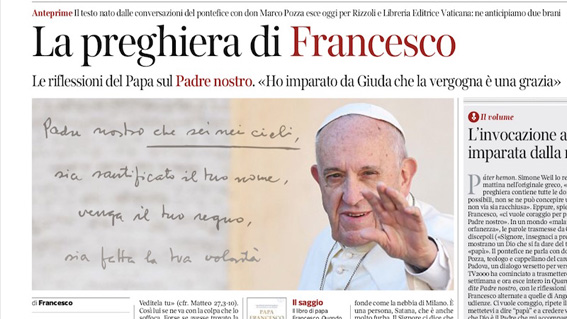
In the interview with Cardinal Giuseppe Betori – Avvenire 10/7/2017 – there is confirmation of a forthcoming correction of the Gospel text, as desired by Pope Francis I, in agreement with the most learned biblical scholars around. “Teamwork”, the Florentine prelate observes pleased, which he determined to be, the passage from Matthew 6, 13 “And do not lead us into temptation” is completely unacceptable because – Pope Francis reasons, Cardinal Betori and the team of biblical scholars – God, which is supreme goodness and infinite mercy, it can never 'lead' into temptation. Therefore, post this 'truth', the offending verb must be replaced with another more corresponding to the aforementioned divine goodness and mercy.
And here it is, At that time, get out of the cylinder of the conciliar vocabulary the magical substitution solution: “Do not abandon us to temptation”, formula that, despite not being – in September 2018 – was sanctioned in AAS, it is recited here and there. A formula, as we said above, which determines a double disastrous drift: theological and semantic and for which we are preparing to give an account and reason.
He N. T., come to, it is written in the Greek language that, although different from the Aramaic spoken by Jesus, it is the canonical text on which the entire Revelation and the 'Depositum fidei' are based. This is to say that, Greek or Aramaic version, nothing changes for the purposes of the inerrancy of the Word of God made man. Read More

Share

Who says capital punishment is, in itself, bad, falls into heresy

of the Prof. Roberto De Mattei

The lawfulness of the death penalty is a truth to be held by faith, defined by the ordinary and universal Magisterium of the Church, in a constant and unequivocal manner. Who says capital punishment is, in itself, bad, falls into heresy.

The teaching of the Church was clearly expressed in the letter of 18 December 1208, in which Innocent III condemns the Waldensian position, with these words, reported by Denzinger: «We assert a secular power, that without mortal sin he can exercise the judgment of blood, provided that I do not hate to take revenge, but by judgment, not carelessly, but let him proceed in consultation» ( A handbook of symbols,definitions and declarations on matters of faith and morals, edited by Peter Hünermann S.J., n. 795). (As for secular power, we affirm that the death penalty can be exercised without mortal sin, provided that revenge is exercised not out of hatred, but by judgment, not in an imprudent way, but in moderation).

The same position was reiterated by Catechism of the Council of Trent (Part three, n. 328), dal Catechism maggiore of Saint Pius (Part three, n. 413) and from the new Catechism of the Catholic Church (n. 2267) (albeit invalid because legislated by illegitimate authorities, n.d.r.). Pope Francis (Il “not-pope” Francesco, n.d.r.) he has now signed a rescript that modifies the Catechism (of the Conciliar Counter-Church itself, n.d.r.) with this new formulation: «The Church teaches, in the light of the Gospel, that 'the death penalty is inadmissible because it attacks the inviolability and dignity of the person', and is committed with determination to its abolition throughout the world». Read More

Share