Problems in the Spanish enclave: Gaddafi's prophecy is coming true?
 Reporting of R.G.
The police were at a loss because, although attacks had also occurred in Ceuta in the past, migrants had never had such violent reactions. In the area surrounding the Spanish enclave, tens of thousands of poor Africans are still waiting for their chance to enter Europe.
Although the number of new asylum requests to the EU has decreased this year, the migration crisis currently seems to have reached its highest point. Hundreds of migrants have shown that they are determined to enter the EU and no one will be able to stop them. Driven by desperation and hunger they are ready to risk their own lives and the lives of border agents to enter Europe. They don't accept “no”.
The violence they employ against the police is shocking and must be a warning sign for Brussels. So far the EU has not responded to this incident, ma, if a concrete action plan is not developed soon, there is the risk that violence and anarchy will also reach the heart of Europe.
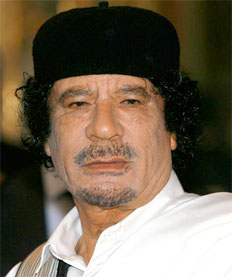
Even before the start of the civil war of 2011 the Libyan dictator Gaddafi warned so:
“Listen to me carefully. If you want to suffocate and destabilize me, you will only play Bin Laden's game and help the armed groups of insurgents. The following will happen. You will be attacked by a wave of migration coming from Africa which will pour into Europe from Libya. There will be no one left here to stop them”.
At the time, Gaddafi probably never imagined that he was alone 6 months later he would be killed by rioters in the street after NATO's intervention. But with his warning Gaddafi was right although this does not intend to justify in any way the actions of the Libyan despot. Until 2011 Libya was the richest African country and the desired destination for the starving Eritrean and Nigerian populations.
As for the population, Libya was among the countries with the most immigrants in the world. Today Libya is a failed state in which there is a dual government but there is no order. The failure of this state has also destabilized neighboring countries. Difficult situations are observed practically from Nigeria to Somalia. During the civil war France and the USA actively supplied the Libyan rebels with weapons who naturally did not return them after the end of the war. Military equipment from Gaddafi's arsenals was looted. Thus Libya was formed into a real one “arms market”. The Humans Rights Watch organization thus warned after the end of the civil war: “It's the largest distribution of weapons we've ever seen. It will be a threat to the region in the coming decades”. A similar development could also be observed following the American interventions in Iraq, Afghanistan e, before the Russian intervention, also in Syria.
Today the majority of asylum applications in Germany are submitted by refugees from the above countries. Mostly Nigerians leave Africa for Europe, Eritrea, Somalia e Chad. More than 75% of refugees arriving in Europe by sea leave from Libyan ports.
The politics of the German Chancellor of “somehow we will make it” recalls the impotence of the Roman Empire shortly before its fall. The Romans failed to manage the migration crisis when the Goths were at the gates and entered the Empire during the attack of the Huns. Initially the Goths were welcomed peacefully, food was provided to them, but when flow became too important, the Romans started a war to stop the Goths.
Furthermore, the corrupt Roman authorities kept food for them and, when the Goths who lived in Rome realized this unfair treatment towards them, an insurrection broke out. The famous historian Alexander Demandr also listed other causes of the fall of the Roman Empire: “Decadence, greed, old-fashioned way of thinking, immobility and loss of national identity”. And today in Europe it seems that many citizens of the Union believe that everything is fine as long as they have a roof over their heads, they can go out to eat and take holidays. The fall of the Roman Empire began before the migration crisis, so the parallels are chilling. And the legendary quote from Cicero: “How long will our patience last??” proves more relevant than ever if addressed to German Chancellor Angela Merkel and Interior Minister Horst Seehofer.
Merkel's security policy towards migrants differs from her predecessor's policy, l’ex cancelliere Willy Brandt: “In our company they work approximately 2,5 millions of people representing other nations. We have reached the point of having to carefully evaluate where the ultimate limit lies beyond which we can no longer welcome other people and our social responsibility ends”.
Helmut Schmidt ten years later he warned:”More than 4 millions of foreigners are the maximum number for German society if we don't want to have serious problems. We will not be able to integrate more than 4,5 millions of foreigners without any negative consequences”. Today they live in Germany 10,6 millions of foreigners and there has been no talk of secure borders for some time. Horst Seehofer attempted together with Austrian Chancellor Sebastian Kurz and the countries of the Visengrad group to present an alternative program for resolving the migration crisis. “Illegal immigrants must be expelled, border defense must be strengthened. In third countries, collection centers must be built for migrants whose asylum applications have been refused and the Frontex agency must be converted into a border police force”.
The main point of this program is the possibility of applying for asylum in the country of origin. So, after the Ceuta uprisings the question arises: what these centers should do and how they should be defended? The African population is growing very quickly and by 2050 will double until it reaches 2,5 billion. The flow of refugees driven by hunger, from economic problems, from corruption and a lack of prospects could increase. It is very likely that refugees will not accept the rejection of their asylum application and will leave for Europe anyway.
In Syria there is a glimmer of hope because that is where a large part of the refugees are currently heading “Europeans”. Thanks to Russian support for President Bashar al-Assad, it was possible to largely expel ISIS from Syria and interrupt the civil war. After the visit of the Russian delegation, the Syrian president confirmed that all refugees “safe repatriation will be guaranteed”. Active work is already being done on the repatriation of Syrian refugees from neighboring countries (Türkiye, Lebanon and Jordan) so that they can be an integral part of the country's recovery. It will probably be possible in the future to dialogue with Assad to conclude similar agreements for the repatriation of refugees.