1) When (and how) it started there “unhooking” of the Italian left by the popular masses?
Left, as a party of the bourgeois classes, illuminists and owners since the end of the 18th century has not been established as a reference point for the popular masses, with which it is actually in conflict. The left has “debut” on the European scene with the Vendée genocide, in which the popular masses considered traditionalists were exterminated by the Jacobins... In the 19th century the left was, in Italy, the reference party of the new industrial bourgeoisie and socialism was not born, originally, as a left-wing but communitarian ideology. The left met next, let's say at the beginning of the 20th century, the popular masses and was the interpreter of the dialectical phase of capitalism but with 1968, founding moment of the new left as a party of the radical modernization of bourgeois customs and consumption, the convergence between the left and the people, between progressive intellectuals and the working classes, had already disappeared again. From there on, the streets of European left-wing intellectuals and those of the working classes, workers and subordinates were irreparably divided, at least from the point of view of the previous ideological alliance established in the culminating phases of the thirty glorious years of Fordist/Keynesian capitalism (1945-1975).
2) Because the left has "abandoned" the latter and has thrown itself onto the bandwagon of global turbo-capitalism?
Because today's European left is a form of Americanization, a prime example of
“politica fashion” which looks to the metropolitan wealthy classes, cosmopoliti, gay-oriented and with intellectual pretensions. I believe that the reference ideology of the liberal and radical-chic left, that is, political correctness and the culture of supermodern mobility, constitutes the systemic side of global capitalism. Liberal democracy, that is, the self-government of the rich classes, it is the political model that the international ruling classes of
"left" they proclaim, uncritically, like some kind of new
“heaven on earth”. Ora, it is obvious that liberal democracy constitutes the best political framework within which today's capitalism can develop, financialized and digitalized. For this reason, liberal democracy is also the worst political model that the subordinate classes could hope for because in a context of real liberalism the claims, social, of the working and subordinate classes have no possibility of establishing themselves or finding acceptance among the dominant ones. The separation between left-wing culture and the popular classes is a historical phenomenon perfectly in line with today's capitalist reproduction cycle. Contemporary capitalism is in fact leftist, that is, animated by assumptions inspired by the principle of liberalization of customs, of consumption and bourgeois desires. The left considers workers' social rights as a statist and patriarchal legacy of memory
“Soviet” and recognizes the pseudo-culture of mobility as the key to today's processes
“liberal economic modernization” which European progressive parties wholeheartedly adhere to. In Italy, the PD is the
“American Liberal Party” and he's happy to be. I take note of it. Peace to his soul...
3) Who benefits / who is behind the drums of anti-fascism in Italy (in the absence of fascism)?
The narrative of anti-fascism in the absence of fascism benefits those political forces, economical, media and academic institutions aimed at trying to shore up the balance of power and class balances existing in the regime of liberal capitalism and market society. In the 2018, in Italy, the mainstream has reactivated the political-ideological mechanisms of the strategy of tension, this time with an anti-sovereign function and, as indeed in the sixties/seventies of the last century, anti-Russian. Italy is in fact a defeated country with limited or non-existent sovereignty, a sort of NATO colony. The Atlantic Alliance cannot in any way allow a shift in Italian foreign policy in a pro-Russian direction. He couldn't allow it in the 1960s/70s and he can't allow it now. The recipients of globalist tension strategy policies are those parties and social actors that are outside the mainstream and that intend to establish relations of détente and collaboration with Russia. Russia is in fact the main geopolitical and cultural opponent of globalism and who seeks an alliance with Russia, on the right as well as on the left, he is demonized by the mainstream and ends up on the NATO and EU blacklist.
4) Can you summarize who is behind – in short – the M5S and its aims?
The M5S is the new party of the globalist left disguised as a mainstream community
“anti-corruption”. Behind the M5S are the professional classes of the new digital economy who founded it and the liberal ideology that determines the liquid-modern society. The M5S is a neo-bourgeois party with a popular electoral base, southern, who asks for welfare. The M5S talks about the fight against caste, but which elite is he referring to when his spokespersons raise the tone on the subject? Certainly not to the international capitalist castes, to the lords of debt-issued money, to the pimps of the exploitation of flexible and precarious work and to the rainbow generals of NATO who wage wars to export abroad the gay-oriented and metrosexual foundation myths of Western society. The formal leader of the M5S, Luigi Di Maio, he is a mainstream politician. Talk about
“fight against annuities” of parliamentarians, a topic that appeals to the general couch potato audience but which has no impact on the real economy of Italy e, contextually, he goes to the City of London to swear eternal loyalty to the regime of globalized capitalism. Furthermore, the M5S is a party in favor of policies of opening borders to immigration and, for this reason, is characterized as a political subject further within the liberal ideological mainstream. I believe that the M5S was formed by the transnational upper class that determines the processes of postmodern anthropological engineering as a political marketing tool and functional gatekeeper to intercept the sovereignist vote and to channel the spirit of rebellion of those penalized and disappointed by globalization in the direction of a liberal-globalist and "synthetic" party, more or less disguised as an interlocutor
“anti-system” of the deprived and oppressed classes.
5) There are – at the moment – credible political forces in Italy that are truly interested in protecting the interests of the poorest, of the poorest, of those who were once represented by the "left"
In Italy there are parties that preach a certain electoral sovereignty whose effectiveness needs to be verified by the facts. Personally, I appreciated the "national" turning point of the League and I consider Matteo Salvini to be a much more intelligent and prepared politician than the left-wing mainstream is portraying him as. However, the League remains a fundamentally liberal party in economics and pro-Zionist in foreign policy, therefore trapped in a whole series of political-anthropological contradictions which weaken the message of criticism of globalization which he sometimes conveys with good communication skills. I also consider it a notable step forward for the League compared to the mainstream past of this movement in having nominated important economists who are critical of the euro as an instrument of neoliberal governance of international private markets., like Alberto Bagnai and Claudio Borghi. Furthermore, the League has made a notable leap in quality on a cultural level by starting and deepening the comparison with thinkers of the caliber of Alain de Benoist and Aleksandr Dugin. I hope that the League continues, in the metapolitical context, on this path undertaken, fully incorporating the lessons of de Benoist and Dugin. Left, Instead, I respect Marco Rizzo, leader of the Communist Party. I do not share Rizzo's integral Marxist-Leninist ideological approach, but I consider this political exponent to be the most lucid opponent, coherent and combative of the regime of liberal capitalism and of
“open society” among those who, in Italy, they refer to the legacy of twentieth-century historical communism.
6) You can explain to the average European what an organization like UNAR is and what it is used for in Italy?
UNAR is one of the public thought police apparatus aimed at repressing those who dare to dissociate themselves from the single and obligatory religion of left-wing cosmopolitanism. It is interesting to note how contemporary liberal governments act to promote the dictatorship of the new politically correct moral conformism calibrated to
“gusto” from the
“young globalized middle classes” and self-styled trendy, in a context of economic precariousness for the lower classes. The Italian case is paradigmatic in this sense. The PD has in fact launched almost simultaneously the UNAR which establishes the regime of moral conformism and the
“Jobs Act” which nails future generations to the slavery of flexible and precarious work. The contemporary liberal regime therefore acts on two fronts: in culture, promotes the new politically correct morality, also providing ad hoc sanctions for those who contest or oppose the new moralism of manner. In economics, passes laws that implement the power of arbitrariness of capital which is self-sustaining and self-legitimizing within the perimeter of the
“open society” in the name of the mainstream rhetoric of
“freedom of profit”.
7) See a solution to the phenomenon of “migrants” in the short term? What are they for and who is behind NGOs in this business?
It is clear that the immigration business is extremely profitable for the upper classes, for the oligarchy, for new economy professionals who can benefit, thanks to the new industrial reserve army made up of illegal immigrants,

of a substantial reduction in the prices of postmodern services of which they are avid users. Mass immigration is useful to the godfathers and godchildren of the liberal capitalist regime while the social costs of such policies of revoking national territorial borders are irremediably passed on to the working classes, those who have to live with immigrants without being able to take advantage of their low or no paid labor benefits. The theme, Anyway, I'm not very passionate about it because I'm practically not there, in Italy, at the political level
“what matters”, parties and movements that propose credible solutions to the problem. Some European countries, those of
“Visegrad Group”, they moved in time and, thanks to their monetary independence, have been able to launch effective policies to combat mass migratory flows. Italy, Instead, a country blackmailed by Brussels and administered by a non-sovereign government, it broke down its internal borders exactly as the European multinational business classes had asked of it. Furthermore, in Italy, the mainstream right-wing parties that claim to be anti-immigration have not yet wanted to understand that one cannot be liberal and libertarian but against mass migratory flows since today's migrations, entering or leaving the country, they are an epiphenomenon of capitalism. Why, these parties will be credible when they understand that the national sovereignty they talk about during the electoral campaign is not a historical category compatible with the opening of the state's borders to the so-called multinational investors of the new economy.
8) Quoting Warren Buffett's now famous phrase “there was a class struggle and we won it”, how to define the figure of Pope Francis (note the lowercase) in this class struggle? It is correct to say that this pope has absolved / it fulfills a useful task for the "class" that Buffett talks about?
Bergoglio inserted Emma Bonino and Giorgio Napolitano, that is, two Italian political exponents who wage class warfare on the side of the rich every day, in his very personal pantheon of the "greatest Italians". To those (Italian Episcopal Conference) it sided with the center-left led by Gentiloni-Bonino in the last political elections.
Yes, essendo ormai una costola del partito transnazionale politically correct, and maybe even something more than just a rib, I think that the contemporary Vatican hierarchy has chosen a side in this gigantic class conflict that characterizes the global reproduction dynamics of capitalism “third phase”…


 (by Franco Bechis) – Italy is officially in trouble, because yesterday the European Commission started the procedure for excessive debt. He did this by writing a report 21 pages, which contains a surprise: the formal basis of the dispute has little or nothing to do with the maneuver of the government led by Giuseppe Conte, because it is relative to the result of the public debt over the years 2016 e 2017. So it was Matteo Renzi and Paolo Gentiloni who got Italy into trouble. The infringement procedure is the Democratic Party's last wonderful gift to Italians.
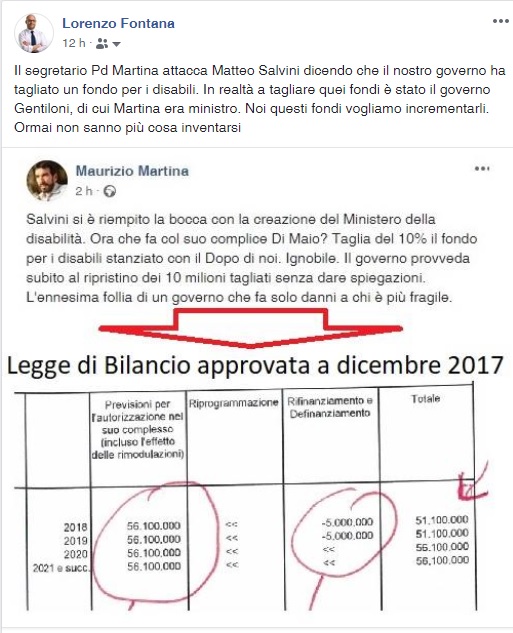 Disabled, “fund reduced by 10 millions". Martina: "shame". But it's a boomerang for the Democratic Party: the cut is made by the Gentiloni government
 Of Francesca Totolo
 Of Gioacchino Rossello


 Reporting of Wall Street Italia