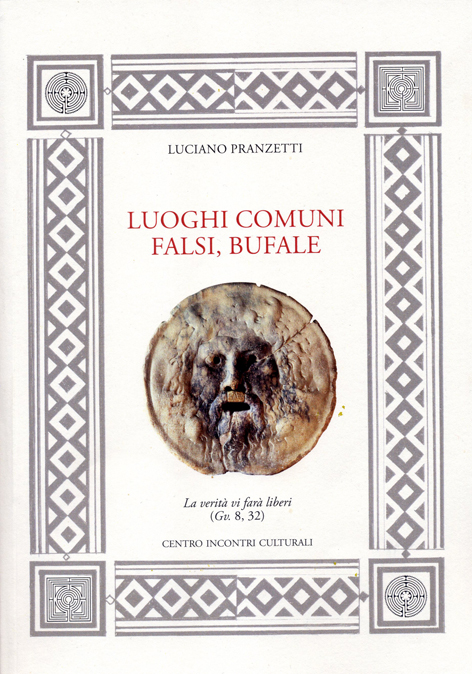
 of the Prof. Luciano Pranzetti
“Common places, false, hoaxes”, own edition, 2018, pp. 155, you can request it from the author: lucianopranzetti@alice.it
It is surprising how so many linguistic observations can be collected in a small book, literary, historical and customs.
This is what we see when reading the latest work that Prof. Luciano Pranzetti published it with the title Luoghi comune, False, Hoaxes, in which considerations are presented in a masterly manner, comments and documented clarifications that constitute just as many ideas to start reflections and insights that could fill entire volumes.
The book is presented with a valuable preface by Prof. Ferdinando Bianchi, which introduces the reader to Pranzetti's refined and caustic prose, highlighting that these «with his Gascon spirit, the formidable chromaticisms of its exclusive communication code, i paradigmi, the counterpoints, i simboli, the tautology, the vigor of his phrasebook, the seduction – ad se ducere – and the charm of its singularity, antonomastic vocabulary, the exemplary effectiveness and semantic rigor of its phrasing, page after demolishing page, it shattered the reckless and already not very solid edifice of an opinionated woman, weak, snooty, repetitive and sometimes uncritical and conformist communication, the foolish simulacra of a conventional historiography, the implosion of a historical sense without true scientific foundations, of an often uncultured literature, even insolent and poor, commodified and pregnant with media lies and hidden meanings, impromptu and often even incomprehensible: preview of his new outpouring of genius. The notes have become volume..."
From your side, the Author, in his introductory note, outlines the purpose aimed at by its relatively small – for quantity and not for quality – composition:
«With this job of simple entertainment, not academic and certainly not new in its literary genre but useful to the intellect, we intend to deny and/or clarify some stereotypes and clichés, false integrals, hoaxes, behaviors that, for having been consolidated for some time, both in everyday speech and in the temples of culture - academies, schools, mass media – as the essence of wisdom itself, they pass for unconquered and proclaimed truth.»
The book can be read in one sitting, and it's worth it: as can be seen from the following examples.
Of "commonplaces"
“Mountaineer dead due to an avalanche – Loses his life due to a freak wave – yet another serious accident on the cursed curve”, and so on blaming. It's now, similar language, of daily frequency, practiced in the news whose reporters, in breaking the news, tone and emphasis also rest on "guilt". Bizarre semantic operation that applies to inanimate things the ethical criteria exclusive to man and relevant to his conduct, his conscience, his responsibility.
Of "fakes"
“Ferdinand II of Bourbon: King Bomba – Vittorio Emanuele II of Savoy: Gentleman King”.
In Sicily, […] under the direction of England which wants to grab the monopoly of the island's sulphur... the insurgents have occupied Palermo and Messina. King Ferdinand II orders and directs the recovery operations […] the fleet, supported by 4 companies of “pioneers” […] begins to bomb the position... outside Messina, equipped with 12 cannons [the station is occupied] 6400 soldiers set off towards Messina, they occupy the port clashing with the rebel troops […] on 8 September the city was liberated.
Therefore, no bombings and no devastated city as the liberal and English propaganda newspaper writers hastened to advertise.
[…]
Opposed to a false 'Bomb King'... stands an equally false 'King Gentleman' - Vittorio Emanuele II - but true 'bomber' […] we won't delay […] on the massacres of GaetaCivitella del Tronto (October 1860/March 1861), of Palermo (September 1866) […] [of] the horror of Pontelandolfo and Calsaduni set on fire, [of] the abjection of the Savoy prison camps such as San Maurizio and Savona, such as the fort of Fenestrelle (To), in Val Chisone where, […] thousands of southerners, soldiers, civilians and pontifical soldiers found death and 'damnatio memoriae' - loss of identity - since their corpses were dissolved in quicklime.
[…] Let's remember, passing by, the massacre, commanded by the 'gentleman', of approx 80 Turin, killed by the army and the carabinieri during the days of popular uprisings - 21-22 September 1864…
[…] We will not say for long about the kidnappings of young women for the purpose of lust that the 'gentleman', seconded by Cavour, entrusted to the Police Commissioner, Filippo Curletti...
[…] We'll talk instead, as a paradigmatic example of naked truth, of the crimes of Genoa – April 1849 – and of the brigand and dirty deeds of Alfonso La Marmora's Bersaglieri (1804-1878) committed there…
From “Buffale”
The painter Picasso was a passionate bullfighter… the 16 May 1920… the bull fatally struck… the bullfighter 'Joselito' […] Picasso, shocked by the tragic death of the young idolized toreador, celebrated his memory by staging, immediately, a cloth [7,77 meters per 3,49] full of crooked figures, dure, angular and asymmetrical… Finished, the title 'Death of the bullfighter Joselito'.
[…] In the 1937 raged, in Spain, the civil war and the anarcho-social-communist government asked Picasso to have one of his works to be placed in the republican pavilion of the Universal Exhibition which would have been held in Paris in 1938.
Picasso had an exceptionally clever idea: he took the old canvas out of the warehouse, he made some slight variations, deleting the original name, for one more suited to the government request. And it was 'Guernica' – name of the Basque town bombed on 26 April 1937 by the Italian-German air force – canvas that was sold to the government for the astronomical sum of 300.000 pesetas, corresponding, more or less, to around one and a half million euros.
[…] Heart on the left, wallet on the right.
And here is the list of topics covered by the Author.
COMMON PLACES
Read More


 of the Prof. Luciano Pranzetti
 of the Prof. Luciano Pranzetti