Of Enrica Perucchietti
Source: uneditors
Aldous Huxley's lesson on the future
In a letter from 21 October 1949, the writer Aldous Huxley thanked the former Eton College student, George Orwell, for sending him a copy of his new novel, 1984. Huxley was enthusiastic about the manuscript but allowed himself to note the substantial difference between the "soft" model of dictatorship imagined by him 17 years earlier in the dystopian novel Il new world, and the dark and "sadistic" one described by Orwell, explaining what, according to him, would happen in the near future:
«I believe that oligarchies will find more efficient ways of governing and satisfying their thirst for power and will be similar to those described in The new world».
Huxley was convinced that rulers would take the form of “soft” dictatorship, asthey would have found in hypnotism, in infantile conditioning and in the pharmacological methods of psychiatry a decisive weapon to bend the minds and will of the masses.
A hypothesis that the English novelist would have confirmed in 1958 in his essay Return to the new world. In a nutshell, the power would soon be convinced to resort to hypnosis and techniques pharmacological conditioning to control and manipulate the masses, in order to implement what Huxley defined «the ultimate revolution»:
«Within the next generation, those who hold the reins of the world will discover that […] the thirst for power can be satisfied in its fullness by inducing people to love their state of slavery, rather than reducing them to obedience with whippings and kicks. In short, I think the nightmare described in 1984 is destined to evolve into the one described in The new world, if nothing else as a result of a need for greater efficiency".
Gentle manipulation: slaves without chains
Today we prefer repressive methods (Still) flank the “gentle” manipulation aimed at making citizens believe, according to Huxley's lesson, that they are free to choose when instead all their decisions are decided and oriented from above. In both models of totalitarianism, dark and sweet, it is though propaganda is essential of which the mainstream media acts as a docile sounding board. Nin fact, no regime can sustain itself without it, as well as, paradoxically, Western democracies resort precisely to the widespread manipulation of public opinion.
In democratic society, opinions, that is, the habits and choices of the masses are addressed, as he explained in 1928 Edward Bernays – considered the founder of Public Relations −, give a «invisible power that truly runs the country». According to Bernays, propaganda is essential to "give shape to chaos". The techniques used by those in power to shape public opinion have been invented and developed over the years, spiegava Bernays, «as society became more complex and the need for an invisible government proved increasingly necessary».
Invisible and widespread technological surveillance
What changes in current society compared to the one imagined by Orwell or the panoptic control system, is that social control, thanks on the one hand to technological surveillance (we had some taste of it with the scandal of Cambridge Analytica) and on the other to increasingly sophisticated propaganda techniques, it was done invisible, permanent and capillary and it affects everyone in what sociologist Marshall McLuhan called the “global village”. Today, thanks to a dense control network that also takes place thanks to the web, every individual can spy on others, even going so far as to "report" them and betray them, effectively siding with the invisible power (as in regimes). Everyone controls everyone and in fact order is maintained thanks to them to the approval of citizens who don't realize they are just pawns in a control scheme bigger than them.
Invisible government and mass manipulation
With the advent of modern mass society, power had to be exercised over an ever-increasing number of people. The art of control ended up becoming the science of Public Relations, Better, a "science of manipulation” of disconcerting refinement that manages to influence behaviors and ways of being, sometimes without even having to use physical coercion (let's think about the phenomenon of spin doctors).
As anticipated, Bernays spoke of "techniques used to frame public opinion" carried out by an "invisible government", echoing what he had already stated in 1884 British Prime Minister Benjamin Disraeli:
«The world is governed by completely different characters that those whose eye does not reach behind the scenes cannot even imagine».
Power today, to be more effective, in fact he prefers to remain "in the shadows", revealing itself as little as possible.
A hidden power, it has the undoubted "advantage" of remaining practically unassailable and hidden. Can Also, if you want, favor now one now the other of the "visible powers" and even, if he deems it necessary, promote two apparently opposing sides at the same time that they will be able to do so, more or less unconsciously, pursue differently the only end to which this Power aims (the method of Divide and Conquer).
In the end, a hidden power (or in any case not immediately identifiable by most) has the ability to do what no government or visible power can fully accomplish: manipulate mass feelings and mentality almost perfectly without giving the impression of doing so; control the people entering their imagination, that is, shaping minds, the consciences of individuals.
Fake news: divide to… censor
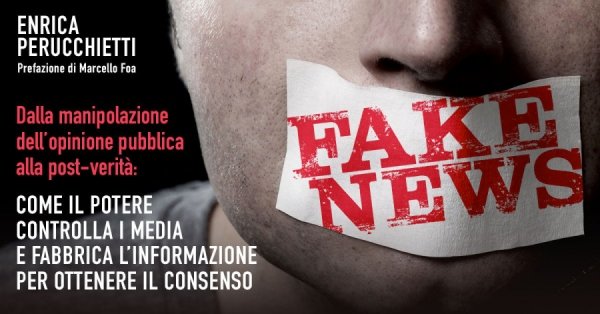
The question of control through the manipulation of the imagination and emotions of the masses that I talk about in Fake news (Arianna Publishing) è fondamentale per comprendere gli attuali attacchi alla libertà individuale di cui siamo testimoni in quest’epoca.
In fact, it fits into this scenario the current battle mainstream against the so-called fake news which seems to echo the work of Orwell's Miniver and seems to propose a new form of McCarthyism 2.0: that is, it is about a complex witch hunt aimed at repressing dissent.It exploits the issue of cyber bullying on the one hand and the spread of hoaxes on the web to lead to the approval of censorship of the Internet, leading to the hypothesis of the introduction of the crime of opinion, a modern form of thought crime.
The aim is to continue to manipulate public opinion and in particular those who are considered "mere spectators", that is, that flock (us, the people) what's going oriented in his choices so that he doesn't wake upand above all that he does not express his thoughts in a free and critical way. The purpose, quoting Chomsky again, is that «the disoriented flock continues not to orient itself» .