The “Our Father” in Bergoglio's sacrilegious version
of the Prof. Luciano Pranzetti
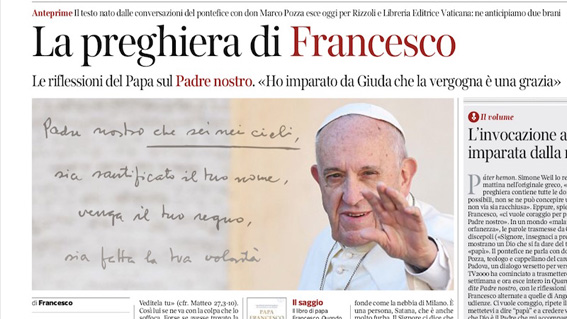
In the interview with Cardinal Giuseppe Betori – Avvenire 10/7/2017 – there is confirmation of a forthcoming correction of the Gospel text, as desired by Pope Francis I, in agreement with the most learned biblical scholars around. “Teamwork”, the Florentine prelate observes pleased, which he determined to be, the passage from Matthew 6, 13 “And do not lead us into temptation” is completely unacceptable because – Pope Francis reasons, Cardinal Betori and the team of biblical scholars – God, which is supreme goodness and infinite mercy, it can never 'lead' into temptation. Therefore, post this 'truth', the offending verb must be replaced with another more corresponding to the aforementioned divine goodness and mercy.
And here it is, At that time, get out of the cylinder of the conciliar vocabulary the magical substitution solution: “Do not abandon us to temptation”, formula that, despite not being – in September 2018 – was sanctioned in AAS, it is recited here and there. A formula, as we said above, which determines a double disastrous drift: theological and semantic and for which we are preparing to give an account and reason.
He N. T., come to, it is written in the Greek language that, although different from the Aramaic spoken by Jesus, it is the canonical text on which the entire Revelation and the 'Depositum fidei' are based. This is to say that, Greek or Aramaic version, nothing changes for the purposes of the inerrancy of the Word of God made man. Read More

Share

INDUCING AND ABANDONNING – Semantic gloss

The result of the image through the Our Fatherof the Prof. Luciano Pranzetti

It is not our intention to intervene, with biblical/theological arguments, on the announced and reiterated Bergoglian intention to modify, In the Our Father, the expression "Do not lead us into temptation” in favor of another less allusive one – according to the opinionated theologians of the Vatican-secondist neochurch – to a God who delights in wanting evil for his creatures. E, because of this, without waiting for a definitive decision by the Hierarchy, already in some French dioceses, as well as in many Italian churches, please with the new replacement formula "Don't abandon us to temptation”. Authoritative interventions have been produced on the subject which, without any shadow of a doubt, have demonstrated how inappropriate and incorrect such a new translation of the Greek text is "kai mè eisenègkes emàs éis peirasmòn “ (Mt. 6, 13) That, given to be authentic and unchangeable Word of Jesus (Mt. 24, 35), corresponds to the Latin "and do notlead into temptation”, as Saint Jerome well understood in the canonical version of the 'Vulgate'. We would like to demonstrate, Instead, like the new formula, far from the intention of making the figure of the Father distant from any connotation of malevolence and injustice but only designed with mercy, harden it and make it worse by handing over to Catholicism the idea of ​​an evil God, distant and disinterested in the events and fate of his creatures. Therefore, with the sole etymological/logical/semantic analysis of the two verbs INDURRE and ABANDONARE, it will be possible to realize a vision that, referring to the second, manifests itself to be stronger than the first e, really, blasphemous. We see, At that time, because the two verbs express opposite semantics.

1INDUCE: verb that, in the various and multiple circumstances in which it is flexed, it means a dynamism with which a subject pushes and/or is pushed to behave, to unbecoming attitudes, come: “mislead, lead to crime". Ora, if we carefully consider the etymology and semantics, you can see how, in the compound in-duce, there is an initial motion to which the subject is connected, he is not necessarily forced to give in, so much so that we can speak of an incitement to commit crime which did not materialize due to an opposing will. Scripture informs us that God tests, but this does not mean that man is required to respond to temptation, term this that, among other things, it configures a circumstance in which an attempt is made, operation, Meaning what, who tries to solicit something but not necessarily complete it. Read More

Share