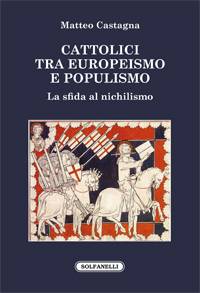
"Cattolici tra europeismo e populismo. La sfida al nichilismo", the book by Matteo Castagna | lafedequotidiana.it
THE REVIEW
Of Michele M. Ippolito, director of “Daily Faith”
“Catholics between Europeanism and populism. The challenge to nihilism” is the new book by Matteo Castagna (Solfanelli Editions, pages 248, € 17).
Although the author is not a professional historian, Castagna making use of the comparison with the best contemporary theoretical production, try to understand Italian history, Western and Catholic by reducing the unilateral and misleading interpretations of those who tend to smooth over the great conflict between integral Catholicism and modernism, flared up at the end of the nineteenth century, “which then continued in the final conflict between the Pacellian front and Montini's Christian Democratic front, great politician but weak theologian, disciple of Maritain's secularist and globalist ecumenism".
Veronese, married, class 1976, collaborator of Veronanews, Vvox e The Truth, Matthew Castagna, He defines himself as one of the Catholics faithful to Tradition who began to be interested in politics 14 years (until he is elected, In the 1998, as councilor of the third district of Verona, being the youngest in the city).
In this, his first book as a single author, which contains a post by Giacomo Bergamaschi and an array of notable quotations, the final proposal is remembered by Castagna himself: “the models of Italian and Portuguese Fascism intended to oppose a model of modernist and revolutionary civilization through a clear counter-revolution, with the affirmation of a modern counter-reformist political and social culture, not theocratic or merely neo-medieval, aimed at the modern establishment of a Catholic corporatist state".
Castagna defines these two fascisms as neither reactionary nor conservative but traditionalist and counter-revolutionary regimes "that is to say orthodoxly counter-reformist since, although they recognized themselves in the values ​​of tradition, they did not consider it appropriate to restore the old regime sic et simpliciter in the context". Read More
Share

I "Santi" the council, Milano 17 November

I “SANTI” DEL COUNCIL, MILANO 17 NOVEMBER

“All Saints… And “san” John XXIII a “san” Paul VI, or the canonization of the Second Vatican Council 1st intervention. The canonization of saints according to the traditional doctrine of the Church 2nd intervention. “The smoke of Satan in the Church”: the “canonization” in GB. Montini and the current situation of the Church speaker Don Francesco Ricossa Milano, Saturday 17 November 2018, ore 15,00 at Andreola
Read all.

Read More

Share

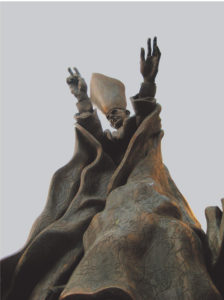
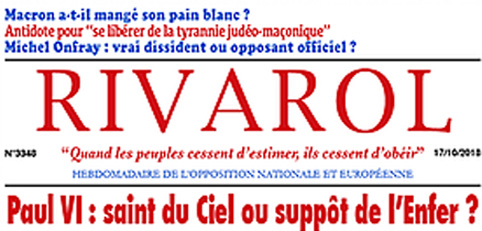
Paul VI: saint of Heaven or collaborator of Hell?

Editorial of the issue 3348 of Rivarol – 17 October 2018
Of Jerome Bourbon
He dared!
After having “canonized”, il 27 April 2014, John XXIII and John Paul II, Francis-Bergoglio returns to us with the "canonization", il 14 last October, of Paul VI.
The modernists who have occupied the seat of Peter for sixty years no longer even use gloves, they do not hesitate before any provocation: they "beatify" and "canonize" each other in a hurry. It was in fact John Paul II who inaugurated this trend, “beatifying”, il 3 September of 2000, John XXIII; and to make the pill swallow the same day he “beatified” Pius IX.
A mockery of the entire world: simultaneously honor the Pope of the Syllabus and the organizer of Vatican II... the Pontiff of Catholic intransigence in a world revolted against God, and the propagator of religious freedom and the cult of man.
Naturally, the "canonization" of Pius IX was never followed by his canonization, contrary to what happened with John XXIII. It was simply a subterfuge to prevent the traditionalists from shouting.
On the other hand, it is unthinkable for the apostates today in the Vatican to "canonize" the Pope of Quanta Cura, who energetically opposed the world and modern civilization.
Read More

Share

don Ricossa (IMBC): L'invalidità della "canonizzazione" of Paul VI (Montini)

Image results for Don Francesco RicossaWe read the statement from the Society of Saint Pius “canonization” of Montini is valid or not. We have listened to this homily and the invalidity appears obvious in the clear exposition of the Catholic argument. We remain convinced that the solution cannot be the Cassiciacum Thesis, but in this homily we find the immutable Magisterium of the Church.
Reporting of Federici Studies Center

We highlight the homily of Don Francesco Ricossa on the so-called "canonization" of Paul VI, held in the church of San Luigi Gonzaga in Albarea (FE) il 14 October 2018:

Read More

Share

And then, Which side are the Catholics on??

REVIEW OF THE BOOK BY MATTEO CASTAGNA
Of Mattia Rossi per The newspaper OFF of The newspaper
It caused a sensation, some time ago, the cover of Christian family against the Minister of the Interior Matteo SalviniGo behind Salvini», it stood out on the cover under the photograph of the Northern League leader). Shortly after, but, the newspaper poll Libero: 85% of Catholics would be in favor of the Minister's policies
And then, which side are they on? (or they have to stay) the Catholics? With what, commonly, is defined as populism or with the pro-European globalism? And southern fascism? Where to position yourself for those who profess to be Catholic? But then, as Catholics? Those of the modernist official hierarchies or those "integral" and faithful to the Catholic Magisterium of all time?
He tries to give the answers Matthew Castagna, journalist and militant Catholic (responsible for the Sedevacantist-oriented “Christus Rex – Traditio” club) in his Catholics between Europeanism and populism. The challenge to nihilism (Solfanelli, pages. 248, euro 17) recently in the bookstore.
Ascertained immediately, from Castagna, that «a “progressive Catholicism” cannot exist» and that «the only possible Catholicism is the “integral” one», There are numerous doctrines that the Veronese journalist reviews (Savonarolism, counter-reformism, the second Francoism, the neo-Lutheranism of Nazism) and then move to the Catholic side in the chapter Integral Catholics, Jesuits, modernist, clerical-fascists.
Catholic integralism, explains Castagna, «perceives in white-Jesuit internationalism, Christian Democrat-Modernist is the political and theological instrument through which the greatest attack is manifesting itself, never conceived, to Christianity". It follows that, according to the author, «the fundamental danger of the Jesuit-modernist union would be represented, per mons. Benign, from the end of the social disintegration of the Western Constantinian and Gregorian Tradition; from absolute and dogmatic anti-fascism; from left-wing Christian Democrats; from fanatical and relativistic technical-pragmatic and politicistic anthropocentrism; from the rejection of the XXIV theses of Thomism; all of this, if achieved with the victory of international anti-fascism, it would have led to neo-modernist nihilism and secularization”. Read More

Share