Saint Paul: "chi non vuol lavorare, don't even eat" (parasite!)
Report www.unavox.it
Of L. P.
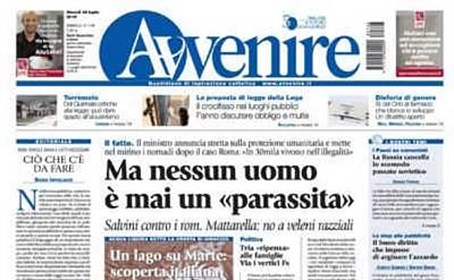 Days ago, during a reclamation intervention on a 'Roma camp' – the River Village in Rome is named with posh Anglomania – carried out by the police in the last week of July, the director of Avvenire, the out of tune organ of the CEI, he came out with a comment saying that “No man is ever a parasite”, the intent to transform is evident, with a cultural procedure – alchemical, the reality of an ethnicity that largely qualifies for exlege behavior, as a model of social and economic efficiency.
Affirm, to be precise, that no man is ever a parasite definitely means that, for the fact of "being a person", also a lifestyle, characterized by illicit activities or abulìa - and the evidence in support of such an evident reality is innumerable - must be recognized as a sign of an objective value.
It is not the purpose of our intervention to dwell on the political aspects, social, judicial authorities in which one or another Roma community is very often accused. Our aim will be, Instead, that of denying and dismantling the 'maxim' uttered by Marcus Tarquinius, director of Avvenire, highlighting its groundlessness and its contingent functionality to its gratuitous desire for controversy.
We are convinced of the concrete anthropological reality of the individual that universal common opinion defines as 'parasite', but it is not on this belief of ours that we will base the critical information given to the aforementioned director. The 'auctoritates' which confirm the existence of the 'parasitic type' both in economic and existential terms are very different.
This word indicates an animal or vegetal organism that lives at the expense of another, for axiological transport, a person who lives by exploiting others. Modern borrowing from classical languages: dal Latin parasite (parasite is the feminine.), freeloading guest, maintained; from the Greek parasites, who eats at other people's tables – from sitos, food, with the prefix para – presso, alongside. A human type, how well the ancient culture classified and that, in concert with Vico, we can define a very true type.
Ora, the great heart of Tarquinius, full of do-goodism and philanthropy, shaken by a lively and agitated desire for a welcome regardless, not only does it deny and reject the dictionary and history and, in the present news contingency, the Minister of the Interior the Hon. Matteo Salvini - the one who ordered the eviction of the camp - but cancels the authority of: