Attention for the first time Big fiscal brother is underway
Reporting of Antonio Amorosi
Taxes, Big fiscal brother is underway For companies, for people's current accounts…



Reporting of Antonio Amorosi
Taxes, Big fiscal brother is underway For companies, for people's current accounts…
 Of Marcello Veneziani
Like today (yesterday for those reading, n.d.r.), fifty years ago, in the fateful '68, he went to the other world Giovannino Guareschi. He left the small world that few had described, to reach the big world, the one where that Lord lived who in his House gave advice to one of his fiery dependents on earth, Don Camillo. At least that's what Guareschi says.He left early, Giovannino, a 60 years, after a troubled life, between concentration camp, prison under fascism and anti-fascism, plus a host of books translated all over the world, of very popular films that represented that fabulous post-war Italy, and adventures in the press, like his impertinent Candide who played a decisive role in the defeat of the social-communist popular front in the 1948 elections.
Giovannino died on 22 July '68 but he had time to write his last Don Camillo dedicated to today's young people. The book was released posthumously and marked the striking contrast between the old communist Peppone (that the anti-communist Guareschi had made sympathetic with his irrepressible humanity), the tough Don Camillo and a young, beardless protester, who was traveling on a motorbike with studded and fringed bags and a black jacket with a skull and the words "Veleno". Which becomes the boy's nickname for Guareschi and also the metaphor of the protest. "The Chinese" also arrive in the town of Brescello and upset the ideological geometries of the Italian-Stalinist Peppone and also displace the religious ones of the parish priest. Guareschi links the protest to the advent of the consumer societyi. For him the antagonism between the two phenomena is only occasional, related, not substantial. Consumerism devours the small ancient world and the old faiths, but he catches Peppone who leaves his bike and rides in a red spider. Consumerism is the habitat of 1968. Read More
Of Alessio Mannino
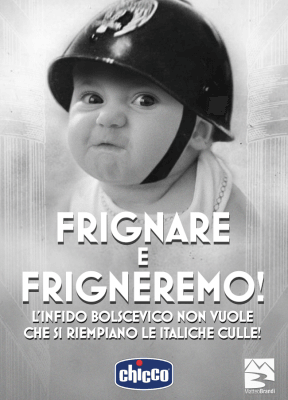 Calling the pro-child advert of the baby products company "fascist" shows that the sense of limits has been lost. And about being parents
Proof of how much advertising is the true Collective Intellectual of the consumer society, lo Chicco television commercial which invites us to do so by taking advantage of the absence of the Azzurri at the World Cup, returning to give birth with gusto in an Italy that procreates little, has sparked outrage on the perpetually menstruating web, as if it were an institutional message promoted by the new populist and sovereignist government. "Alarms, they are fascists": even the copywriters of the pram and baby articles company? Yes, according to those who spilled the beans on social networks, which then are i beam-all-seeing, those who he sees people bandage everywhere – next time, what do we know, it could happen to Nutella (too dark, almost black), or to agricultural trade associations that invite you to buy Italian (autarky, autarky!) or to anyone who should ever recall in non-defamatory terms works such as the reclamation of the Agro Pontino (oh no, Antonio Pennacchi has already done it, hard and pure communist, with its – beautiful – “Mussolini Canal”). Read More
Of Luca Leonello Rimbotti
Source: Italicum
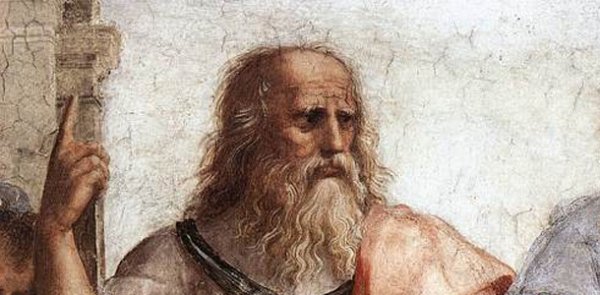
Literary utopia, or a true manual for building politicians? Criticism of Plato's most scathing and incisive work has often moved between these two poles, considering this capital text from time to time as a rhetorical exercise, or an ontological proof, or instead, something that is to be shared, a true manifesto of universal politics, capable of constituting at any time a code of exemplary social stability. Other times however, as in the case of the liberal Popper, Plato and his “Republic” played the part of public enemy number one, the ideology that, proposing a well-organized society in itself, firm and solid and therefore closed to external dangers and evils, more than others, it endangers the beatitudes of the "open society".
The catalog of positions that the Platonic "Republic" presents is one that is difficult to digest for those with an egalitarian stomach, pacifist and progressive. It is impossible not to see that ancient classicism and postmodern degeneration are in antithetical positions. For bourgeois and moderate eyes, cosmopolitans and "do-gooders", Plato's thought represents the greatest scandal: it outlines the community to the highest degree, and therefore dismisses individualism a priori, which instead is the great refuge of liberal impotence. These are some of the most qualifying points of Platonic politics, which constitute – as rightly so, from his point of view, Popper noted – how much more unassimilable to the mentality of post-modern "democrats".: the rigid and severe paideia, the education and selection to which Plato entrusted in the "Republic" the growth of the ruling classes of the ideal city; the suppression of individualism in the face of the prevalence of community interests; community, really, of women and property; the abolition of private property; the dominance of the "organic" State over the individual, whose rights are unknown, but only duties; the type of government, hierarchical, aristocratic and elitist, in which philosophers participate and not at all the mass of the people. All this scandalises the hypocritical and fraudulent nature of modern "democrats"., who pass off their upper-bourgeois oligarchies as governments "of the people" and exchange their financial dictatorships for services rendered to the majority. Read More