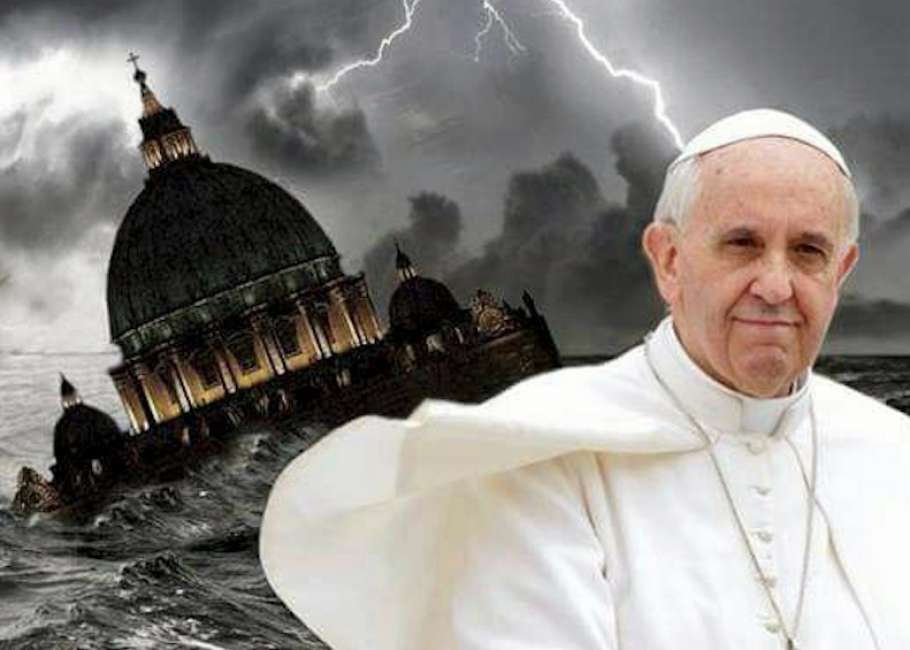
Bergoglio abolisce la "pena di morte", against the entire Tradition of the Church

Report Zenit

AGAINST THE TRADITION OF THE CHURCH, AGAINST THE DOCTORS OF THE CHURCH, AGAINST THE CORRECT INTERPRETATION OF THE COMMANDMENT “DO NOT KILL”, AGAINST S. TOMMASO D’AQUINO, BERGOGLIO INVENTS ANOTHER AMENITIES’ FOR HIS CHURCH, MORE AND MORE’ FAR FROM THE RIGHTS OF GOD AND EVER MORE’ CLOSE TO AN ABSURD ANTHROPOCENTRISM WITH A LIBERAL-MASONIC FLAVOR (N.D.R.)

“The death penalty is unacceptable”

New editing of the n. 2267 of the Catechism of the Catholic Church (conciliate, n.d.r.) sulla pena di morte Rescriptum "ex Audentia SS.mi"

Read More

Share

Guareschi, del '68 se ne fece un baffo

Of Marcello Veneziani

Like today (yesterday for those reading, n.d.r.), fifty years ago, in the fateful '68, he went to the other world Giovannino Guareschi. He left the small world that few had described, to reach the big world, the one where that Lord lived who in his House gave advice to one of his fiery dependents on earth, Don Camillo. At least that's what Guareschi says.

He left early, Giovannino, a 60 years, after a troubled life, between concentration camp, prison under fascism and anti-fascism, plus a host of books translated all over the world, of very popular films that represented that fabulous post-war Italy, and adventures in the press, like his impertinent Candide who played a decisive role in the defeat of the social-communist popular front in the 1948 elections.
Giovannino died on 22 July '68 but he had time to write his last Don Camillo dedicated to today's young people. The book was released posthumously and marked the striking contrast between the old communist Peppone (that the anti-communist Guareschi had made sympathetic with his irrepressible humanity), the tough Don Camillo and a young, beardless protester, who was traveling on a motorbike with studded and fringed bags and a black jacket with a skull and the words "Veleno". Which becomes the boy's nickname for Guareschi and also the metaphor of the protest. "The Chinese" also arrive in the town of Brescello and upset the ideological geometries of the Italian-Stalinist Peppone and also displace the religious ones of the parish priest. Guareschi links the protest to the advent of the consumer societyi. For him the antagonism between the two phenomena is only occasional, related, not substantial. Consumerism devours the small ancient world and the old faiths, but he catches Peppone who leaves his bike and rides in a red spider. Consumerism is the habitat of 1968. Read More

Share

Bergoglio, the conciliars and the shame of tradition

Of Matthew Castagna

Per traditionalist part, now reduced to those (clergy and lay people) who do not recognize the “conciliar hierarchy” as legitimate, there is a certain reluctance to the loud objection of Bergoglio, compared to its predecessors, because it might seem that the crisis and problems arise with him, almost getting the result of “absolve” everyone else, as a consequence.
I believe that it is not wrong to consider it limited to attack only the Argentine chemical expert for his bizarre or heretical expressions, because whoever wants (and must) having an overall vision must begin the overview of what happened at an ecclesial level and therefore, harshly criticize documents and people, at least since the Second Vatican Council (1962-1965). Announced by Roncalli, continued and finished by Montini, this meeting laid the foundations for a genetic mutation, on the human level, of the official Church. Not being able to, but, It transforms but is handed down, as the Mystical Body of Christ is only in continuity with Its Founder, we are forced to believe that the Vatican 2 was not a Council of the Roman Catholic Apostolic Church, as much as a Council of the “Counter-Church”, composed of fallen clerics, infiltrated by liberal and social-communist ideology, theologically modernists (“modernism is the synthesis of all heresies” – Saint Pius X). Prepared for some time in the lodges, found fertile ground in Roncalli, While His Holiness Pius XII he refused to call it, since he had grasped the seditious will of the so-called innovators. All of Pope Pacelli's predecessors had, moreover, energetically rejected the embrace of modernity, understood as the adaptation to sins against God and against others, always condemned, but passed off as mercy and charity (sic!). Read More

Share

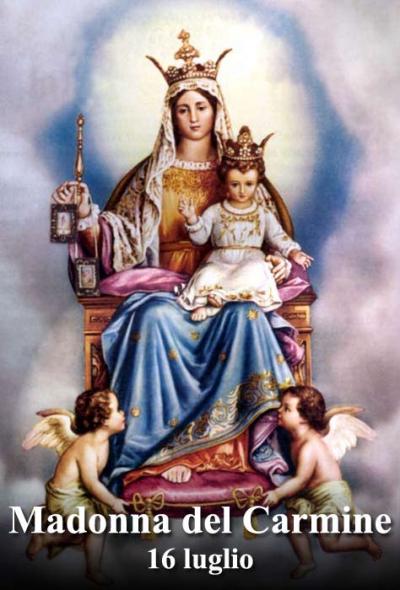
Our Lady of Mount Carmel, who promises salvation to anyone who becomes "his"

Image results for The Virgin of CarmelOf Cristina Siccardi

Il 16 July a very important Marian feast occurs in the Tradition of the Church: Our Lady of Mount Carmel, one of the oldest and most loved devotions in Christianity, linked to the history and spiritual values ​​of the Order of Friars of the Blessed Virgin Mary of Mount Carmel (Carmelites). The liturgical feast was established to commemorate the apparition of 16 July 1251 a san Simone Stock, at the time prior general of the Carmelite order, during which Our Lady gave him a scapular (from Latin scapula, shoulder) in fabric, revealing to him notable privileges connected to his cult.
In the First Book of Kings of the Old Testament it is said that the prophet Elijah, who gathered a community of men right on Mount Carmel (in Aramaic «garden»), he worked in defense of the purity of faith in God, winning a challenge against the priests of the god Baal. Who, afterwards, Christian monastic communities were established. The Crusaders, in the 11th century, they found some religious people in this place, probably of Maronite rite, who called themselves heirs of the disciples of the prophet Elijah and followed the rule of Saint Basil. In the 1154 the French nobleman Bertoldo retreated to the mountain around this time, arrived in Palestine with his cousin Aimerio from Limoges, patriarch of Antioch, and it was decided to reunite the hermits for cenobitic life. The religious built a small church in the middle of their cells, dedicating it to the Virgin and took the name of Brothers of Santa Maria del Monte Carmelo. Carmel acquired, in this way, its two characterizing elements: the reference to Elijah and the link to the Holy Mary. Read More

Share

Francesco, Marcello Veneziani accuses: "Più figlio della globalizzazione che della Chiesa"

Image results for Bergoglio hereticE’ Seplenist, but some of his observations make us think. Let us therefore ignore the attribution of Catholic terms to the conciliars (N.d.r.)
http://www.liberoquotidiano.it/news/sfoglio/13317619/papa-francesco-marcello-veneziani-figlio-globalizzazione-piu-che-della-chiesa.html
On the occasion of the first 5 years of pontificate of Pope Francis, The weather produces a special issue with a front page almost entirely dedicated to Bergoglio. Many comments on the Pontiff and his work, including that of Marcello Veneziani, “A vicar for three crises”. The editorialist clearly speaks of “radical turning point“, but it does so in critical terms. And he writes: “He is a Pope perceived as a son of his time rather than of the Church, son of globalization rather than tradition". And again: “A Pope open to the most distant, who loves the most remote neighbor, open to Muslims before Christians, to Protestants before Catholics, to the poor more than to the faithful, to individuals - even gays - more than to families".
Heavy words, In short, and Veneziani notes how “all this has been ennobled as a return to early Christianity“. In his analysis, the editorialist recalls how "once the Pope did not want to criticize some behaviors until yesterday considered deplorable by the Church, taking refuge behind Christian humility: Who am I to judge. One would have to answer him: you are a Pope, that is, a Holy Father, and you have not only the right but the duty to judge, to orient, to exhort and condemn. Otherwise – warns Veneziani – you are failing in your pastoral role, to your evangelical mission". Read More

Share