Comparison between the Catholic Church and the false conciliar Church

Of Father Maria Romualdo Lafitte
TRUE CATHOLIC CHURCH FALSE CHURCH OF BERGOGLIO
Dal 0 until 1958, Dal 1958 until now Our Lord until Pius XII 6 Antipapi: and “John XXIII” a “Francis I”
 
Image results for Pius XII
Rosario: 15 mystery 20 mystery
Sodomy: Unnatural abomination, 1 of the 4 sins that cry out No more
vengeance before God (Catechism of Saint Pius)
Onanismo, contraception, masturbation : Against nature No more
6o / 9a cdti: fornication (pre-marital reports), adultery: mortal sins No more
Priests celibates, unmarried Now they can Read More

Share

St. Thomas: it is demonstrated by nature that all power comes from God

The care of Di Pietro Carlo
PRINCIPAL OF THE GOVERNMENT
• As the book of Proverbs says: «The king's heart is in the hands of God; to everything he wants, He bends it". And the famous great monarch of the East also confesses this, Ciro, King of the Persians, with a public edict. In fact after defeating Babylon, which he had razed to the ground, as the story goes, said these words, as appears at the beginning of the Book of Ezra: «Thus says Cyrus, King of the Persians: – The Lord, the God of heaven, he has given me all the kingdoms of the earth". From this it is evident that all dominion comes from God as from the first lord: something that can be demonstrated, as Aristotle mentions, through three ways, that is, considering it as an entity, as an engine, as an end.
• Under the aspect of an entity: because all the individual entities must be traced back to the first entity, as at the beginning of every entity, just as all heat must be traced back to the heat of fire, according to Aristotle's explanations in the second book of the Metaphysics. So, for the same reason that every entity depends on the first entity, dominion will also depend on him; since it is based on being; and on an even more noble entity, How much, to dominate over men of equal nature, a man is placed before them. But from this one must not draw reason to be proud, but rather to govern his people with humanity, as Seneca says in a letter to Lucilius. This is why it is written in Ecclesiasticus: «They made you boss? Don't show pride: be among them as one of them". Therefore, as every entity depends on the first entity, which is the primary cause, so also every dominion of the creature depends on God as the first dominant and first being.
• Moreover: every plurality proceeds from the one, and is measured with unity, as the tenth book of Aristotle's First Philosophy teaches; therefore in the same way the plurality of dominants also originates from a single dominant, which is God. Precisely as in the royal court we find the respective superintendents for the various tasks, but they all depend on one, that is, by the king. Therefore Aristotle in the twelfth book of First Philosophy says that «God, that is, the first cause, he is to the entire universe as the commander, on which all the multiplicity of camps depends, it's up to the army". Therefore Moses in Exodus also calls God the leader of the people: «In your mercy – dice – you made yourself leader of the people you liberated". Therefore every dominion originates from God. Read More

Share

Bergoglio, the conciliars and the shame of tradition

Of Matthew Castagna

Per traditionalist part, now reduced to those (clergy and lay people) who do not recognize the “conciliar hierarchy” as legitimate, there is a certain reluctance to the loud objection of Bergoglio, compared to its predecessors, because it might seem that the crisis and problems arise with him, almost getting the result of “absolve” everyone else, as a consequence.
I believe that it is not wrong to consider it limited to attack only the Argentine chemical expert for his bizarre or heretical expressions, because whoever wants (and must) having an overall vision must begin the overview of what happened at an ecclesial level and therefore, harshly criticize documents and people, at least since the Second Vatican Council (1962-1965). Announced by Roncalli, continued and finished by Montini, this meeting laid the foundations for a genetic mutation, on the human level, of the official Church. Not being able to, but, It transforms but is handed down, as the Mystical Body of Christ is only in continuity with Its Founder, we are forced to believe that the Vatican 2 was not a Council of the Roman Catholic Apostolic Church, as much as a Council of the “Counter-Church”, composed of fallen clerics, infiltrated by liberal and social-communist ideology, theologically modernists (“modernism is the synthesis of all heresies” – Saint Pius X). Prepared for some time in the lodges, found fertile ground in Roncalli, While His Holiness Pius XII he refused to call it, since he had grasped the seditious will of the so-called innovators. All of Pope Pacelli's predecessors had, moreover, energetically rejected the embrace of modernity, understood as the adaptation to sins against God and against others, always condemned, but passed off as mercy and charity (sic!). Read More

Share

Of Calumny and Judgment

Image results for slander and judgmentThe first, commendable contribution of one of our new militants
Of Luca Sbroffoni
Don Carlo Tommaso Dragone (Requiem…) -in “Explanation of the Catechism of Saint Pius. For catechists”, CLS-, offers us a definition of some bad actions that unfortunately reign supreme in society (media, politics, ecc.) and also in the “traditionalist” microcosm, certainly favored by a reckless use of social media, in which everyone, behind a keyboard, he can undisturbed attack everything and everyone, condemn, judge, without a minimum of fraternal Christian charity.
So let's see what Father Dragone tells us about it: “It is a sin of slander when you attribute to others faults or defects that they do not have, or the ones he has are exaggerated... Slander is a serious fault when he falsely attributes serious faults to others, or even light but which cause serious damage…
Deduction -Father Dragone continues- “means to deduct, take something away from your neighbor's good name, revealing real flaws and shortcomings, without necessity; the deduction is also called murmur. When untrue sins and defects are attributed to others, there is slander; when real sins and defects are attributed to absent people, there is deduction or murmuring; when finally a sin or defect is accused of a person present, there is contumelia. The deduction that unnecessarily spreads knowledge of serious faults, it is a grave sin; if of light sins, it's venial. It is permissible to express the evil of others when there is a just reason, how to avoid damage to third parties… Read More

Share

Our Lady of Mount Carmel, who promises salvation to anyone who becomes "his"

Image results for The Virgin of CarmelOf Cristina Siccardi

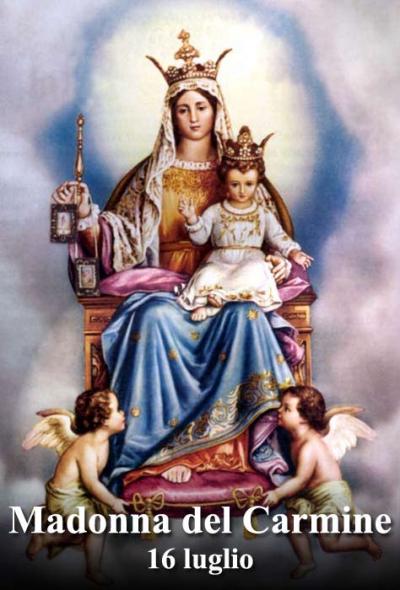
Il 16 July a very important Marian feast occurs in the Tradition of the Church: Our Lady of Mount Carmel, one of the oldest and most loved devotions in Christianity, linked to the history and spiritual values ​​of the Order of Friars of the Blessed Virgin Mary of Mount Carmel (Carmelites). The liturgical feast was established to commemorate the apparition of 16 July 1251 a san Simone Stock, at the time prior general of the Carmelite order, during which Our Lady gave him a scapular (from Latin scapula, shoulder) in fabric, revealing to him notable privileges connected to his cult.
In the First Book of Kings of the Old Testament it is said that the prophet Elijah, who gathered a community of men right on Mount Carmel (in Aramaic «garden»), he worked in defense of the purity of faith in God, winning a challenge against the priests of the god Baal. Who, afterwards, Christian monastic communities were established. The Crusaders, in the 11th century, they found some religious people in this place, probably of Maronite rite, who called themselves heirs of the disciples of the prophet Elijah and followed the rule of Saint Basil. In the 1154 the French nobleman Bertoldo retreated to the mountain around this time, arrived in Palestine with his cousin Aimerio from Limoges, patriarch of Antioch, and it was decided to reunite the hermits for cenobitic life. The religious built a small church in the middle of their cells, dedicating it to the Virgin and took the name of Brothers of Santa Maria del Monte Carmelo. Carmel acquired, in this way, its two characterizing elements: the reference to Elijah and the link to the Holy Mary. Read More

Share

Hope, the little girl holding hands…

Of Danilo Quinto
It's not suitable, both for its length, both for his intentions, to those who are in a hurry.

image

"Gentleman, there you are, you are enough for me". This is what he who has faith says in the face of humiliation, to discouragements, to suffering, to injustices, to the defeats he suffers on his earthly journey.
When the man who has faith feels prostrate and experiences a struggle that is unbearable for him - even humbly turning to God to ask Him for help and support – precisely then he exercises faith. In the deepest depths of his life, man's response to this state of prostration can rend and open Heaven. Make it strong against any kind of earthly event that occurs.
Jesus expresses this reality of our life with the image of “narrow door”. Dice (Lu, 13, 24): “Strive to enter through the narrow door, because many, I tell you, they will try to enter it, but they won't succeed". Read More

Share

Of the feast of Saints Peter and Paul


On the feast day of these great Saints of the Catholic Church we inform you that the site will suspend updates until Sunday 15 July 2018 for some maintenance work. However, the site remains accessible in its entirety.
Major Catechism of Saint Pius, and in particular of Saints Peter and Paul.
194 D. Who were the Apostles?
R. The Apostles were disciples of Jesus Christ chosen by Him to be witnesses of his preaching and his miracles, custodians of his doctrine, invested with his authority, and sent to proclaim the Gospel to all people.
195 D. What was the fruit of the Apostles' preaching?
R. The fruit of the Apostles' preaching was the destruction of idolatry, and the establishment of the Christian religion.
196 D. By what means did the Apostles induce the nations to embrace the Christian religion?
R. The Apostles induced the nations to embrace the Christian religion by confirming the divinity of the doctrine they preached with the power of miracles, with the sanctity of life, and finally with constancy in suffering, and by giving his life itself for it.
197 D. Because the feast of Saints Peter and Paul is celebrated with greater solemnity?
R. The feast of Saints Peter and Paul is celebrated with greater solemnity, because they are the princes of the Apostles.
198 D. Why Saints Peter and Paul are called princes of the Apostles?
R. Saints Peter and Paul are called princes of the Apostles, because S. Peter was specially elected by Jesus Christ as head of the Apostles and of the whole Church, e S. Paul worked harder than anyone to preach the Gospel and convert the Gentiles.
199 D. Where he had S. Peter his seat?
R. S. Peter first had his seat in Antioch, then he moved it and settled it in Rome, then capital of the Roman Empire, and in Rome he ended the long and painful travails of his apostolate with a glorious martyrdom. Read More

Share

I 150 years of the Basilica of Mary Help of Christians


Reporting of Federici Studies Center

Exactly one hundred and fifty years ago
9 June 1868: solemn consecration of the church of Mary Help of Christians
Preparations for the party
In mid-March Archbishop Riccardi set the consecration of the church for the first fortnight of June. Everything was now ready: the two bell towers of the facade surmounted by two archangels, the large golden statue on the dome already blessed by the archbishop, the five marble altars with their respective paintings, including the wonderful one of Mary Help of Christians with the child in her arms, surrounded by angels, apostles, evangelists, in a riot of light and colours.
An exceptional plan for preparation was then triggered. First of all it was a question of finding the consecrating bishop; then to contact various bishops for the solemn celebrations in the morning and evening of each day of the octave; also to issue personal invitations to dozens of illustrious benefactors, priests and lay people from all over Italy, many of which should be worthily hosted at home; finally to prepare hundreds of young people both to solemnize the pontifical and liturgical ceremonies with songs, and to participate in academies, games, parades, moments of joy and happiness.

Read More

Share
1 11 12 13 14 15 16 17 20