blob:https://gloria.tv/20d0dda3-e390-41f2-b00a-af0868db114e In truth it is the “Our Age” of the Second Vatican Council which lays the doctrinal foundations to equalize the one Way, Truth and Life (Jesus Christ) with the error (heresies, other religions, other philosophies, nihilistic ideologies etc.). This equalization has edified, over the years, the new ecumenist Church, conciliar cosmopolitan, which is not Catholic because it contradicts the Trinitarian Dogma, precisely by putting him on the same level as Allah, Yahweh, Luther and company. So Bergoglio is only the latest (for now) of the apostates occupying the Throne of St. Peter, the dioceses and parishes. Before him, we get to Roncalli. THE PASSION OF PERPETUA AND HAPPINESS
Bergoglio should be deeply ashamed when reading the few lines that follow: these two young women could have very easily saved themselves for what the judge considered a mere formality: incense idols. Instead Bergoglio incenses and honors idols exclusively for his own vainglory! Read More
It is an apocryphal text attributable to the Spiritual heretics or Fraticelli of the Middle Ages. Cf Membership no. 49, April 1999, pp. 65-67. Therefore it has no reliability on a Catholic level. While on a historical level it is an interesting observation. The clarification, arrived from Don Francesco Ricossa, which we thank, is also useful at the source “Gloria.tv”
Reporting of Luciano Gallina “Our Lord Jesus Christ will send them not a worthy shepherd, but an exterminator".
After summoning his brothers shortly before his death (1226), Francis warned of future tribulations, saying: “Brothers, act with strength and firmness while waiting for the Lord. A period of great tribulations and afflictions in which great temporal and spiritual dangers and embarrassments will occur; the charity of many will grow cold and the iniquity of the wicked will abound. The power of the demons will be greater than usual, the immaculate purity of our religious community and others will have withered to the point that very few Christians will want to obey the true Supreme Pontiff and the Roman Church with a sincere heart and perfect charity.
“At the decisive moment of this crisis, a non-canonically elected character, elevated to the papal throne, he will do his best to wisely dispense the deadly poison of his error to many. Read More
Pope Leo XIII in I have learned enough he states: Jesus Christ established in the Church a "vivo, authentic and perennial teaching”, which he himself strengthened with his power, he informed of the spirit of truth and authenticated with miracles; and he wanted and commanded that the precepts of his doctrine should be received as his own. Therefore every time this magisterium declares that this or that dogma is contained in the body of divinely revealed doctrine, everyone must take it as true, so long as, if it could be fake, it would follow that God himself would be the author of man's error, which is repugnant: “O Lord, if there is an error, we were deceived by you” [Richard of St. Victor, By Trin., lib. I, cap. 2]. So, every reason to doubt has been removed, who will ever be allowed to repudiate even one of these truths, without his falling into heresy and without that, being separated from the Church, rejects all Christian doctrine on the whole? Indeed, such is the nature of faith that nothing is so repugnant to it as admitting one dogma and repudiating another. In fact, the Church openly declares that faith is a "supernatural virtue, with which, inspired and helped by the grace of God, we believe that the things he revealed are true, not for the intrinsic truth of the same known with the natural light of reason, but by the authority of the revealing God himself, who cannot deceive or be deceived” [Conc. Vat., sess. III, cap. 3]. Therefore, if a truth is known to have been revealed by God, and yet it is not believed, it follows that nothing at all is believed by divine faith. In fact, what James the Apostle sentences regarding the crime in matters of morals, must assert itself about an erroneous opinion on matters of faith: “Anyone will have missed only one point, he was guilty of all”. On the contrary, with greater reason it must be said of this than of that. Indeed, less properly the whole law is said to have been violated by one who transgressed it in one thing alone, not being able to see themselves in him, if not by interpreting its will, a contempt for the majesty of God the legislator. Instead he who, even in just one point, disagrees with revealed truths, he has completely lost his faith, as it refuses to venerate God as the supreme truth and proper reason for faith; therefore Augustine says: “In many things they agree with me, in some few no; but for those few things in which they do not agree with me, The many things in which they agree with me are of no use to them”[S. Augustine, In Psal. LIV, n. 19]. And with reason; because those who take from the Christian doctrine what they like, they are based not on faith, but on one's own judgement: and not "bringing all one's intellect back to obedience to Christ”(1Cor 10,5), they obey themselves more properly than God. “Oh, said Augustine, that you believe what you want in the Gospel, and don't believe what you don't want, believe yourselves rather than the Gospel” [S. Augustine, lib. XVII, Against Faustus the Manichean, cap. 3]. End of quote.
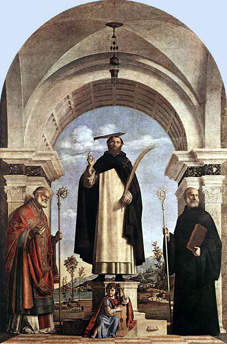
It was the 2012 when, After 5 years of tireless and varied battles, almost daily, the traditionalist Catholics of Verona managed to free the church and birthplace of the co-patron saint from the Lutherans. We remember it as one of the battles won by the Saint, for the constancy and dedication in Faith and Action of many of us. Since then, the church remained closed until it was granted to a tourism promotion association. SAINT PETER THE MARTYR, INQUISITOR KILLED BY HERETICS SEVESO 1252, DEATH OF AN INQUISITOR
(Article by Massimo Trifirò, from La Padania del 29 August 2004) The dramatic story of the ambush of the Venetian Dominican friar Pietro Rosini carried out in Brianza by some Lombard heretics 1. THE DOMINICAN Pietro Rosini, the Dominican who would later be martyred and quickly elevated to the honors of the altars, came into the world in Verona on an unspecified day in 1206. His family, like others of some influence in the northern territories of the Peninsula, belonged, even if he didn't show blatant evidence of it, to the Cathar sect, a Manichean, specifically indicated by the name of Patarini, or to one of the most widespread Christian heretical forms in those years. It therefore appears paradoxical, or perhaps determined by a superior will, that the subsequent unraveling of his existence then took place in the name of the most rigid Catholic orthodoxy, and that even Pietro later became a champion, a staunch defender, someone who paid for his firm religious beliefs with his life. Read More
Of Luciano Gallina (“Dr. S.L.”: copyrighted title and we won't reveal why) AFTER ALL, IT CAN’ READ THE ARTICLE TO WHICH THE LETTER REFERS Open Letter
Director of Treviso People's Life
Bishop of Treviso
Treviso 23-04-2018 Anno LIII E. 157 TO WHOM IT BENEFITS?
Let's play with our cards exposed.
Sinning of presumption, I am known and disliked by the Curia and the Diocese of Treviso.
I am writing in reference to the article signed by Lucio Bonomo (SIC), on the Life of the People of 22-04-2118 Anno LIII E. CVII n°15. Article with headline on the front page: WITH FAITH AND RESPECT and title on third page: APPROACH WITH FAITH WITHOUT EXCESS OF ZEAL. I ask the question: To whom it is useful?Read More
We have long observed a clear support from the ecclesiastical hierarchy and from a large part of the Catholic world (conciliate, n.d.r.) to the idea of encouraging a reception of immigrants that is almost free of filters and rather broad and generalized. It should be noted, however, that this new attitude differs from what is traditionally proposed by the Social Doctrine of the Church, that is, a government of migration guided by the criterion of the common good. Consequence, Indeed, of this new attitude seems to be the replacement of the common good with the multi-religious society, seen as the goal of society. A welcome without filters and without the governance of the common good means that the resulting multi-religious society is good in itself., to the point that even Catholics should work for it rather than for the common good or for it as it coincides with the common good.
The question owes its interest to the fact that a new approach of this kind would entail a substantial revision of the Social Doctrine of the Church, its structure and foundations. I don't process intentions, and therefore I cannot say whether the purpose of this “opening” to the immigration phenomenon is precisely to change the Social Doctrine of the Church in some fundamental points, However, I cannot avoid an objective verification of this important question. Read More
Wrongly according to what someone instrumentally says, in an era of do-goodism and indiscriminate hospitality, San Zeno was not black, although some depictions represent him as such. Native to Northern Africa (hence the nickname “Moorish bishop”) he was not black in complexion. In the adjacent image, Indeed, you can see how it probably really was the image of the Patron Saint of Verona (n.d.r.)
The abbey church of San Zenone, o, as the Veronese say, of San Zeno Maggiore is one of the oldest and most glorious monuments in Verona. It often happens that on the body of a Martyr or a Saint, as if on particularly fertile soil, a large church sprouts or a slender bell tower is thrown back.
A Verona, the most beautiful Italian church of the Romanesque era flourished on the miraculous body of San Zenone, with the pink stone bud of the elegant bell tower. The life of Saint Zeno, Veronese saint, is shrouded in legend.
Zeno was born in Africa and lived around the 4th century. We don't know how or when, from the African sands, has reached the gentle hills on the banks of the Adige, driven by his apostolic vocation. In those times, Emperor Julian, said the Apostate, he sought to re-establish the cult of the pagan gods, fighting Christianity, denied by him. The first barbarian invaders of the Empire were Aryans, that is, heretical Christians, fiercely opposed to Catholicism.
There were therefore bad times for the Church and for the decimated flock of the faithful. But his preaching and his example were stronger than political impositions and sectarian opposition. The converted pagans, the reformed heretics, they were soon legion, and it could be said of Saint Zeno that "by preaching he led Verona to Baptism". Read More
A letter to the magistrate of the city of Turin of 18 April 1865 opens an interesting and unprecedented glimpse into the daily life of Valdocco at the time. We are perhaps accustomed to thinking that in Valdocco, with the presence of Don Bosco, things always went well, especially in the fifties and early sixties when the Salesian work had not yet spread and Don Bosco lived in direct and constant contact with the children. Instead later, with a large heterogeneous mass of young people, educators, apprentice craftsmen, young students, novices, students of philosophy and theology, evening school students, “external” workers, difficulties could have arisen in the disciplinary management of the Valdocco community.
A rather serious fact
A letter to the magistrate of the city of Turin of 18 April 1865 opens an interesting and unprecedented glimpse into the daily life of Valdocco at the time. We reproduce it and then comment on it.
Report Effedieffe Editions
CATHOLIC CLASSICS nr. 13 An essential tool for Catholic education
The magnificent Dictionary of Dogmatic Theology edited by Cardinal Pietro Parente and the great theologian Monsignor Antonio Piolanti, published in 1943 and which went through four editions, the last of which in 1957, is now reprinted by EFFEDIEFFE.
It is possible to define this work as a little miracle, a masterpiece of precision and synthesis of two thousand years of theology, history, dogmatic and moral contained in a very careful selection of hundreds of voices, ranging from the highest mysteries of Christianity to its most evident truths.
The soul of this Dictionary draws its infallible inspiration from Evangelical Wisdom, from that of the courageous Fathers, from the clear one, balanced and profound by San Tommaso (from which all the entries are inspired). Furthermore, it draws its strength from the infallible magisterium of the Church in its most representative Councils: Nicaea I (325), Constantinople I (381), Trento (1545-63), Vatican I (1869-70) and by the greatest Encyclicals of the Popes (in particular those of Pius IX, Leo XIII, Pius X, Pius XI to Pius XII).
The concentration of imperishable elements of human action under the impulse of Grace, expertly drawn up in this work, led to a result of exceptional value. Read More


 Watch and listen to the video carefully:


 Of Luciano Gallina (“Dr. S.L.”: copyrighted title and we won't reveal why)
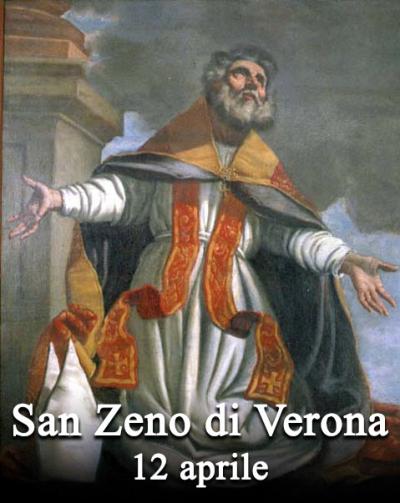 Wrongly according to what someone instrumentally says, in an era of do-goodism and indiscriminate hospitality, San Zeno was not black, although some depictions represent him as such. Native to Northern Africa (hence the nickname “Moorish bishop”) he was not black in complexion. In the adjacent image, Indeed, you can see how it probably really was the image of the Patron Saint of Verona (n.d.r.)
 Report Effedieffe Editions