

Of Lent
 Major Catechism of Saint Pius
35 D. Which is Lent?
R. Lent is a time of fasting and penance established by the Church by apostolic tradition.
36 D. For what purpose is Lent established??
R. Lent is established:
1. to make us aware of the obligation we have to do penance throughout our lives, of which, according to the Holy Fathers, Lent is the figure;
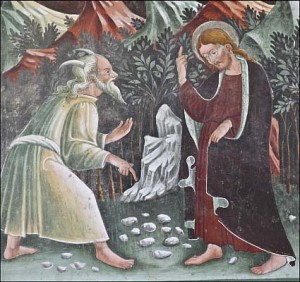
2. to imitate in some way the rigorous forty-day fast, that Jesus Christ did in the desert;
3. to prepare ourselves through penance to celebrate Easter in a holy way.
37 D. Because the first day of Lent is called Ash Day?
R. The first day of Lent is called Ash Day, because the Church places the sacred ashes on the heads of the faithful on that day.
38 D. Because the Church at the beginning of Lent uses to impose sacred ashes?
R. At the beginning of Lent, the Church uses to impose sacred ashes, so that we remember that we are composed of dust, and with death we must reduce ourselves to dust, we humble ourselves and do penance for our sins while we have time. Read More
R. Lent is a time of fasting and penance established by the Church by apostolic tradition.
36 D. For what purpose is Lent established??
R. Lent is established:
1. to make us aware of the obligation we have to do penance throughout our lives, of which, according to the Holy Fathers, Lent is the figure;
2. to imitate in some way the rigorous forty-day fast, that Jesus Christ did in the desert;
3. to prepare ourselves through penance to celebrate Easter in a holy way.
37 D. Because the first day of Lent is called Ash Day?
R. The first day of Lent is called Ash Day, because the Church places the sacred ashes on the heads of the faithful on that day.
38 D. Because the Church at the beginning of Lent uses to impose sacred ashes?
R. At the beginning of Lent, the Church uses to impose sacred ashes, so that we remember that we are composed of dust, and with death we must reduce ourselves to dust, we humble ourselves and do penance for our sins while we have time. Read More
 Giuseppe Federici Study Center – For a new onset
 Since the Constitution "Repent" of the 1966 of Paul VI and the "New Canon Law" of 1983 of John Paul II have no legal value, the discipline observed under the pontificate of Pius XII is still in force (according to the Canons 1250-1254 of the Benedictine canon law of the 1917, modified by the Decree from the S. Congregation of Rites of 16 September 1955 and from the S. Congregation Council of 25 July 1957).
 Giuseppe Federici Study Center – For a new onset
 Giuseppe Federici Study Center – For a new onset
 Giuseppe Federici Study Center – For a new onset
 It is a dogma of faith proclaimed by the Fourth Lateran Council under Innocent III that «The universal Church of the faithful is unique and outside of it absolutely no one can be saved». How on earth did Innocent III come up with being so rudely uninclusive, so blatantly biased, so obtusely certain that there is a true and a false, that good and evil exist and that he knows them? The concept that good and evil exist and how to actually establish them should be the ABC of any religion, without which you might as well just let it go. The pillar on which religion is based is called dogma, everything that is built on top of this initial pillar. Contrary to the new Church 2.0, all whipped cream and cotton candy, Christianity has an initial pillar which is made of granite, this pillar is the figure of Jesus Christ, which is not debatable and is not debatable and cannot be contradicted. Indeed Christianity, before being a religion, it was a historic event. Cristo, the third day, he was resurrected yes or no. If he has risen, we are right and the others are wrong, if he hasn't risen, the others are right and we are the ones who made the mistake. The fact that we can both be right about an event that either occurred or did not occur is contrary to the reality principle., which is a very cultured way of saying it's rubbish.
  Number Index 148 Give Up Hearts, 17 February 2019
 Major Catechism of Saint Pius, The sixtieth of the fiftieth
 • After these events (cfr.