Saint Philip Neri... a saint to understand how much Christianity is characterized by true joy

Saint Philip Neri is a particular saint. If you really want to choose an adjective, it can be said that his was a cheerful sanctity; in the sense that it was a holiness marked by the desire to highlight how Christian life is capable of giving true joy. Philip Neri (“Pippo bono” for friends) it was brilliant, witty, he always had a ready and biting joke (like a good Tuscan) and so much goodness, understanding and availability. “Retreat, Gentleman, retreat. Hold back the wave of your grace” he said when his heart was full of happiness and gratitude. At the same time he prayed to the Lord to keep his hand on his head."…otherwise – he used to say- Filippo, without your help, he does some of his own.”
Holiness as a providential sign
The sanctity of Saint Philip is a providential sign in a time in which Catholicism had to respond to the sad Lutheran atmospheres. It must be remembered, Indeed, that the Protestant theory of justification , as a simple attestation from God but not as a real and substantial event in the human soul, it entailed an admittedly pessimistic perspective in the theology of the Reformation, distressing and sad. More simply - according to Protestantism- God would not recognize it as true justification of the sinner, but he would pretend that it is so even if it is not; instead in Catholicism the justification it is real and substantial.
But let's go back to Saint Philip Neri. He was born in Florence in 1515. Son of a notary, He was soon orphaned by his mother; ma, despite this, he had a peaceful childhood, facilitated by his cheerful temperament. He studied music and poetry and was very sensitive to beauty, especially that of nature.
At eighteen he was sent to Cassino, from a merchant uncle to learn the trade. However, in the Lazio town he was immediately attracted by the majestic abbey and felt a strong push towards religious life, but the Lord did not want him to be a monk. Read More

Share

Video of the conference: "Christianity, Judaism, Islam”

Reporting of Federici Studies Center
Giuseppe Federici Study Center – For a new onset
Video of the conference: "Christianity, Judaism, Islam”
Modena, 26/01/2019, conference by Don Francesco Ricossa: "Christianity, Judaism, Islam” (organized by “Virtute e Canoscenza”): https://youtu.be/UwvpL2hPVh0
Share

J. M. Bergoglio and sexual education


Il 28 January 2019, during the plane ride back from “World Youth Day” (WYD) held in Panama, J.M. Bergoglio, as is now his habit, gave a pearl of his usual interviews. Answering journalists' questions, he talked about “sex” and sexual education. Evidently these words of Bergoglio do not claim to be the expression of a solemn and infallible magisterium; however, they express his thoughts expressed in his typical way of approaching delicate issues, which should be addressed with extreme care and competence, but which instead are presented with an irreverent naturalness and summarized in a few words. He expresses himself rather as a private doctor, but in the collective imagination his words are still perceived as words of the Pope and perhaps have much more influence than many official documents since "the Pope said it" "so it can be done... so there is nothing wrong...".
The purpose of this article is to compare the words of "Francis" with the Orthodox teaching of the "pre-conciliar" Popes, and make some simple reflections.
Read More

Share

Traditionalists without Tradition

Scan-copy-678x381by Don Ugo Carandino

Giuseppe Federici Study Center – For a new onset
Press release no. 10/19 of the 4 February 2019, Saint Andrew Corsini

Traditionalists without Tradition
Opportune Importune editorial (information letter from the Casa San Pio) n. 35
In this period I am reading the life of Saint Joan Antide Thouret (1765-1826), written by Msgr. Francois A little. The religious saint, founder of the Sisters of Charity (congregation that was appreciated by anti-liberal rulers such as Carlo Felice of Savoy and Francis IV of Modena) and canonized by Pius XI, lived through the tragedy of the French Revolution. Thanks to the happy pen of Msgr. A little, the reader can grasp all aspects of the drama that shocked the life of the Church and society in that period. What is most striking is the firmness with which almost all the faithful deserted the masses of the constitutional clergy (who had sworn allegiance to the schismatic "Civil Constitution of the Clergy") and turned, at the risk of his life, to clandestine masses celebrated in the woods, in the cellars or stables by the "refractory" priests (who refused the oath imposed by the revolutionaries). Read More
Share

Six out of seven!

Giuseppe Federici Study Center – For a new onset
Six out of seven!
E’ the reprint of the monumental is almost finished “Social History of the Church” of Msgr. Umberto Benigni edited by the Centro Librario Sodalitium: the tome was printed 2 del volume 4.
Source: http://www.centrostudifederici.org/sei-su-sette/
Share

Don Bosco and the Waldensian sect

Giuseppe Federici Study Center – For a new onset
Press release no. 9/19 of the 31 January 2019, St. John Bosco
Don Bosco and the Waldensian sect
“Biographical Memoirs of Don Giovanni Bosco”, Vol IV, ed. 1904 – Capo XXX. Apostasy – Sermon on the Virginity of the Most Holy Mary. – Zeal and charity of D. Forest for those deceived by heretics – Disputes with the partisans of’ Valdesi and co’ their ministers – A wicked sermon; the eagle and the fox – Constructions of’ Waldensians around their temple.
The WALDESIANS continued to spread their errors among the people through words and the press, giving away 80 lire to those who allowed themselves to be ascribed to their sect. Some of the young people from the festive Oratories, which had caused serious displeasure to D. Bosco, and in certain matters they had sided against him, they had allowed themselves to be led into apostasy, accepting that vile coin. The consequence was therefore that their hatred sought to be vented against their former companions, from whom their conscience warned them that from now on they would be considered renegades. One evening Tomatis came home around 9 ore. Passing near the Consolata church, descended towards the Oratory, when he notices that two individuals are chasing him. Fearful, he quickens his pace, and they too. He runs and can enter the courtyard and close the door in time, because if he had delayed an instant they would have caught up with him. He immediately went to tell the story [347] a D. Bosco, who arranged for some precautions to protect the safety of the community.

Read More

Share

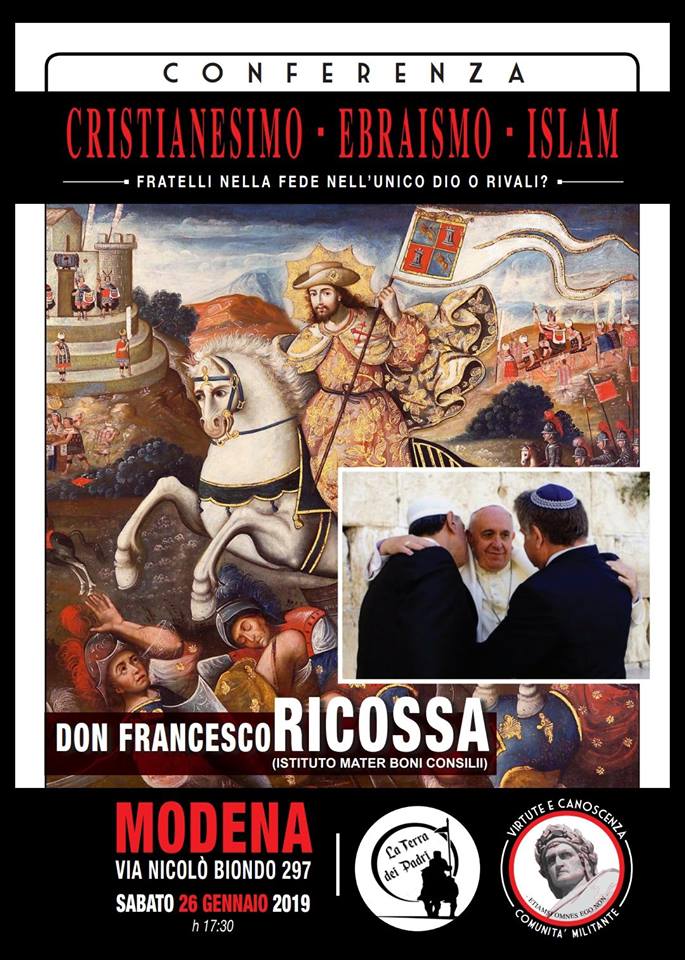
Conference in Modena on Christianity, Judaism, Islam

Giuseppe Federici Study Center – For a new onset49072186_2285042858445190_8826460459625349120_n
Conference in Modena on Christianity, Judaism, Islam
Saturday 26 January 2019 at hours 17,30 “Virtute e canoscenza” organizes in Modena, in via Nicolò Biondo 297, the conference "Christianity, Judaism, Islam. Brothers in the one God or rivals?”. Speaker: Don Francesco Ricossa.
Previous conferences:
“Freemasonry”, Bologna, 3/12/2016: https://youtu.be/p989hYtG83o
“Of that Rome where Christ is Roman. Rome and the pagans in the Holy Scriptures", Bologna, 2/12/2017: https://youtu.be/Y6omUx9FAuk
source – http://www.centrostudifederici.org/conferenza-modena-sul-cristianesimo-ebraismo-islam/

Share

The voice of the Church on mystical-sensual literature

Giuseppe Federici Study Center – For a new onset

Press release no. 5/19 of the 17 January 2019, Saint Anthony the Abbot
The voice of the Church on mystical-sensual literature
Sodalitium note: We publish the full text of the Instruction of the Holy Office "Inter mala" of 3 maggio 1927, on “sensual and mystical-sensual literature”. As demonstrated by Jean-Baptiste Amadieu's study (https://halshs.archives-ouvertes.fr/halshs-01315561/document), the mystical-sensual literary current in question is that of Decadentism (in this case French-speaking) e del più recente “Catholic Renewal”, and the authors examined, following a complaint since 1917 by the Nice lawyer Raymond Hubert (close to the priest Emmanuel Barbier and father Charles Maignen, del Sodalitium Pianum) I am, among others: Baudelaire, Verlaine, Rimbaud, Huysmans, Barbey d’Aurevilly, Léon Bloy and Charles Péguy among the deceased, Psychologist, Montier, Claudel, Vallery-Radot, Baumann,Bourget, Bernanos, Vaussard, James, and Mauriac among the living. The text of the Instruction will be published in a possible new edition of the book "The shame of tradition", published by our Library Center.

Read More

Share
1 6 7 8 9 10 11 12 20