Radical right and bourgeois mythology of the Risorgimento
Image results for Mussolini Counter-revolutionaryTHE ANALYSIS
Of Thomas of Torquemada
For several years, driven by the new revival of an alleged Italian nationalism with positivist roots, secularist and Masonic, certain Italian radical right has embraced the Risorgimento mythology. Practically, the same mythology that is at the basis of the anti-fascist state that, from the foundation of the republic to today, dominates unchallenged with the inevitable blessing of the subversive neo-Church, fruit of the conciliar storm of the Montini operation.
Now we are not interested in disclosing information again, data, statistics on the genocide in Southern Italy and on the Masonic-bourgeois revolution called Risorgimento; the interested reader can consult the texts of the Neapolitan essayist Luigi Di Fiore (largely published by UTET), those of the historical Elena Bianchini Braglia, She is also the author of an excellent monograph on Donna Rachele, the texts of Mattogno on the bourgeois revolution in Italy or the fundamental essay “Il Genocide: the conquest of the Kingdom of the Two Sicilies, mystification, the pain of memory, memory after oblivion” by Stefano Pellicanò, Calzone Publisher, Crotone. We do not consider it necessary to rehabilitate pre-unification history; we are not clericalists, we are not reactionaries nor ridiculous nostalgic commemorators in eighteenth-century uniforms of a finite past, that will never come back. We are and will be Italians and counter-revolutionary comrades, as Romans, Catholics and Mediterraneans. It does not exist nor has it ever existed, nor can it exist, another Italy that does not have Rome as the sacred center of the West and axis of the world. Read More

Share

Tyranny at Nuremberg

Report Arianna Publishing
Of Paul Craig Roberts – 14/01/2018
Tyranny at Nuremberg
Source: Like Don Quixote
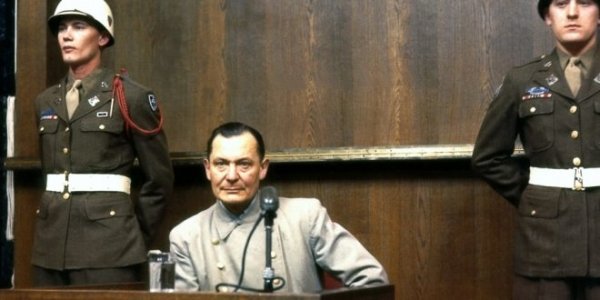
The mock trial in Nuremberg against a somewhat arbitrary group of 21 surviving Nazis in 1945-46 it was a spectacle orchestrated by U.S. Supreme Court Justice Robert Jackson, who was the chief prosecutor. Because I have long been an admirer of Jackson, I always thought he did a good job.
My admiration for Jackson comes from his defense of the law as a shield of the People rather than a weapon in the hands of the government and his support for the legal principle known as “Mens Rea”; or a crime (to be considered as such-N.d.T.) requires voluntariness. I often quote Jackson for his defense of these legal principles which are the very foundation of freedom. In fact I mentioned Jackson in my recent chronicle of 31 July. His defense of law as a check on government powers plays a central role in the book I wrote with Lawrence Stratton, “The tyranny of good intentions”. Read More

Share

A 130 years after the death of the general. Chancellor

Reporting of Federici Studies Center

Il 6 January 1888 the general died. Hermann Chancellor, supreme commander of the papal army from 1865 al 1870. We remember the 130th anniversary of the general's death with the voice ofCatholic Encyclopedia dedicated to Kanzler, edited by Paolo Dalla Torre (1910 – 1993), son of Joseph (director of the Osservatore Romano since 1920 al 1960) and author of “The year of Mentana. Contribution to a history of the Papal State in 1867", published in 1938 and seized by the government of the time because it was in contrast with the holographic historiography of the Risorgimento.
The text of the Catholic Encyclopedia highlights the profound admiration and gratitude that every Catholic should have for the general, who was very faithful to Pope King Pius IX and who consecrated his life to the defense and service of papal Rome. In particular, Dalla Torre defends Kanzler's actions in the excited hours of 20 September 1870, responding to criticism from detractors (of yesterday and today). The text is integrated with some information taken from "The Kanzler-Vannutelli papers of the Vatican Archives" (Vatican City, Vatican Secret Archive, 2013), which we have inserted in brackets.

Read More

Share

Zionism in Italy and in fascist foreign policy

Report Ar editions

Spinelli, Livy
Borghese's books, 2013
This essay collects a set of memories on the life of Italian Jews during the fascist regime; on Mussolini's policy towards the Israeli communities; about Jabotinsky's Judeo-fascist supporters. Among the anecdotes narrated by Spinelli is that of Colonel Liuzzi, among the organizers of the impressive parades in honor of the Fuhrer 6 maggio 1938; a few months later, Liuzzi himself was dismissed for racial reasons, as a Jew. Nevertheless, he was one of the many Italian Jews who believed in Fascism, openly favorable to the Duce, who supported his adventure from the beginning. Indeed, that 23 March 1919, in Milan, the founding ceremony of the Fasci di Combattimento was held in a small room in Piazza San Sepolcro, made available to Mussolini by Cesare Goldman, Jewish financier and politician. The author remembers the exponents of Judaism close to the Duce, like Margherita Sarfatti, your lover, co-editor of the magazineHierarchy and author of Dux, the first biography of Mussolini, which contributed to magnifying Fascism abroad. It is remembered Maritime School for young Jews of Civitavecchia, born in 1934 from the agreement between the Italian State and the followers of Jabotinsky; first nucleus of the modern Israeli Navy, arisen therefore, with the 'blessing' of the Duce.
176 pages, 16 € FOR ORDERS: info@libreriaar.com Read More

Share
1 7 8 9 10