Verona, Bacciga: "E se fosse stato un errore?"

Today, on September 8th 1943, not everyone betrayed their homeland.

of the City Councilor of Verona, Lawyer. Andrea Bacciga
In Piazza Viviani there is a commemorative plaque of the battle in the Post Office building which took place on 9 September 1943.
In data 9.10.2000 the Verona newspaper "L'Arena" reported a letter from the journalist Sergio Stancanelli , reporting that “the so-called battle in the Post Office in which they allegedly took part 50 young people... it never took place" and "it is the result of pure imagination"
Theyig. Stancanelli had written that: “The reason why we didn't know about them wasn't just their personal details, but it wasn't even known where the bodies had ended up , lay in the fact that the fight had never happened and that the six heroes had never existed."
For this reason Stancanelli was sued for defamation, but he was acquitted with the formula of "no place to proceed", with sentence issued on 6 maggio 2004 by the Court of Verona, and the costs of the proceedings were borne by the injured party
Stancanelli himself wrote: "the defendant was spontaneously joined by various testimonies from people who attested that absolutely nothing had happened that day in the Post Office square. Among the many I want to mention that of a colleague who at the time was a delivery boy at a law firm and who that day was responsible for sending registered letters,he went to the central post office, dove, he testified, everything was quiet and the offices functioned regularly”.
The undersigned Councilor on 3 September 2018 has requested access to the documents to the Council Secretariat, requesting vision and copies of all the documentation relating to this plaque.
However, receiving negative feedback, or that there is no documentation in the following offices: demonstrations, monumental civil construction and plant engineering, service to citizens.
Today I filed a written question asking the competent Councilor, clarifications on the matter.
Excuse me, but what if it was a mistake, and it was discovered that there was never any battle of the Post Office building and never any death of "six unknowns" ,
in the absence of certain historical evidence demonstrating this event, it would perhaps not be permissible to remove this plaque?

Verona 6 September 2018
Read More

Share

In Prague the dear beloved Soviets

FIFTH COLUMN
Of Marcello Veneziani
Like today, in the night between 20 and the 21 August fifty years ago, Soviet tanks invaded Czechoslovakia and crushed the Prague Spring dream of freedom. They will talk about it adequately on TV and in the newspapers? They will also remember this shadowy side of '68? They will remember the infamy of those who defended them and took their side, as the Italian communists did? Or they'll say it's been too long now, and therefore we can talk about fascism and Nazism every day, dead 73 years ago, but we can no longer talk about communism, which is much more recent and present?
It should also be remembered that a part of the Italian communists dissociated themselves from the PCI and condemned the Russian invasion, as the Manifesto group did. But with a small detail: they did not dissent to embrace socialism with a human face but to pursue a much more inhuman socialism, the Chinese one, with Mao who with his cultural revolution was much bloodier than Stalin and Brezhnev. In a debate in a hall of the Chamber opened by Napolitano, a few years ago I remembered the silence of the PCI regarding the revolt, the contempt towards the insurgents and the silence of the party and L'Unità towards dissidents, come Jiri Pelikan, which was then "adopted" by Craxi's PSI. Fassino pointed out to me that, on the contrary, the PCI had supported Prime Minister Dubcek and socialism with a human face. Right, until Dubcek was in power, tolerated by the Soviet Union… But later, when the tanks arrived, and there was the revolt, an embarrassed silence fell and the orthodox thesis prevailed, supported precisely by the communist right of Amendola and Napolitano, that those who show solidarity with the insurgents are playing the usual lurking reaction game. The Italian communists aligned themselves with the Soviets, like in Budapest before, in '56, and to Gdańsk and Szczecin afterwards, in the '70s. Furthermore, we must not forget that until 1978 the funding for the PCI and L'Unità continued to come from the USSR, and the contributions from the Italian-Czechoslovak Association continued to arrive. That's how it was in '68, the Soviet tanks lost a few r and for the local communists they remained the dear beloved Soviets... Read More

Share

L'ultimo incursore

THE LAST RAID.

THE LAST RAID.

Farewell to the raider Emilio Bianchi, 103 years, last survivor of the Alessandria enterprise https://www.ilmessaggero.it/primopiano/cronaca/addio_incursore_emilio_bianchi_103_anni_superstite_impresa_alessandria_durand_de_la_penne-1196188.html Winston Churchill, as the Times recently recalled in one of its moving obits, he was so impressed by that feat of the Italian enemy in the port of Alexandria that he ordered the leaders of His Majesty's Navy to adopt as soon as possible the techniques and strategies of the adversaries among the ...
Read all.
 

Read More

Share

Ponti fascisti opere d'arte resistenti a tutto

Fascist bridges works of art resistant to everythingExamples of engineering and architecture that not even Anti-Fascism throws down
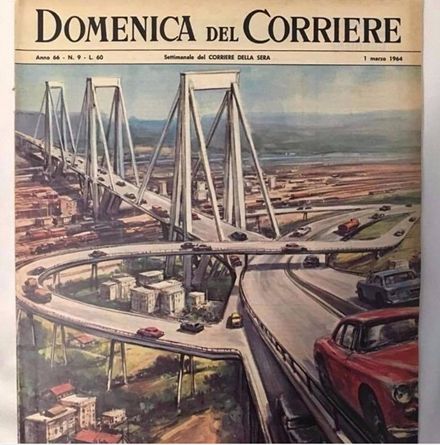
Of Angela Di Pietro
When He was there, not only did the trains arrive on time, but the bridges never came down and even today they resist everything, also two point zero for Anti-Fascism, all carelessness, to the absence of maintenance. For the bridges built in Italy during the twenty years of fascism, designed by eminent professionals of the time, the toponym “littorio” was frequently used, or “of the lictor”. The war conflict ended and the Republic was established, In the 1946, the viaducts lost the name "Littoria" and changed names (don't do it). Everyone. They were well made, they were resistant, but they were destined to oblivion because they were linked to the figure of the Duce.
One of the most important is without a doubt the littorio bridge in Venice, today known as the “Freedom Bridge”. The Brescia engineer Eugenio Giuseppe Miozzi was in charge of the design work, example of honesty and ability, who doesn't even have a registered street because men like him are considered "to be forgotten", like Mussolini. The most important work entrusted to him was that of the littorio bridge (today Liberty Bridge) which connects Venice with the mainland by car. A highway on water. The construction, long 22 meters, it was made of reinforced concrete and stone, from “Ferrobeton” with great rapidity, alone 18 months. The bridge was inaugurated in 1933 with the name of “Littorio bridge” by Umberto II of Savoy together with his wife Maria José of Belgium, Benito Mussolini was also present. Still in Veneto", in the municipality of Verona, there is the “Vittoria bridge. It was the 1925 when…

IF YOU WANT TO CONTINUE READING CLICK HERE Read More

Share

Anti-fascism and eco-monsters: who was Riccardo Morandi, the designer of the Genoa bridge

Image results for richard morandiOf Nicola Mattei
Genova, 15 ago – What unites the Corviale snake in Rome, an attempt that started badly and ended worse to build a public housing "barracks" in Soviet style bridge over the Polcevera collapsed yesterday? A name, that of engineer Riccardo Morandi.
Born in Rome in 1902, he began his activity in the 1930s by experimenting - among the first in Italy - with the use of reinforced concrete and pre-stressed reinforced concrete. At the beginning of his career he designed churches and cinemas, and then specialized in the construction of bridges.
The skills in the field of reinforced concrete they are worth the call to the team that will design and build the Corviale, where Morandi will work alongside the architect Mario Fiorentino. The result is dramatic: almost a kilometre (e 11 floors in height) of a real city dormitory on the outskirts of the capital where the building boom of those years created eco-monsters destined to last and produce devastating effects. Applied social engineering will result in failure, managing to replicate for the worse all the distortions imported from the total and totalitarian planning that was experimented in the same period in the Soviet Union.
An ideological aspect, the latter, which cannot be overlooked. We are in the Italy of the conflict (also armed), in which remaining helpless in the face of political opposition is almost impossible. E Morandi had made his choice: “His family – writes Repubblica on the occasion of his death, er he 25 December of 1989 – they remember him as a man who always made a point of defending his independence from all powers, starting with the fascist one of which he was an opponent".
Source: https://www.ilprimatonazionale.it/cronaca/antifascismo-ecomostri-chi-era-riccardo-morandi-91330/ Read More

Share

The anti-corporal law? Fascism did it in 1926. And Badoglio abolished it

The anti-corporal law? Fascism did it in 1926. And Badoglio abolished itOf Antonio Pannullo

Il "corporal" he is the figure of an illegal intermediary between landowners and unskilled labor. It is a plague that has always been present, and in Italy it has joined forces with organized crime, especially in the centre-south. The word "caporalato" has returned to the spotlight in recent days due to the incidents involving foreign seasonal workers in Puglia, ma è un male antico, a “liberal” evil. In the 2016 the Chamber approved the so-called anti-corporal law, which however evidently had no effect on the phenomenon, probably due to poor controls by the authorities. The magazine and blog Colonial Italy but, directed by Alberto Alpozzi, reminds us that the gangmaster was fought and defeated, like the rest of the mafia, from fascism, that in 1926 I passed the law 563, called "union law", perfected and modified until 1938 with other rules aimed at “balance the interests of employers with those of workers in an equitable manner by protecting, in any case, the superior interests of production". Colonial Italy, in the piece by Maria Giovanna Depalma, also remember that these revolutionary regulations, included in the fascist corporate and labor code, they were valid not only in Italy but also in the colonies, which contributed to abolishing slavery and serfdom in Italian Africa, flourishing until the conquest of East Africa by Italy.

Read More

Share

Salvini quotes Him: "Molti nemici, molto onore". But the phrase is not from the Duce…

Salvini quotes Him: âMany enemies, much honourâ. But the phrase is not from the Duce...Of Antonio Pannullo
Now who knows how many they will tell Salvini: “Many enemies, so much honor!”. Deputy Prime Minister Salvini writes it, are Facebook, by posting a press article reporting news of the various attacks on the Minister of the Interior, in the past few days, from the Catholic sectors to those of the left. In reality Mussolini's motto was not "many enemies", but “many enemies”, however, that is the meaning.
And it is also not the first time that Salvini has used this phrase, and then it is a sentence of simple common sense: the leader of the League used it at least one other time, in February 2015, referring to the criticism of him by do-gooders who underlined that there were Italians in poverty while the State paid for hotels for illegal immigrants. The phrase, being sure to be effective, it has been used by many people, and is erroneously attributed to Julius Caesar, like many other mottos of the Duce. But it's not even his. This beautiful phrase was almost certainly invented by a man who had many enemies in his life: the German leader Georg von Frundsberg (1473-1528), obviously unknown in Italy. He was a general of the Holy Roman Empire of the German nation who fought for the House of Habsburg, and in particular for Emperor Maximilian I. Georg spent his whole life fighting almost continuously for the Habsburgs, especially in Italy. It seems that right in Vicenza, fighting against the Venetians in the Battle of La Motta, Venetians who were in overwhelming numbers, the leader told his servant that he had pointed out the disproportion: “many enemies of von Frundsberg, much honour!”. It was the 1513.
Today there is a statue in his honor at the Military Museum in Vienna, commissioned by Franz Joseph, and during the Second World War a Waffen SS division was allowed to bear the title Frundsberg. The German leader has been forgotten, but the phrase remained, just as the phrases invented by the Arditi during the Great War remained and were used, mottos taken up by Mussolini and relaunched for their validity and for the message they conveyed. Among these, “He who stops is lost”, “Better one day as a lion than a hundred years as a sheep”, etc. In short, the sentences, the mottos, the slogans one would say today, they rarely belong to the person who made them famous, but the merit of Mussolini and other leaders is certainly that of having valorized those concepts that touch the emotional chords of man and which are ultimately eternal values. Returning to Salvini, we are ready to bet that the storm over his use of certain expressions will continue. But we also bet that Salvini, to stay in the metaphor, "don't worry".
P.S: this was also a motto of the Arditi of the Great War...
Source: http://www.secoloditalia.it/2018/07/salvini-cita-lui-molti-nemici-molto-onore-ma-la-frase-non-e-del-duce/ Read More

Share

It was the French who killed Enrico Mattei

Of Maurizio Blondet

WE REMEMBER, IT WAS THE FRENCH WHO KILLED ENRICO MATTEI

WE REMEMBER, IT WAS THE FRENCH WHO KILLED ENRICO MATTEI

In the current hate campaign launched by Macron against our rulers, This title on Dagospia worried me, which reports an article from Il Messaggero: TIM ACCUSES THE FRENCH LOW COST COMPANY, ARRIVED IN ITALY WITH AN ULTRA COMPETITIVE OFFER: “ILIAD VIOLATES ANTI-TERRORISM LAWS”. ACCORDING TO GENISH, THE SIM ACTIVATION MECHANISM DOES NOT PROVIDE FOR DIRECT RECOGNITION OF THE HOLDER, THAT …
Read all.

 
Read More

Share
1 4 5 6 7 8 9 10