Times and manners

Reporting of Radioromalibera.org
Of Lorenzo Benedetti
Trento, December 1545: it opens, in the solemn setting of the cathedral of San Vigilio, the nineteenth ecumenical council of the Catholic Church, destined to become a cornerstone in world history and to clearly and rigorously define doctrinal aspects, theological, disciplinary, hierarchies at the dawn of the modern age. The assembly of bishops, convened by Paul III and met for almost twenty years, defined the theory of justification, reiterated the real presence of Christ in the Eucharist, created the seminaries, he condemned the heretical theses of the reformed, regulated the Sacraments instituted by Jesus himself as Tradition teaches: an epochal moment in the history of Christianity, which saw the most enlightened minds of the time converge precisely in Trentino «to the praise and glory of God, to increase the Christian faith and religion», come scrisse Joseph Hergenröther.
Trento and its territory have always been a crossroads of men, armies, culture, idea, but the region has incessantly kept its traditions and identity intact: this is why she was chosen, for example, as the seat of the council responsible for recomposing the Lutheran schism, by virtue of the intermediate position between Italy and Central Europe, center equidistant from the countries involved in the meeting, as well as for his proven loyalty to the papacy. Read More
Share

The victims of the victors. The accounts of history

Of Umberto Bianchi
The victims of the victors. The accounts of history
Source: Heretically
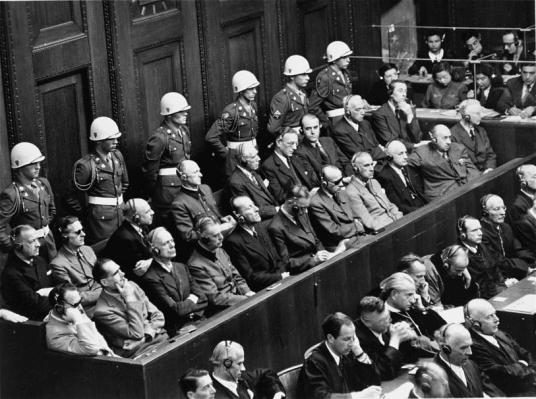
In Italy it has now become ordinary practice, in the face of all those tensions and political fibrillations that risk endangering the establishment, pull out of a dusty cylinder, the mangy rabbit of an anti-fascist victimism "ad usum delphini". The Corybantes of the "politically correct" with their fussing and shouting, they seem, but, having left something macroscopic along the way. In the long flow of human events, if anyone hasn't noticed yet, history is never made, or almost, a single and monothematic actor, ma, more and more parts, surrounded by a series of elements and contexts, which should be taken into account, before spewing banalities, falsehoods and distortions that, rest assured, as well as not helping to have a clear and comprehensive picture of everything, they end, Instead, by playing into the hands of the establishment of the various established powers, who is interested in everything, unless various peoples have a clear historical consciousness, able to provide them with guidance for the present and the future.
And so it is with the events of the last world conflict. S. Anna di Stazzema certainly represented a terrible and execrable episode, like the terrible vicissitudes of Auschwitz. But no one, he seems to want to be interested in the "other" victims. To what, just to be clear, of the very democratic victors of the Anglo-Americans and so on. Ora, to really want to be fiscal, if what various historians are saying about the number of six or more million deaths is true, caused by Nazism, among deportees of the Israelite religion and other groups, in addition to civilian victims caused by war actions, retaliation and various company, it's equally true, but, That, just to give a small example, Stalin caused approximately forty million "civilian" deaths, deporting and lovingly exterminating the “kulaks” (that is, those small landowners who frowned upon the work of forced collectivization undertaken by the latter to their detriment, no ifs or buts…sic!), as well as Cossacks, Ukrainians, Chechens, Lithuanians, Estonians, Latvians, Poles, Secretary, not to mention the very nice practice of periodic "purges" to which the good "Baffone" subjected his subordinates, as well as the Red Army soldiers themselves, that in full conflict, as well as having to withstand the tremendous impact of the Axis troops, between purges and purges, ended up finding each other again, several times, on the brink of catastrophic defeat, precisely because of the perseverance of this practice. Read More

Share

L'esodo giuliano-dalmata: "Volevano farci perdere l'identità italiana"

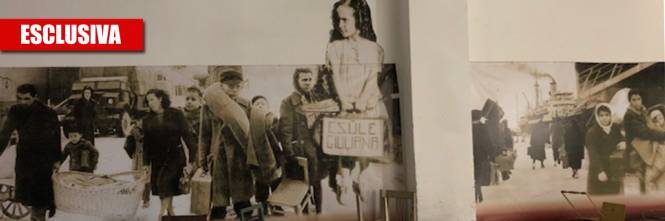
At the end of the Second World War over 300 thousand Italians lived in Istria, from Fiume and Dalmatia flee from their lands to escape the violence of Marshal Tito's partisans
Of
“Every time I close my eyes, I'm going to sleep at my house”. Anita Derin stares at photographs from her childhood and, with his voice cracking with emotion, recounts his exodus.
I had 12 years when she was forced to leave her city, Koper, to escape the violence of partisans of Marshal Tito. “The Slavs have arrived, they began to kill“, explains Anita. “It had become dangerous there. We couldn't do anything but run away”.
“The military occupied my house, ate my horse. I have been several times imprisoned: or because I had a nice dress, or because I went around taking photographs with my Vogtlander”. Anita today has 83 years, He lives in Trieste and carries the memories of his entire childhood in his heart (watch the video). Read More

Share

The infoibata memory: communist crimes in Isola d'Istria

Reporting of Federici Studies Center

List of missing people from Isola d'Istria since 1943 al 1945
(…) In the notes that Luigi Drioli, my father, left to remember the atrocities of those sad days, a list appears of people who were arrested and tortured by the Titoites and whose end was never known with certainty. In most cases these are people who had no specific responsibilities and there were no charges against them: some carried out the work of municipal guards, of municipal employees, of workers, of trade unionists, of firefighters, and many came from various parts of Italy and were ordered to carry out their work in Isola d'Istria in the various administrations. Some arrests, with their tragic consequences, they also happened after the war was over, in peacetime, without any justification. I think the list is incomplete and contains some inaccuracies, but unfortunately too many years have passed and I have not been able to trace people present at that time. I added a lot of data and some names after various searches (…). Victorina (Grazia) Drioli.
Attilio Benvenuti known as Furia
Born on 28 August 1899. Arrested in Trieste on 7 maggio 1945 in Piazza Venezia. Translated to the Jesuit prison. Transferred to Isola d'Istria and Koper. Then disappeared.
On the site www.isfida.it it reads: WELCOME Attilio (said Fury) by Almerigo and Anna Paoli, born in Isola d'Istria on 28-9-1899. Arrested in Trieste Piazza Venezia on 5-5-1945 and deported to an unknown destination. News provided by his wife Ada Mossut who lives in Trieste in via Vercellio n.9 near Borsatti.

Read More

Share

10 February: the Truth cannot be disclosed

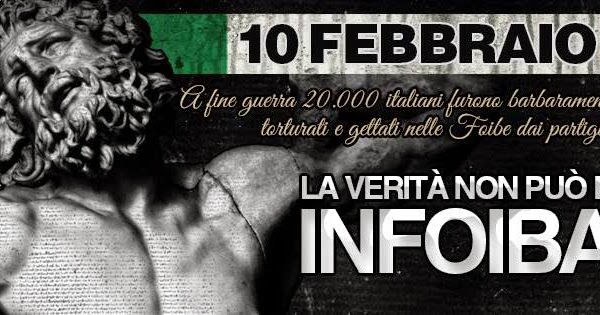
Image results for the memory there is no infoibaTOMORROW, SATURDAY 10 FEBRUARY DAY OF REMEMBRANCE FOR THE VICTIMS OF THE FOIBE
reporting of Federici Studies Center

The cowardly silence on 50 priests and friars massacred by communist partisans in the foibe: these victims are of no interest to memory professionals, perhaps because they were at the service of the Catholic Church and not the Synagogue.
The priests massacred in the foibe
Among the many, many thousands murdered in the foibe there were at least 50 priests. Ranieri Ponis dedicated a monograph to the story, entitled “Stories of Istrian priests killed to erase their faith”, published by Litografia Zenit.
The Slavic invaders in fact tried to attack first of all those who were in various ways part of the Italian ruling class or in any case points of reference and aggregation, such as intellectuals, and politics, entrepreneurs, the teachers, the ecclesiastics.
The hatred towards the latter also derived from the ideological beliefs of the Yugoslav partisans, Tito being Stalin's close ally at the time.
After the total cancellation of every Italian civil and military body in Venezia Giulia and Dalmatia, only bishops and priests capable of representing the Italian population remained on site, who was usually very religious.
There is no doubt that, among the causes that led the Italians of Venezia Giulia to the exodus, religious persecution played an important role, which was also carried out with the specific intention of pushing the Italians to leave.

Read More

Share

February 1945: i 30 friars massacred by communists in Bosnia

Reporting of Federici Studies Center

Bosnia and Herzegovina: i 30 martyrs of Široki Brijeg in memory of Fr. Jozo Zovko
During the Turkish domination of Bosnia-Herzegovina, twelve Franciscans originally from Herzegovina and coming from Kresevo in Bosnia, they decided to build a monastery in their homeland, as a sign of faith, and chose the location of Široki Brijeg. They settled in this little village and, after having bought a large plot of land at a high price, they began to build the church, dedicating it to the Madonna Assunta in Cielo. Work also began immediately to build the monastery and subsequently a building to be used as a seminary.
Nearby they built a school center which also included a gymnasium where the friars taught the young generations of Bosnia-Herzegovina. A house was also built for all those who came from afar to attend the school. Thus the place became a Christian cultural center and the sanctuary transformed into a symbol for Herzegovina. Exactly one hundred years later the monastery was destroyed and devastated.
It happened like this: il 7 February 1945, the communist partisans decided to destroy the Christian symbol from its foundations and eradicate the Catholic faith and the benevolence and gratitude towards the Franciscan friars from the hearts of the people.

Read More

Share

Le false libertà del '68

Of Marcello Veneziani
The false freedoms of '68
Source: On Earth
l 1968 It's not a date like many others. It's like a plaque fixed on the path of history. Which establishes a before and an after. But a tombstone also means something else. AND a tombstone on a world, on a series of values ​​and customs, of languages ​​and systems, questioned and partly eradicated by the revolutionary vortex triggered by an unstoppable impulse to contest everything that represented authority, discipline, identity.
On Earth interviewed the writer and philosopher on the topic Marcello Veneziani, who published a book with an eloquent title ten years ago “Overthrowing '68” (ed. Mondadori).
On what form of freedom was '68 based ideologically??
“Freedom took on the global meaning of liberation in 1968. Liberation of the subject, of repressed sexuality, of oppressed peoples, of chained instincts and impulses. Liberation from the State and from the Norm, from the Family and its obligations and rituals, liberation from constraints of all kinds, praise of infidelity and chameleonism as a permanent mutation. It is the passion for the unlimited, freedom as forbidden to forbid, as a desire for creation and permanent self-creation, without any border. But behind the promise of liberation from everything, behind the Marcusian denunciation of repressive tolerance (the very same Marcuse who had written an essay on liberation), his arrogant other side was also hidden in '68, permissive intolerance; that is, extreme permissiveness but woe to those who do not accept the new commandment of liberation and protest. That background of intolerance then gave rise to political extremism, to the violence of radicalism, to the justification of regimes such as that of Mao and Pol Pot, than in the name of the cultural revolution and liberation from every past, they carried out exterminations that not even Hitler and Stalin together did". Read More

Share

The League of the Godless

Report Arianna Publishing
Of Raffaele Panico
The League of the Godless
Source: Arianna publisher
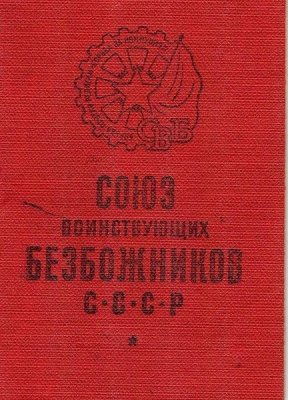
The new Russia, nineties. In Moscow, following the changes, unpublished documents come to light, after further 70 years of silence. Documents that date back to the culminating moments of anti-religious persecution. Not the usual written documents, but also vintage films with impressive gruesome images. Let's observe, backwards, the history of the “Kiev Castrate Sect”, how this was dismantled in 1920 thanks to the new Bolshevik forces in power. A film remained unpublished for a long time. Thanks to the researcher Marco Dolcetta, Italian essayist writer director, teacher at the Sorbonne in Paris “History of religions”, we have an idea of ​​how intense and irreverent the propaganda activity of the new regime established in 1917 by Lenin on the religious question. The film was made thanks to the zeal of the anti-religious section of the Interior Ministry of the Soviet regime which, dal 1920, would have given life, Then, to the so-called League of the Godless militants, a seemingly autonomous institution whose mission was to eradicate religious sentiment in the Russian population. Filmed in Ukraine, former Soviet Union, it is the documentary account although "stuffed" with fiction, on the activities of an Orthodox Christian agricultural-religious community. The scenes in the film highlight the self-inflicted mutilations on the body by believers to mortify the flesh and leave no room for desires, to carnal physical appetites. The sexophobic dilemma of religions. Bolshevik propaganda exposed the kind of life that took place in the churches. In the video you can see the followers of the "Kiev Castrati Sect" dancing: of the possessed, possessed as in the tradition of voodoo and in the ecstasies of the dervishes of southern Turkey. The Klisty, the religious sect to which Rasputin also belonged, danced in the same way. More oddities: the children put in the oven, religious people who try to fly and rites of all kinds to bring rain against the impending drought. While religious fanatics wait for rain and messages from the divine, with propitiatory rites, Bolshevik propaganda focuses on and teaches the modernization of the new Soviet man. In the film while the religious people are blamed, you see Soviet activities using technologies and intelligence of work, that is, the extraction of water from wells, or its conveyance into irrigation canals: it is the logic of socialist materialism. Read More

Share
1 6 7 8 9 10