Silence of the Italian media on Tiananmen: the Chinese regime won

Reporting of BastaBugie editorial team
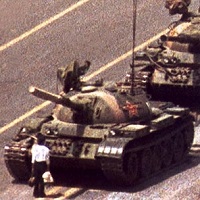
Courier, Repubblica and the others forgot about the 29th anniversary of the massacre in China, but they told us about the anti-robot strike in Las Vegas, Nobel Prize winner Malala's defense of university hangovers, a new drink from Japan, ecc.
Of Leone Grotti

(AUTOMATIC READING)

More than 115 thousand people in the square to remember one of the largest massacres in contemporary history ordered by a totalitarian regime against its own people. It happened in Hong Kong, where myriads of young and old for the 29th consecutive year lit a candle in Victoria Park to "resist authoritarianism" and condemn the Chinese Communist Party, that the 4 June 1989 ordered the People's Liberation Army to massacre students peacefully gathered in Tiananmen Square in Beijing.
NOT EVEN A LINE IN THE ITALIAN NEWSPAPERS
It's an event. In a world where young people are accused of being careless, concerned only with the moment and lacking historical memory, tens of thousands courageously take to the streets (Hong Kong is certainly not free from the influence of mainland China) to denounce one of the greatest horrors in history, fruit of one of the bloodiest regimes in history, e… no one talks about it. Leafing through the pages of the main Italian newspapers, one discovers that today no one has dedicated even a single line to the event.
Worse. Corriere della Sera, Republic, Press, Sheet, Newspaper, Libero, Sole 24 Ore, Daily Fact: no one found space – not even a short one, not even a box, not even a photo, not even a line – to mark the 29th anniversary of the massacre. In the editions of 3-4-5 June the main Italian newspapers dedicated articles to the most disparate topics: the anti-robot strike in Las Vegas, Nobel Prize winner Malala's defense of university hangovers, the criticism of Blair's former spokesperson for not doing housework, the success of the Ogiek tribes of Kenya and that of the new alcoholic drink from Japan. But not a word about the tragic events in Tiananmen Square. Read More

Share

Peru, massacre of 140 children: the greatest mass sacrifice/ Chimu Empire: “È stata un'uccisione rituale”

Remains of the Chimu civilizationReporting of Stefano F.
The remains of 140 children killed as human sacrifice by tearing out their hearts, the largest human sacrifice of children in history
Of Paolo Vites

Evidence of the largest mass child sacrifice ever committed in the Americas has been discovered on the northern coast of Peru, and perhaps throughout the history of the world. Beyond 140 children and 200 llama would have been killed approx 550 years ago as part of a ritual sacrifice. The research was carried out by an international and interdisciplinary group led by Gabriel Prieto of the Universidad Nacional de Trujillo and John Verano of Tulane University. «I never expected it. And I think it's the same for other colleagues too", the comment to National Geographic by the physical anthropologist Verano who worked for over three decades in this region. The site of the sacrifice is known as Huanchaquito-Las Llamas. Here in the 2011 remains of were found 42 children and 76 lama. At the end of the research, finished in 2016, the number rose to 140 children and 200 lama. “It was a ritual killing and it was systematic”, says Verano. «Explaining the sacrifice of children is decidedly more difficult», dice invece Joseph Watts, postdoctoral researcher at the University of Oxford and the Max Planck Institute for the Science of Human History. This is because most societies that practiced human sacrifice nevertheless practiced it on adults. (agg. by Silvana Palazzo) Read More

Share

Resistence, l'Anpi alla comunità islamica: "Tra i partigiani anche numerosi musulmani"

https://www.piacenza24.eu/wp-content/uploads/2018/04/incontro-anpi-comunità-islamica-piacenza-11.jpg

“History teaches us” is the title of the meeting held yesterday at the headquarters of the Islamic Community of Piacenza. Ad…

CONTINUE ON:
https://www.piacenza24.eu/resistenza-lanpi-alla-comunita-islamica-tra-i-partigiani-anche-numerosi-musulmani/ Read More

Share

Verona, 23/04 Stimate theatre, "Gentes": MAROCCHINATE by Simone Cristicchi

Of Editorial team
This evening, Monday 23 April 2018 all 21.00 at the theater at the Stimate in Verona (Via Montanari, 1) will be on stage Moroccan! A painful piece of our history, that deserves to be told and remembered.
Of Simone Cristicchi e Ariele Vincenti, con Ariele Vincenti e Marcello Corvino on the violin. Directed by NICOLA PISTOIA.
The event is organized by the friends of’ Gentes Cultural Association, with the patronage of Municipality of Verona and the contributions of AGSM e It will be sown. The proceeds (entrance to 5 euro, on sale today starting at 20.00 at the Stimmate theater, adjacent to the school where many of us were students…) will be donated entirely to the foundation ABE of Verona (Hemopathic Oncology Child Association).
Lower Lazio, 1944, the allies have just broken through to Monte Cassino. Among these were the Moroccan troops following the French expeditionary force. As a reward for the victory they get carte blanche to 50 ore: but not against German soldiers as much as Italian men and women in a sort of way “right of prey”. E’ the beginning of hell… Read More

Share

Book news: "Fascisti prima di Mussolini" (Ed. Seventh Seal)

Report Seventh Seal Editions
New Seventh Seal

Seventh Seal

Sideri Rodolfo Culture
pag. 266

EURO 22,00
ISBN 978-88-61481-97-8

PAPERBACK

Fascism between history and revolution.

Among the kaleidoscopic images of fascism, the autobiography that the Mussolini movement wanted to offer about itself has often been underestimated. Through the analysis of “precursors” it is instead possible to read against the light what fascism deemed itself to embody and represent in the construction not only of a new social order, but also of a lifestyle inspired by a peculiar vision of the world.
During the twenty years of the regime, the debate developed in the contrast between those who believed that in these constructions fascism was in continuity with national history and that only in this continuity would the achievements that were carried out have the necessary solidity to last and those who instead believed that fascism should present itself as a radical revolution that constituted a clear break with the historical past of the nation.
If fascism did not clearly choose one of the two positions it is because it was still looking for its own ideological definition, but the necklaces dedicated to the pre-fascists and the forerunners, the parliamentary debate and even some statements by Mussolini himself, although reluctant to recognize precursors for his creation, lead us to lean towards the continuity thesis.
An inevitable propensity in a movement that considered the historical dimension of the individual and the State to be indispensable.

Read More

Share

The tombs of the Latin Kings in the Basilica of the Holy Sepulchre

Image results for tombs of latin kings basilica of the holy sepulchreReporting of Federici Studies Center

Holy Land – The tombs of the Latin kings destroyed by the Greek schismatics
The tombs of the Latin Kings in the Basilica of the Holy Sepulchre
The significance of the Basilica of the Resurrection for the Crusaders and for the institutions they introduced in the East does not require new confirmation: however the topic always deserves a few "stops", especially when it happens – as in the current case – say dealing with an archaeological trace of which little more than a memory now remains, which however does not deserve total oblivion on the part of the pilgrim.
Godfrey of Bouillon, founder of the Crusader state in 1099, and the subsequent kings up to Baldwin V were buried in the Anastasi basilica which was also used for this purpose until 1187, when the Islamic reconquest of Jerusalem forced the capital to be moved to Acre, except for some periods that were not sufficient to restore the custom of Jerusalem burial; it was obvious that those burials were housed in the same Basilica of the Holy Sepulcher in which the same kings had been crowned, with the exception of Baldwin I who in 1100 he had worn the royal diadem in Bethlehem in a period of conflict with the patriarch of the Holy City. Godfrey of Bouillon, even with his refusal to be proclaimed king and the preference given to the title of "advocate of the Holy Sepulchre", he had established the vital link between the new state institution and the tomb of the Redeemer; of the rest, her qualification as "lawyer" remained substantially unchanged under her successors, monarchs in all respects.

Read More

Share

The sensational chastity belt hoax

Report BastaBugie editorial team
It is not true that the Crusaders forced their wives to wear them… the first date back to 1800 (such as erotic games or to avoid sexual violence)
and Aleteia

(AUTOMATIC READING)
The use of so-called chastity belts, flexible metal bands capable of covering the genitals and then closed with padlocks, it dates back to the times of the Crusades, when the knights leaving for the Holy Sepulcher wanted to ensure the fidelity of their wives during their absence. The belt is nothing more than a historical fake. Just looking at them is enough to understand how they can be a source of wounds and infections and have locks that are relatively easy to open.
As Focus notes (August 2014) first of all, there is a hygiene problem: even if the classic belt has small openings for the fulfillment of physiological needs, wounds, infections and consequently the death of the wearer would have occurred very quickly.
Furthermore, it is plausible that before leaving the knights mated with their wives, perhaps with the hope of finding a child upon their return. It is evident that the presence of an iron belt would have prevented childbirth. Not to mention the simplest objection: any medieval lock could be opened by a blacksmith in seconds.
THEOLOGICAL PURITY
Beyond these logical inconsistencies, there is the fact that there are no authentic belts dating back to the Middle Ages. The idea of ​​sexual abstinence is certainly very ancient, as is the Latin term cingulum castitatis (translatable precisely as chastity belt) compare, starting from the 6th century, in some texts by Pope Gregory the Great, Alcuin of York, Saint Bernard of Clairvaux, up to Giovanni Boccaccio. But in all these cases it is intended as a symbol of theological purity, certainly not as an object of erotic dissuasion. Read More

Share
1 5 6 7 8 9 10