
Of Caterina Giojell
Source: Times
Didn't read up yesterday Republic the appeal of the twelve finalists of the Strega Prize who ask for the order to close the ports to be immediately revoked, «but it's as if I had done it, these kinds of appeals are all the same and extremely predictable". Only the day before Luca Ricolfi, sociologist, professor of Data Analysis at the University of Turin and scientific director of David Hume Foundation, on the basis of the Ipsos survey which gave the 71 percent of Italians in favor of Salvini's hard line - «not just the voters who vote for the right or Five Star, but also a third of the voters of the Democratic Party" -, he had signed a letter to the illuminati on Messenger: «Dear progressive politicians, dear committed intellectuals, dear enlightened manager, dear prelates, writers, singers, professor, television hosts, journalists who every day practice heartfelt appeals to cultivate a sense of humanity, have you ever wondered why so many Italians don't think like you?».
On the other hand, he tells tempi.it, «I listened (what are youtube) the thought of one of these witch prizes, that a few days ago, when the Aquarius had not yet arrived in Valencia, he confessed: "I myself, I have to say, con realpolitik, which I was also ashamed of, I thought yesterday, I wished someone would die on the Aquarius ship. I said: and now, if a child dies, I want to see what happens to our government". There's no need to even specify who, in particular, made such a miserable reasoning why, judging by the non-reactions of the progressive world (and indeed from the official defenses of his words, that would have been "taken out of context") one might think that what escaped a single intellectual was the afterthought of many. An afterthought that is not only a sign of lack of humanity but also of little interest in the common good. I find the attitude of those who harbor within themselves such great hatred and contempt for their political adversary as profoundly barbaric that they wish for anything that could harm the enemy.: today that a child dies, tomorrow the spread will rise and Italy will go under. And look, I don't love this government at all, and the only explicit public position I took before the vote was against the League and the Five Star Movement, because I believed them (and I believe them) a danger for the Italian economy. But this doesn't lead me to hope that they will sink the country, on the contrary, I hope they are able to prove me wrong".
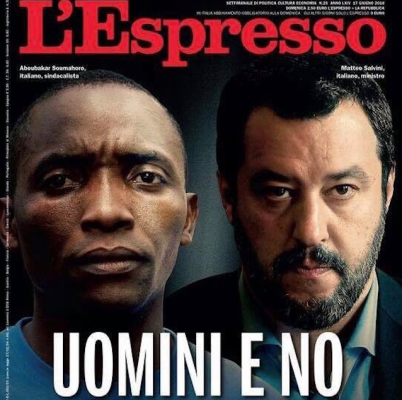
Republic presents the cover of theEspresso “Men and Men”: this Manichaean scheme aimed at summarizing the problem in such absolute categories does not seem to be an equal and contrary form to the so-called populist slogans?
No, It doesn't seem equal and opposite to me: It seems worse to me. Because there is a profound difference between left and non-left. The left, or rather a still important component of the left, it is convinced of its ethical superiority over the right, while the opposite does not happen. Right-wingers and populists may loathe the left-wing establishment, but they rarely feel like bearers of superior morality. When I wrote Because we are unpleasant? (almost fifteen years ago) I thought that within a few years the left would be cured of its moral superiority complex, but I was wrong: it has improved a lot with Veltroni and Renzi in government, but the defeat of the was enough 4 March to make it return to the worst years of anti-Berlusconism. Perhaps the ruling class that leads the left, having no real solutions to the country's problems, he needs an enemy to demonize, despise, hate: yesterday it was Berlusconi, today it is Salvini.
It makes sense to call Salvini a non-man as if his ideas circulated in a marginal sect of fanatics? Apply the scheme usually used for zero point parties (I think of Casapound or Forza nuova)?
It is true that Salvini's ideas are liked by many, also on the left, it should make you think. But this doesn't worry left-wing culture too much, because that culture predicts (not without reason, judging by history) the possibility that the majority is wrong, and let the minority be right. I say "not without reason" because the Nazi experience has demonstrated once and for all that the majority can very well be wrong. But the real point is another: it makes sense to treat the populist wave as if it were the invasion of the Hyksos or the rise of the Führer? What the left-wing establishment persists in not understanding is that, while Salvini's language and some of his positions are indefensible, the substance of this government's migration policy is questionable but not unreasonable, and for this reason it is supported by the majority of citizens. People think that Salvini just wants to bring some order (and European equity) in migratory flows. E, even though it is continually urged to do so, he just cannot see the parallelism between Nazi inhumanity and Salvino's inhumanity. On the contrary, one could conjecture that it is precisely anti-fascism and anti-Nazism that legitimize Salvini: progressive culture, and the rhetoric of the Resistance, have kept alive for over half a century such an extreme idea of the evil embodied by Nazi-fascism, that people smile when people like Giorgia Meloni or Matteo Salvini are compared to absolute evil.
She remembered, given to them, that the 71 percent of Italians are in favor of Salvini's hard line based on the closure of ports, among these a third of the voters of the Democratic Party: what happened? When and why doubts about reception policies began to spread among what you defined as "the battered electorate of the Democratic Party"?
The doubt has always been there, in the last ones 20 years, but the multiplication of landings after the so-called Arab Spring and the Libyan crisis has led to a leap in quality. But, even more than the landings, the denialist attitude counted (“Immigration is not a problem, it's a resource") of the entire political establishment of the left, with the only late exception of Marco Minniti.
What is the crux of the migration problem and who is the real enemy of migrants today?
The crux of the problem, as British historian Niall Ferguson explained on The Times, is that Europe can only accommodate a small part of the Africans who would like to move there, In the 90 percent of cases not as refugees but as bearers of legitimate aspirations to change their lives. Who is the enemy of migrants? Migrants have many enemies, starting from human traffickers, but the biggest enemy is the ruling classes of their countries, which have left those countries at the mercy of poverty, of disorder, of arbitrariness and corruption. A condition that could seriously change, if it ever changes, when the citizens of those countries are convinced that the solution is to replace their rulers, do not flee to countries that have better rulers.

