

 Reporting of Federici Studies Center
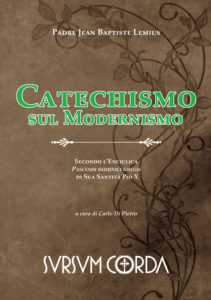
Father Jean Baptiste Lemius, Catechism on Modernism. According to the Encyclical Pascendi dominici gregis of His Holiness Pius, Lift up your hearts 2018, pages. 156, euro 10,00
Modernism is «synthesis of all heresies». It is a "system of delusions" that "opens the way to atheism". The first and immediate cause of Modernism lies «in the aberration of the intellect». As its remote or moral causes we recognize "curiosity not wisely curbed and pride". The modernists, Furthermore, «they owe their deceptions and trappings to total ignorance of scholastic philosophy». To "mislead people" they use a "double tactic". They laugh, they despise and marginalize the wise; finally they dedicate themselves with zeal, openly or behind sophistries, to the "fierce fight against the Religion of Jesus Christ". Nonetheless, modernists also know how to be flatterers and attentive to human respect. They agitate their "counsels of destruction within the Church", the danger lurks "almost in her very veins and bowels". The "most obvious" clue to recognizing a modernist is the "craze for novelty". The modernist «goes against the Magisterium, against Tradition, against history". True Catholics "are marked by the modernists with the utmost malice and envy". In this volume Father Jean Baptiste Lemius (1851 – 1938), using the Pascendi dominici gregis di Papa San Pio X, illustrates Modernism to the simple, highlights the dangers and indicates the remedies. A Catechism on Modernism composed of 510 articles in the form of question and answer, introduced by Card. Merry del Val, blessed by the Pontiff and the Holy Church. It is a necessary antidote to survive the many "chairs of plague that inculcate their destructive doctrines in churches, in congresses, in books, in society". Irresponsible use of the internet has made the situation much worse. In the 20th century most of the protagonists of Modernism, many already condemned by the Church, they were surprisingly elevated to "fathers" and "doctors" within the Second Vatican revolution. The book «Catechism on Modernism», by Upward Hearts, it was edited by the Lucanian journalist and essayist Carlo Di Pietro. Sursum Corda is non-profit and uses its entire income for association activities and for spiritual and corporal works of mercy.
Summary
• Introductory letter from the Card. Merry del Val 7
• Preface 9
• Dangerousness of the evil of Modernism 13
• The religious philosophy of the modernists 19
• The believing modernist 39
• The modernist theologian 51
• The seeds of faith for the modernist 57
• The historical and critical modernist 81
• The modernist apologist 99
• The modernist reformer 111
• Complex of all heresies. Road to atheism 117
• Cause of Modernism. Curiosity and pride 125
• Cause of Modernism. Ignorance 129
• Tricks of modernists in propagating their errors 131
• Remedies against Modernism 141
• Conclusion 161
• Index of articles with page number 163
• Summary 185
The Author
Jean Baptiste Lemius was born on 23 May of 1851 by Francis Lemius, a policeman originally from Lorraine, e Jeanne Marie Begarry o Begery. Third of five children: Marie, Francis, Jean Baptiste, Louis e Joseph, the latter was the editor of part of the Encyclical Pascendi against Modernism. He lived his childhood in Montfort-en-Chalosse, a 18 kilometers from Dax, in the shadow of the Pyrenees. In the 1862, a 11 years, he entered the minor seminary of Aire-sur-l'Adour, joining his brother Francis. At Easter 1871 the novitiate began again, interrupted in 1870 from the Franco-Prussian War, at Notre-Dame-de-l’Osier. He then completed his scholastic studies in Autun, where he was ordained Priest 16 June 1876. Il 4 November 1880, together with others 70 Oblates of Mary Immaculate, he was forced to leave the scholasticate, while the revolutionary police broke in with axes because of the laws against religious orders. He found hospitality in Dublin, Ireland. Starting from 1881 he was charged with preaching parish missions. In the 1890 he was sent to Pontmain as Superior. Of robust appearance and integral doctrine, he was able to immediately win the trust of the people. In Saint-Pierre de Cholet, during Lent 1889, filled the three naves of the church and the square in front only by placing a small statue of the Sacred Heart on the altar: devotion that he spread until his death. In the 1883 he was appointed Superior of the Oblates in the Basilica of the Sacred Heart in Montmartre. He found spiritual and financial support from Pope Leo XIII, then he completed the work on the Basilica, which he defined as "refuge of the poor", with whom he prayed the Rosary daily, before offering them food. In the 1901 suffered a new persecution and, with the Nuns of Montmartre, he managed to buy a convent in Tyburn (London), place of glorious Martyrs, where they shared bitter trials. Until 1905 he worked incessantly to found the Oblates of Mary Immaculate and to spread devotion to the Sacred Heart in Dinant, Belgium. He had great talent for writing catechisms and for illustrating theological questions to the laity. Among his memorable works we remember the explanation of the Encyclical Humanum Genus of Pope Leo XIII, against Freemasonry (1884); subsequently he presented the Encyclical Pascendi dominici gregis of Pope Saint Pius, against Modernism (1907). He died in Talence on 22 July 1938, at the age of 87 years. It is estimated that in only 1901 he preached further 140.000 men, without counting the faithful of Montmartre. He was truly the apostle of the Sacred Heart in France, in England (especially through the Sisters) and in Belgium.
To request the book:
