Populism: between rebellion and construction

“We Catholic traditionalists give the metaphysical reason for the existence of populism. Like it or not. In the long term, the right path of sovereignty and identity will converge, even unconsciously, in the restoration of the Papacy, as a transcendent condition for the reordering of society” (Matthew Castagna, Christ the King-Tradition)
Of Roberto Siconolfi
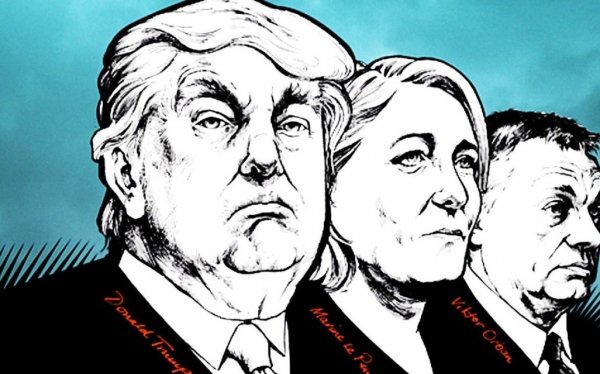
Populism: between rebellion and construction
Source: over the line
Today the entire establishment is moving full steam ahead in opposition to the nascent populist movement. Populism, this derogatory term invoked for every maneuver, political or theoretical, which goes beyond EU directives and single thinking. A gap that opens within an increasingly complete and totalitarian system and which vehemently affirms the renewed needs of the European peoples.
In the preface to the essay “Populism – the end of the right and the left” by Alain de Benoist, Prof Zarelli states that it is also a mentality and a state of mind. And how could he not, from a conscious and rational point of view we can affirm that it is "the voice of the soul of the European peoples". A process that follows the awakening of the sacred feminine of the original metaphysical conceptions. A soul that revolts against the abuses of a society of obtuse bureaucrats, of a system of debtors and creditors (see Eurozone), of technocrats who have debased the best identity and cultural qualities of the peoples of Europe with the force of mass psychology.
But who is afraid of populists and why?? By analyzing the categories we can define a group of restricted oligarchies made up of: financial economics; mainstream (a vast category that includes both the world of media and mass culture); heteronomous centers of power (Bilderberg, Trilateral, Aspen Institute, NATO etc.). It is from here that the threads are woven as well as political domination, also of the attack on the entire populist movement as a whole. Read More

Share

Salvini: «This government is scary. The strong powers will try to crush us"


Wall Street Journal: «Italy is a danger for the euro». Salvini: «The strong powers want to crush us»
According to the newspaper, the "danger" is represented by the "market shocks experienced last week on Italian debt and the new attacks against the European establishment by politicians in Rome"

Of Paola Di Caro

The first was Giancarlo Giorgetti about ten days ago: «I expect the attack, the markets are populated by hungry hedge funds who choose their prey and act". Parole, those of the Northern League undersecretary to the Presidency of the Council, that had shaken the political scene, and which were immediately collected by other government officials. Like Luigi Di Maio, who immediately said he was ready to react if the much-feared storm on the markets were to arrive: «If someone wants to use the markets against the government, know that we are not blackmailable. There is no Berlusconi at Palazzo Chigi who gave up for his companies".

The Wall Street Journal article
L'articolo del quotidiano americano
The article from the American newspaper

Il 19 Matteo Salvini took up the theme of a possible assault on the government and the "Italian experiment" by international "strong powers" in August, with a stark warning: «They will try to crush us, but we will not retreat an inch. Almost as if to open a preventive polemical front, also - perhaps - in reaction to an article in the Wall Street Journal according to which the end of the "long marathon" to save Greece will mark "the closure of the Eurozone crisis", if it weren't for "Italy and the nagging fear that the euro isn't so stable after all". A "danger", the Italian one, represented by the «market shocks relived last week on Italian debt and the new attacks against the European establishment by politicians in Rome», which could lead to a "destabilizing capital flight". The financial newspaper explains that the decisive test will be in the autumn, when "the Italian populist government will have to present the budget law and explain how it will cover its expensive promises to voters".

CONTINUE ON:

https://www.corriere.it/politica/18_agosto_19/salvini-questo-governo-fa-paura-poteri-forti-proveranno-stroncarci-beb70a00-a3c4-11e8-9b60-adccaa96935d.shtml Read More

Share

Savona, plan A – Europeanist

Reporting of Blog on Maurizio Blondet

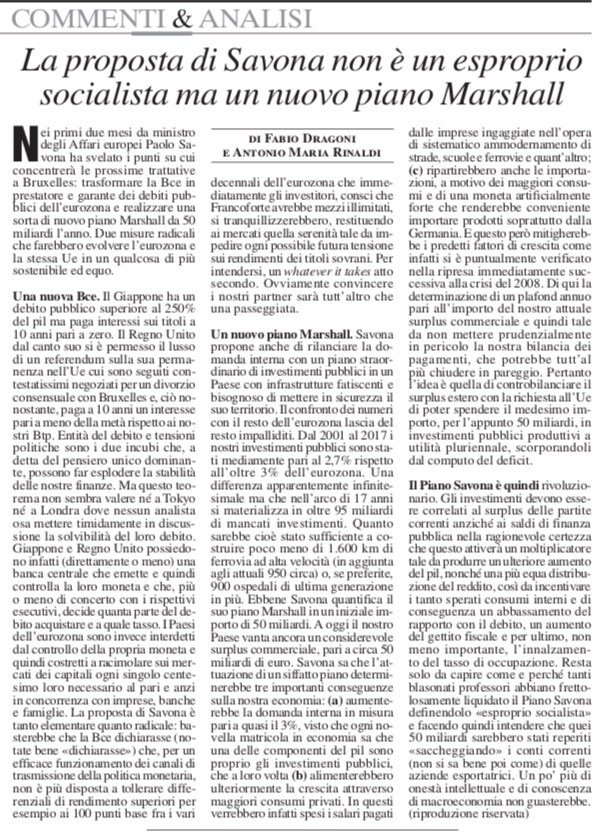
SAVONA, THE PLAN A – EUROPEANIST

In his first two months as Minister of European Affairs, Paolo Savona has revealed the points on which he will focus the next negotiations in Brussels: transform the ECB into lender and guarantor of the eurozone's public debts and create a sort of new Marshall plan from 50 billion a year. Two radical measures that would make the eurozone and the EU itself evolve into something…
Read all.


Read More

Share

Alert “Swexit”, Sweden tries to leave the EU

SwexitReport Wall Street Italia
Of Alessandra Caparello

From rallies draped with swastikas and swastika tattoos to the Swedish government: This is what the members of the SD aspire to, having thus cleaned up their image by calling themselves not racist but rather social conservatives.
“We believe in social values ​​and try to protect them, for example fromimmigration (…) If populism means being close to people and understanding their needs, then we are populists. But if it means that we don't have an ideology, we're going astray. We have a strong ideology based on two cornerstones: a welfare state with strong national security”.

He has clear ideas Matthias Karlsson, SD group leader in Parliament interviewed by La Stampa in which he indicates his party's moves, i.e. Swexit. Read More

Share

Draghi: sulla fine del QE "non è detta l'ultima parola"

Mario DraghiReporting of Wall Street Italia
Of Alessandra Caparello
Inflation is on the right track but “there is still a need for significant accommodative measures”. Go back to talking about Quantitative easing the number one of the European Central Bank Mario Draghi during his speech at the Sintra Economic Forum in Portugal where his colleagues from the Fed and the Bank of Japan, respectively Jerome Powell and Haruhiko Kuroda.
For Draghi thelast word regarding the end of Qe.

"In the 2017 Eurozone growth was higher than we had expected: growth on annual basis recorded in the fourth quarter was the strongest in a decade. But in the 2018 growth has slowed and, until now, it was lower than our expectations (…) Regarding the ECB's monetary policy, as indicated last week the progress made so far towards a sustained adjustment in inflation has been substantial. The expected end of our net asset purchases in December this year is subject to new macro data confirming the medium-term outlook for inflationinflation. Furthermore, the asset purchase program can always be used if contingent events arise that we cannot see at the moment.".

Draghi underlined how confidence in the return of inflation towards the long-term objective has strengthened significantly over the last few months., but uncertainty permeates theeconomic outlook.

“With long-term inflation expectations well anchored, the underlying strength ofEuropean economy and the continued large degree of monetary accommodation allow us to be confident that inflation will converge towards our objective and that this convergence can be maintained even after a gradual winding down of our program of net asset purchases.".

Therefore, says Draghi, the "monetary policy in the Eurozone must remain patient, persistent and prudent”. Read More

Share

The climate has changed, thanks to the Italian vote


Of Maurizio Blondet
“The EU must understand that populism is the symptom of real political failure”
“It's Europe's lack of reform, not Italy, that will break up the eurozone”.
These are not two headlines from Slovenian sovereignist newspapers. The first, is leading an analysis of the powerful – and globalist-imperialist Royal Institute of International Affairs, the legendary "Chatham House”. The second, it is a title of the Financial Times, the theological guarantor of dogmatic liberalism, and is signed by one of its great signatures, Wolfgang Munchau, who among other things is a "Europeanist", having fought against Brexit.
How the climate has changed. The Italian vote has opened the floodgates to critical analyzes of the German-led European Union, never before expressed explicitly
Chataham House warns the oligarchies of Brussels and Berlin against the contemptuous interpretation they are giving of the Italian political situation: a comfortable read, self-acquittal, which - being wrong - can only lead to serious consequences. “The term populism is adopted not as a signal of necessary political reforms in Europe, but as a convenient excuse to dismiss society's demands as incompatible with liberal democracy.". Read More

Share