Anti-fascism and eco-monsters: who was Riccardo Morandi, the designer of the Genoa bridge
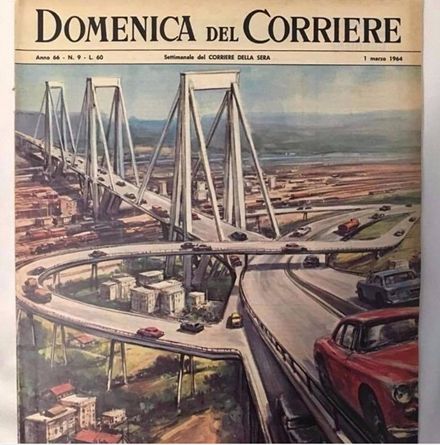
Image results for richard morandiOf Nicola Mattei
Genova, 15 ago – What unites the Corviale snake in Rome, an attempt that started badly and ended worse to build a public housing "barracks" in Soviet style bridge over the Polcevera collapsed yesterday? A name, that of engineer Riccardo Morandi.
Born in Rome in 1902, he began his activity in the 1930s by experimenting - among the first in Italy - with the use of reinforced concrete and pre-stressed reinforced concrete. At the beginning of his career he designed churches and cinemas, and then specialized in the construction of bridges.
The skills in the field of reinforced concrete they are worth the call to the team that will design and build the Corviale, where Morandi will work alongside the architect Mario Fiorentino. The result is dramatic: almost a kilometre (e 11 floors in height) of a real city dormitory on the outskirts of the capital where the building boom of those years created eco-monsters destined to last and produce devastating effects. Applied social engineering will result in failure, managing to replicate for the worse all the distortions imported from the total and totalitarian planning that was experimented in the same period in the Soviet Union.
An ideological aspect, the latter, which cannot be overlooked. We are in the Italy of the conflict (also armed), in which remaining helpless in the face of political opposition is almost impossible. E Morandi had made his choice: “His family – writes Repubblica on the occasion of his death, er he 25 December of 1989 – they remember him as a man who always made a point of defending his independence from all powers, starting with the fascist one of which he was an opponent".
Source: https://www.ilprimatonazionale.it/cronaca/antifascismo-ecomostri-chi-era-riccardo-morandi-91330/ Read More
Share

L'Africa siamo noi

by Paolo Becchi
Africa is us
Source: Paolo Becchi
To understand something about what is happening in Africa and the mass emigration from that continent, we must first detoxify ourselves from what the newspapers write every day or what the mainstream publishing houses publish, and maybe start by reading a book recently published by Amazon and Youcanprint (both as an ebook and in paperback).
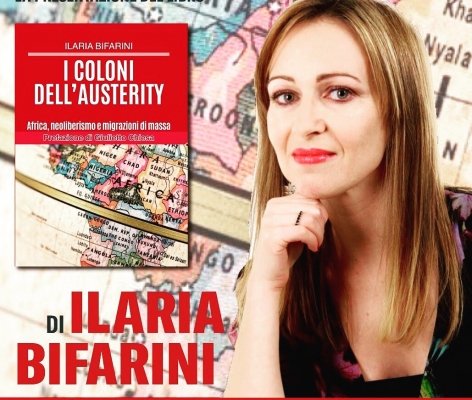
The author, Ilaria Bifarini, she is a young scholar, who presents herself as a "redeemed Bocconian", already known for a volume, Neoliberalism and mass manipulation (2017), which has sold thousands of copies online. His new book, titled The settlers of austerity. Africa, neoliberalism mass emigration (2018) continues the same critical theoretical path towards the neoliberal doctrine, tackling the topic from a counter-current perspective, very relevant today, of mass migrations. The fundamental thesis is soon stated: let's get out of our heads the convenient narrative that traces current African underdevelopment to the colonial past. This thesis is often supported today to justify uncontrolled reception. But it's false.
The disintegration of colonial empires starting from the 1950s led to the formation of independent national states, who however did not have the opportunity to develop their economies independently because they were prevented from doing so: colonialism was thus replaced by something even worse, a form of postcolonialism, focused on economic control, which prevented local economies from growing and developing. Read More

Share

1948 – 2018: the catastrophe of the Palestinian people

Reporting of Federici Studies Center

Life as refugees, the story of Hejar and his family
These days in the Holy Land, the Israelis celebrated their independence and the Palestinians their national tragedy, which we reread through the eyes of Hejar Zghari, refugee in Bethlehem.
A dumpster burns, filling the air with a sour smell. It's a Thursday morning and in the narrow streets of the Dheisha refugee camp, at the gates of Bethlehem, there is almost no one there. Hejar Zghari opens the doors of his home to us, surrounded by other concrete buildings in the camp, populated by 15 thousand Palestinian refugees.
Cheers ha 67 years («I am the first born in my family in the camp»), born in diaspora and raised as a refugee. She graduated here, she got married and became a nurse, mother and grandmother. She appears dressed in traditional clothes and a plate of fruit: Tells: «I am originally from Zakaria, between Ramle and Hebron: ours was a peasant village, there were olive trees, fields cultivated with cereals and orchards. My five brothers were born there. My mother and father had a beautiful house, many animals, rabbits, sheep, goats. When the Zionists arrived they were chased out of the village. Adolescents and young people up to 30-35 years they were taken prisoner. Many of them were killed, a pregnant woman was also murdered. The rest of the village, little more than 1.500 people, he was terrified: they all ran away".

Read More

Share