

 Reporting of Federici Studies Center
Life as refugees, the story of Hejar and his family
These days in the Holy Land, the Israelis celebrated their independence and the Palestinians their national tragedy, which we reread through the eyes of Hejar Zghari, refugee in Bethlehem.
A dumpster burns, filling the air with a sour smell. It's a Thursday morning and in the narrow streets of the Dheisha refugee camp, at the gates of Bethlehem, there is almost no one there. Hejar Zghari opens the doors of his home to us, surrounded by other concrete buildings in the camp, populated by 15 thousand Palestinian refugees.
Cheers ha 67 years («I am the first born in my family in the camp»), born in diaspora and raised as a refugee. She graduated here, she got married and became a nurse, mother and grandmother. She appears dressed in traditional clothes and a plate of fruit: Tells: «I am originally from Zakaria, between Ramle and Hebron: ours was a peasant village, there were olive trees, fields cultivated with cereals and orchards. My five brothers were born there. My mother and father had a beautiful house, many animals, rabbits, sheep, goats. When the Zionists arrived they were chased out of the village. Adolescents and young people up to 30-35 years they were taken prisoner. Many of them were killed, a pregnant woman was also murdered. The rest of the village, little more than 1.500 people, he was terrified: they all ran away".
a living memory, a burning wound
The oral memory of the Nakba, the catastrophe of the Palestinian people (no less than 700 thousand people, maybe a million, forcibly displaced from their lands; beyond 530 destroyed villages; the entire Palestinian society devastated), resists among the houses of refugee camps in the Occupied Territories as in the rest of the Arab world. The new generations describe their villages of origin as if they had visited them yesterday and the escape as if they had experienced it directly.
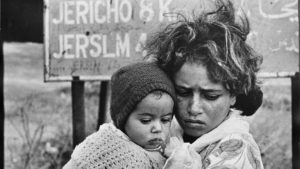
«My family took refuge in an area near Hebron; they walked kilometers to find water for washing and cooking. They had nothing, they had no clothes or shoes except those with which they had fled – continues Hejar – After a few months they thought they could return to Zakaria and tried. But the militias shot anyone who approached: they killed many people. A few months later my family moved to Jericho, for a year, without any help. Only later did they arrive at Dheisha camp: I am the first to be born here, In the 1951, in a tent".
Zakaria, although just a few kilometers away as the crow flies, now seemed very far away. The village was destroyed. Of a very ancient community, from a few centuries before the birth of Christ only a few houses were saved, together with the school. The name of the place comes from the prophet Zechariah, lived in the 4th century BC. And here, the old inhabitants say proudly, it seems that Joseph and Mary stopped before arriving in Bethlehem. In its place, the newly formed State of Israel immediately built another community, baptizing it in a similar way: Zechariah.
«Before the separation wall was built (in the early years of this century – ed), when my mother was still alive, we went to visit the village. My grandfather's house was one of the few still standing, a family of Iraqi Jews lived there. My mother knocked, he asked to be allowed in, but they chased her away rudely. He cried".
Hejar's husband nods. He teaches English in the camp, together they built this house after spending their childhood first in a tent and then in a room of a few square meters: "In the 1950 l’Unrwa (agency created by the UN to assist Palestinian refugees – ed) began to build the first structures: one room for each family, with a small kitchen; there was a common bathroom for the whole neighborhood, Everything is fine 500 meters. The amenities were dirty, it had to wait: in the first years there were in the camp 5 thousand people, families who all came from different villages and we didn't know each other. A social fabric had to be rebuilt from scratch, while we were experiencing individual and collective trauma. It was a difficult period, suddenly becoming refugees had destroyed relationships between people, families had lost their homes, the earth, the animals to meet in a tent. There was no longer any security, there was no longer a sense of stability or independence: from having, in our small way, a comfortable life, we had moved on to surviving with aid from UNRWA, ceci, lentils, farina».
Hejar shows us a photo: he is his nephew, last year he was the best student in the West Bank. «We all attended UNRWA primary schools, only high school in Bethlehem. They cost more, but there are none here. The school was immediately fundamental in the field: was seen, and is still seen today, as the only way to improve one's situation. I graduated in 1971 and I started studying as a nurse: all my life I have worked at the Caritas Baby Hospital in Bethlehem. It was my mother who pushed me to study, she was a very intelligent woman. I often wonder what she could have become if she had been able to study.".
These were the first years of the Israeli occupation of the West Bank, Gaza e Gerusalemme est, with the Six Day War (1967) which has once again distorted the face of Palestine: «My uncles all ran away – recalls Hejar –, while my parents didn't want to leave: they said they had already escaped once, this time they would have stayed and died here".
Our host accompanies us outside, to visit the neighbors. Many of them still live in the concrete rooms that UNRWA almost built 70 years ago, someone merged two or three of them to make a small home. An elderly man shows us his mini-market, the packets of rice, the flour, the oil illuminated by a light bulb: the small window with grates doesn't let in enough light.
Not far away, another door opens onto three rooms where three families live. Children play, mothers offer us fruit juice. On the walls there are posters with the face of Yasser Arafat. «Over time the situation has worsened – continues Hejar –, we have always experienced this situation as temporary, convinced to return. Today, the usual hope is fading both due to the policies of American President Donald Trump and the crisis (financial) dell’Unrwa. Now the services are almost nil, apart from schools. Medicines are missing: I suffer from diabetes and UNRWA cannot cover everything. It is unable to provide specialist services: for any other type of treatment we have to go to Bethlehem ourselves, to public hospitals. The problem is political: reducing services, they try to say that the refugees are no longer there, they no longer exist. But it doesn't matter: even in a hundred or thousand years this will remain our land. Trump can say what he wants about Jerusalem, the city speaks for itself and no one will be able to change its history, identity"".

Part pray ,I can't do anything else. But I would like to do more.