Encyclical Quarto Abeunte Saeculo di Leo XIII, 16/7/1892
To the Venerable Brother Archbishops and Bishops of Spain, of Italy and the Americas.
Venerable Brothers, health and Apostolic Blessing.
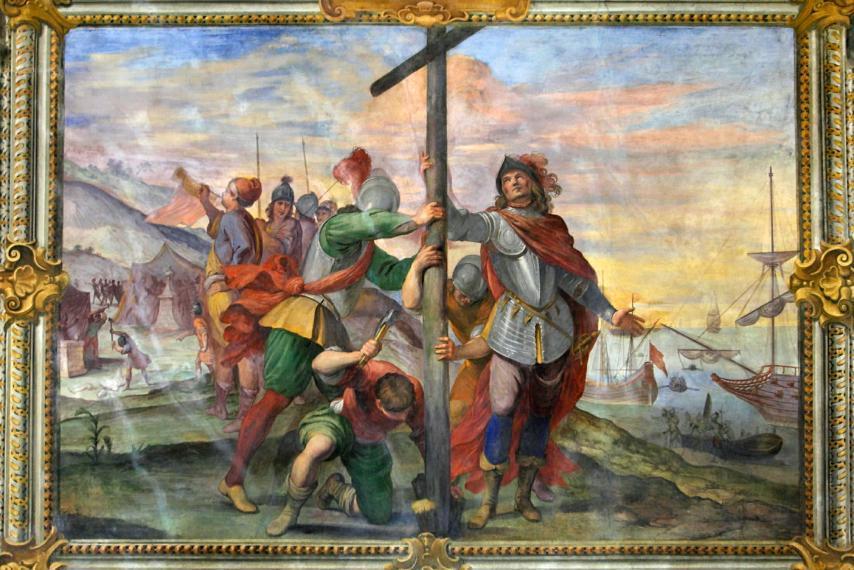
At the end of the fourth century from the day in which, God wishes, a Ligurian man landed, first of all, beyond the Atlantic Ocean to unknown shores, the people are happy to celebrate the memory of that fact with feelings of gratitude, and to exalt the author. Certainly it would not be easy to find a more worthy reason than this to excite souls and arouse enthusiasm. Indeed, the undertaking itself is the greatest and most marvelous of any that has ever been seen in the order of human affairs: and the one who brought it to completion is comparable only to a few of those who were great in terms of spirit and height of ingenuity.. A new world arose thanks to him from the unexplored womb of the Ocean: hundreds of thousands of creatures came from oblivion and darkness to integrate the human family; from barbarism they were led to meekness and civilization: and what is infinitely more important, as lost as they were, they were regenerated to eternal life thanks to the participation in the goods that Jesus Christ provided.
Pope Leo XIII in I have learned enough he states: Jesus Christ established in the Church a "vivo, authentic and perennial teaching”, which he himself strengthened with his power, he informed of the spirit of truth and authenticated with miracles; and he wanted and commanded that the precepts of his doctrine should be received as his own. Therefore every time this magisterium declares that this or that dogma is contained in the body of divinely revealed doctrine, everyone must take it as true, so long as, if it could be fake, it would follow that God himself would be the author of man's error, which is repugnant: “O Lord, if there is an error, we were deceived by you” [Richard of St. Victor, By Trin., lib. I, cap. 2]. So, every reason to doubt has been removed, who will ever be allowed to repudiate even one of these truths, without his falling into heresy and without that, being separated from the Church, rejects all Christian doctrine on the whole? Indeed, such is the nature of faith that nothing is so repugnant to it as admitting one dogma and repudiating another. In fact, the Church openly declares that faith is a "supernatural virtue, with which, inspired and helped by the grace of God, we believe that the things he revealed are true, not for the intrinsic truth of the same known with the natural light of reason, but by the authority of the revealing God himself, who cannot deceive or be deceived” [Conc. Vat., sess. III, cap. 3]. Therefore, if a truth is known to have been revealed by God, and yet it is not believed, it follows that nothing at all is believed by divine faith. In fact, what James the Apostle sentences regarding the crime in matters of morals, must assert itself about an erroneous opinion on matters of faith: “Anyone will have missed only one point, he was guilty of all”. On the contrary, with greater reason it must be said of this than of that. Indeed, less properly the whole law is said to have been violated by one who transgressed it in one thing alone, not being able to see themselves in him, if not by interpreting its will, a contempt for the majesty of God the legislator. Instead he who, even in just one point, disagrees with revealed truths, he has completely lost his faith, as it refuses to venerate God as the supreme truth and proper reason for faith; therefore Augustine says: “In many things they agree with me, in some few no; but for those few things in which they do not agree with me, The many things in which they agree with me are of no use to them”[S. Augustine, In Psal. LIV, n. 19]. And with reason; because those who take from the Christian doctrine what they like, they are based not on faith, but on one's own judgement: and not "bringing all one's intellect back to obedience to Christ”(1Cor 10,5), they obey themselves more properly than God. “Oh, said Augustine, that you believe what you want in the Gospel, and don't believe what you don't want, believe yourselves rather than the Gospel” [S. Augustine, lib. XVII, Against Faustus the Manichean, cap. 3]. End of quote.


 Reporting of Federici Studies Center