

 Reporting of Federici Studies Center
Encyclical Quarto Abeunte Saeculo di Leo XIII, 16/7/1892
To the Venerable Brother Archbishops and Bishops of Spain, of Italy and the Americas.
Venerable Brothers, health and Apostolic Blessing.
At the end of the fourth century from the day in which, God wishes, a Ligurian man landed, first of all, beyond the Atlantic Ocean to unknown shores, the people are happy to celebrate the memory of that fact with feelings of gratitude, and to exalt the author. Certainly it would not be easy to find a more worthy reason than this to excite souls and arouse enthusiasm. Indeed, the undertaking itself is the greatest and most marvelous of any that has ever been seen in the order of human affairs: and the one who brought it to completion is comparable only to a few of those who were great in terms of spirit and height of ingenuity.. A new world arose thanks to him from the unexplored womb of the Ocean: hundreds of thousands of creatures came from oblivion and darkness to integrate the human family; from barbarism they were led to meekness and civilization: and what is infinitely more important, as lost as they were, they were regenerated to eternal life thanks to the participation in the goods that Jesus Christ provided.
Europe, struck then by the novelty and the miracle of the unexpected portent, Gradually she realized how much she owed to Columbus when the colonies established in America, incessant communications, the reciprocity of services and the development of maritime trade gave a very powerful boost to the natural sciences, to common riches, with incalculable valorization of the European name.
Among such various honorific manifestations and in this concert of congratulations it is not appropriate for the Church to remain silent, given that it, according to his custom and character, He willingly approves and strives to promote everything that appears honest and praiseworthy. It is true that the Church reserves its particular and highest honors for the heroism of the most eminent moral virtues as they are directed towards the eternal salvation of souls., but this does not mean that he ignores or takes little account of other heroisms: Indeed, he was always pleased to pay honor with great willingness to the deserving of civil society, and to those who live gloriously in the memory of posterity. In fact, God is certainly wonderful above all in his saints: but the mark of divine value also shines in those in whom a certain superior strength of soul and mind shines, as the light of genius and the sublimity of soul reach men only from God the Father and Creator.
But beyond these generic reasons, we have very particular reasons for wanting to commemorate the immortal feat with gratitude. In fact, Columbus is our man. For a little while reflecting on the main purpose behind which he led himself to explore the dark sea, and the way he took it, There is no doubt that the Catholic faith played a major role in the design and execution of the undertaking: so that in truth by this title the whole human race has no slight obligation towards the Church.
Fearless and persevering explorers of unknown lands and even more unknown seas, before and after of Christopher Columbus, there are many of them. And rightly so, fame, mindful of charitable works, celebrate their name, as they managed to broaden the boundaries of science and civilization, to increase public well-being: and this does not come at a small cost, but at the cost of strenuous efforts of will and often very serious dangers.
There is, however, a great difference between them and the man we are talking about. The well-known characteristic that distinguishes Colombo lies in this, than in plowing and re-plowing the immense spaces of the Ocean, he aimed for greater and higher things than others. Not that he wasn't driven by the noble desire to know, nor to deserve good from the human family; not that he despised glory, whose stimuli are usually more acute in the chest of adults, or that he took little account of the hope of his own advantages; but above all these human reasons the sentiment of the religion of his fathers prevailed, from which he undoubtedly took the inspiration and will for the undertaking and often, in supreme difficulties, he drew reason for firmness and comfort. In fact, it appears that he intensely understood and wanted this: pave the way for the Gospel across new lands and new seas.
This may seem unlikely to those who, concentrating their every thought within the confines of the sensible world, they refuse to believe that we can look to higher things.
Ma, on the contrary, Truly great souls mostly love to aspire to a higher goal, because they are better disposed to the holy enthusiasms of divine faith. Columbus had certainly combined the study of nature with the zeal of piety, and he had deeply formed his mind and heart according to the principles of the Catholic faith. Therefore, persuaded by astronomical arguments and ancient traditions, that beyond the known world, large terrestrial spaces not yet explored must also extend on the western side, he imagined exterminated populations, shrouded in deplorable darkness, lost behind crazy ceremonies and idolatrous superstitions. He considered it extremely painful that one could live according to savage customs and ferocious customs; worse still because they did not know things of the utmost importance and ignored the existence of the only true God. Where, full of such thoughts, he aimed more than anything to extend the Christian name to the West, the benefits of Christian charity, as evidently appears from the whole history of discovery. Indeed, when to the kings of Spain, Ferdinand and Isabella, he proposed for the first time that he wanted to take on the company, he clarified the purpose by explaining that "their glory would live imperishable if they allowed the name and doctrine of Jesus Christ to be brought to such remote lands". And not long after, satisfied with their requests, declares that he “asks the Lord to make kings with his divine grace [of Spain] may they persevere in their desire to spread the Gospel in new regions and new shores". By letter he asks Pontifex Maximus Alexander VI for missionaries: “with the aim - as he himself writes - of spreading throughout the world, with the help of God, the sacrosanct name of Jesus Christ and the Gospel". We believe it should overflow with jubilee when, fresh from his first voyage from the Indies, he wrote from Lisbon to Raffaello Sanchez: “Having to give God infinite thanks for having given him such prosperous success. May Jesus Christ rejoice and triumph here on earth, how he rejoices and triumphs in the heavens, the salvation of many peoples being imminent, whose legacy hitherto was perdition.".
That if he suggests to Ferdinand and Isabella not to allow other than Catholic Christians to sail towards the new world and start trade with the natives, the reason is that "the design and execution of his undertaking had no other purpose than the increase and honor of the Christian religion".
And Isabella fully understood this, she who, much better than anyone else, had been able to read the great man's mind: Indeed, there is no doubt that that most pious queen, of a virile mind and sublime soul, it itself had the same purpose. In fact, he had written of Columbus that he would courageously face the vast ocean "in order to accomplish a great feat for the glory of God". And in Colombo itself, fresh from his second trip, writes: “the expenses she had made for the expedition to the Indies must be used well, and what he would do again, as the spread of Catholicism would follow".
On the other hand, if we ignore a motive superior to human things, from which he could have drawn perseverance and strength to face and sustain all that he was forced to endure and suffer to the last? We mean the oppositions of the learned, refusals by the princes, the risks of the stormy ocean, the incessant vigils, until he lost his sight more than once; add the battles with savages, the betrayals of friends and companions, the wicked conspiracies, the perfidy of the envious, the slanders of the malicious, the undeserved chains. He certainly should have succumbed to the enormous weight of so much suffering, if the awareness of the noble undertaking had not supported him, fertile with glory to Christianity, of health to millions of souls.
Business, around which subsequent events shed splendid light. In fact, Columbus discovered America while a severe storm was gathering over the Church: so, as far as it is permissible for the human mind to conjecture from events the ways of divine Providence, this man's work, glory of Liguria, it seems to have been particularly ordained by God to compensate for the damage that Catholicism would soon after suffer in Europe.
Calling the Indians to Christianity was without fail the work and task of the Church. Which, since the beginning of discovery, he set his hand to his uninterrupted task of love, and continued and still continues to do so, as recently up to the extreme Patagonia.
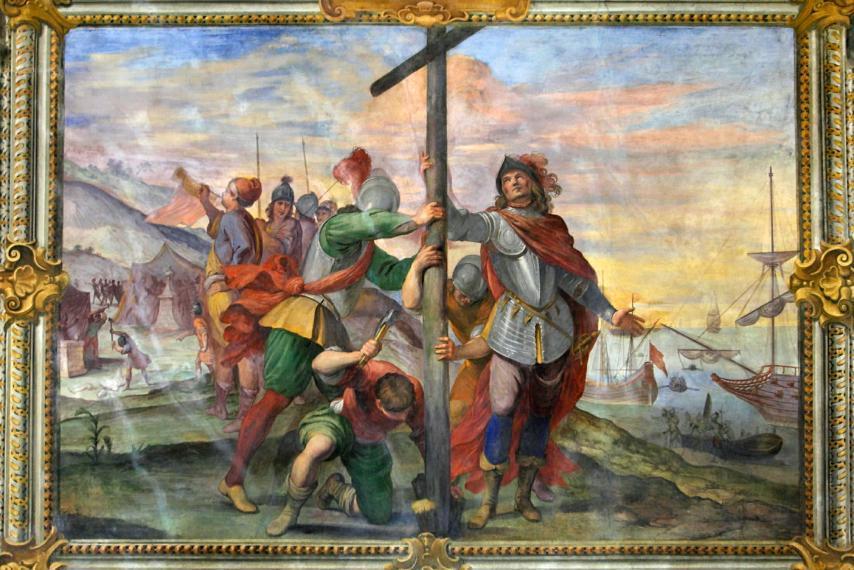
Nonetheless, convinced of the need to anticipate and pave the way for evangelization and everything understood by this thought, Colombo coordinò ogni suo atto a tal fine, nulla quasi operando se non ispirandosi alla religione e alla pietà. Rammentiamo cose a tutti note, ma preziose a chi voglia penetrare ben addentro nella mente e nel cuore di lui. Costretto ad abbandonare, senza avere nulla concluso, il Portogallo e Genova e voltosi alla Spagna, fra le pareti di un monastero egli viene maturando l’alto disegno, confortato da un monaco Francescano. Dopo sette anni, giunto finalmente il giorno di imbarcarsi per l’Oceano, prima di partire si preoccupa di fare le cose necessarie per purificarsi l’anima: supplica la Regina del cielo che protegga l’impresa e guidi la rotta: e non comanda di sciogliere le vele se non dopo avere invocato la Santissima Trinità. Avanzatosi quindi in alto mare, between the raging waves and the tumult of the crew, he keeps the serenity of his soul unchanged by trusting in God. The same new names imposed on the new islands attest to his purpose: in each of them, as soon as you set foot, supplicately adore almighty God, and takes possession of it only in the name of Jesus Christ. Wherever you land, his first act is to plant the Cross on the beach: and after having many times, to the roar of the roaring waves, praised on the high seas to the most holy name of the Redeemer, He was the first to make it resonate in the islands he discovered: and therefore at Spagnuola he began the construction of a church, starting the popular festivals with religious ceremonies.
This is therefore what Columbus intended and wanted in his adventure, for so much land and sea space, into regions unexplored and uncultivated until that day: however, they are in terms of civilization, of notoriety and strength then quickly rose to that high degree of progress that everyone sees.
The magnitude of the event and the power and variety of the benefits that derived from it require grateful memory and glorification of the character. But it's necessary, first of all, recognize and venerate singularly the high decrees of that eternal mind which he obeyed, conscious tool, the discoverer of the new world.
To celebrate Colombian solemnities worthily and in harmony with historical truth, it is therefore appropriate that the splendor of civil pomp is accompanied by the sanctity of religion. Why, as already at the first announcement of the discovery they were made immortal to God, most providential, public thanks first of all from the Pontifex Maximus, so now in celebrating the memory of the highly desired event we believe we must do the same thing.
Therefore we have that day 12 October, or the following Sunday, if the local Ordinary deems it appropriate, in the cathedral and collegiate churches of Spain, of Italy and the Americas, after the day's office, let the Mass of the Most Holy Trinity be solemnly sung.
We trust that, in addition to the populations mentioned above, on the initiative of the Bishops the same thing should be done in the others, it being appropriate for everyone to help celebrate with piety and gratitude an event that was useful to everyone.
In the meantime, as a wish for divine favors and a pledge of Our paternal benevolence to you, Venerable Brothers, We affectionately impart the Apostolic Blessing to your clergy and people.
Given in Rome, at St. Peter's, il 16 July 1892, fifteenth year of Our Pontificate.
