Giuseppe Federici Study Center – For a new onset Press release no. 90/18 of the 29 November 2018, Saint Saturninus Rav Red Shoes Benedict XVI: I didn't write about "mission" to the Jews
The Pope Emeritus intervenes publicly on Herder Korrespondenz to contest an article by the German theologian Michael Böhnke which criticized his previous contribution on Communio
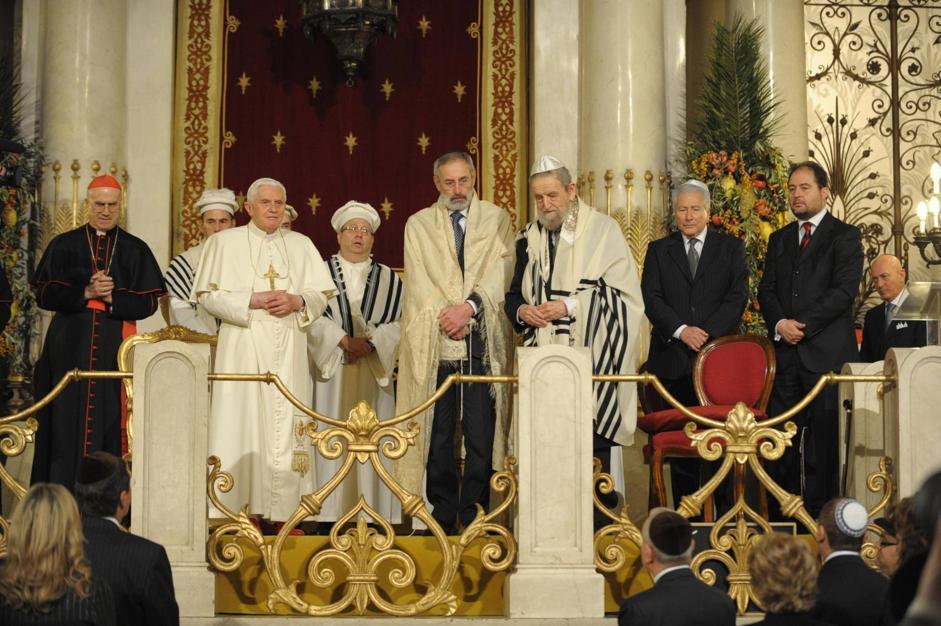
VATICAN CITY – Not "mission" to the Jews but "dialogue" with the Jews: Benedict XVI appears in public again with a letter - "correction" - sent to the German Catholic magazine Herder Korrespondenz aimed at refuting a September article in which the Wuppertal theologian Michael Böhnke criticized a writing by the Pope Emeritus regarding the relationship between Jews and Christians which appeared this summer in the magazine Communio . Read More
Although not adhering to the Cassiciacum Thesis, as widely known, the Christus Rex Circle shares and recognizes itself in the observations of this article in every anti-modernist statement
Giuseppe Federici Study Center – For a new onset
Press release no. 63/18 of the 3 September 2018, Saint Pius X
We celebrate the feast of Saint Pius (n. 69, July 2018), which indicates the anti-modernist doctrinal line to follow in order to remain faithful to the teaching of the holy pontiff.
Editorial of the Sodalitium magazine, n. 69 July 2018
“The hiatus between the statements of the 19th century Popes and the new vision that begins with Pacem in Terris is evident and there has been much debate about it. It also lies at the heart of Lefebvre and his followers' opposition to the Council.". It is not the first time that Joseph Ratzinger expresses his opinion on the irreconcilability between the teaching of the Church (“the statements of the Popes of the 19th century”) and the modern one (O human dignity - come who - Peace on earth): we have already talked about it in relation to his greeting speech to the Roman Curia of 22 December 2005, his Membership no. 59, pp. 41-43. The hiatus (in the figurative sense of “interruption”, “solution of continuity”) it is therefore "evident", that is, immediately and totally comprehensible.
Pope Leo XIII in I have learned enough he states: Jesus Christ established in the Church a "vivo, authentic and perennial teaching”, which he himself strengthened with his power, he informed of the spirit of truth and authenticated with miracles; and he wanted and commanded that the precepts of his doctrine should be received as his own. Therefore every time this magisterium declares that this or that dogma is contained in the body of divinely revealed doctrine, everyone must take it as true, so long as, if it could be fake, it would follow that God himself would be the author of man's error, which is repugnant: “O Lord, if there is an error, we were deceived by you” [Richard of St. Victor, By Trin., lib. I, cap. 2]. So, every reason to doubt has been removed, who will ever be allowed to repudiate even one of these truths, without his falling into heresy and without that, being separated from the Church, rejects all Christian doctrine on the whole? Indeed, such is the nature of faith that nothing is so repugnant to it as admitting one dogma and repudiating another. In fact, the Church openly declares that faith is a "supernatural virtue, with which, inspired and helped by the grace of God, we believe that the things he revealed are true, not for the intrinsic truth of the same known with the natural light of reason, but by the authority of the revealing God himself, who cannot deceive or be deceived” [Conc. Vat., sess. III, cap. 3]. Therefore, if a truth is known to have been revealed by God, and yet it is not believed, it follows that nothing at all is believed by divine faith. In fact, what James the Apostle sentences regarding the crime in matters of morals, must assert itself about an erroneous opinion on matters of faith: “Anyone will have missed only one point, he was guilty of all”. On the contrary, with greater reason it must be said of this than of that. Indeed, less properly the whole law is said to have been violated by one who transgressed it in one thing alone, not being able to see themselves in him, if not by interpreting its will, a contempt for the majesty of God the legislator. Instead he who, even in just one point, disagrees with revealed truths, he has completely lost his faith, as it refuses to venerate God as the supreme truth and proper reason for faith; therefore Augustine says: “In many things they agree with me, in some few no; but for those few things in which they do not agree with me, The many things in which they agree with me are of no use to them”[S. Augustine, In Psal. LIV, n. 19]. And with reason; because those who take from the Christian doctrine what they like, they are based not on faith, but on one's own judgement: and not "bringing all one's intellect back to obedience to Christ”(1Cor 10,5), they obey themselves more properly than God. “Oh, said Augustine, that you believe what you want in the Gospel, and don't believe what you don't want, believe yourselves rather than the Gospel” [S. Augustine, lib. XVII, Against Faustus the Manichean, cap. 3]. End of quote.
DEDICATED TO “RATZINGERIAN WIDOWS”: Here is yet another proof of Ratzingerian conciliar disaster, which admits continuity with Bergoglio and the difference in styles, as we have always supported, also in reference to others “occupants” up to Roncalli (N.d.r.)
Letter from Pope Benedict XVI on the eve of Bergoglio's fifth anniversary: “There is internal continuity between the two pontificates”
Of Sergio Rame
“There is an internal continuity between the two pontificates”. Il Pope Emeritus Benedict XVI defends the magisterium of Pope Francis of which, Tomorrow, the fifth year after the election will occur.
After months deeply marked by internal controversies and by doubts raised by several cardinals, Ratzinger himself is acting as a screen for Bergoglio and today he wrote a letter to the prefect of the Secretariat for communication, Monsignor Dario Viganò. “Pope Francis – we read in the letter – he is a man of profound philosophical and theological training and therefore helps to see the internal continuity between the two pontificates, despite all the differences in style and temperament”.
It is not the first time that Benedict XVI has shown harmony with Pope Francis. Today the opportunity comes from the presentation of the series The theology of Pope Francis (published by Lev), but it arrives on the eve of the fifth anniversary of the appointment of Pope Francis. In the letter Ratzinger openly applauds the editorial initiative which, according to him, “wants to oppose and react to the foolish prejudice according to which Pope Francis is just a practical man without any particular theological or philosophical training, while I would have been solely a theorist of theology who would have understood little about the concrete life of a Christian today”. In the personal letter sent to the prefect of the Secretariat for communication, the pope emeritus thanks having received the gift of the eleven books written by as many theology of international fame that make up the series edited by Don Roberto Repole, president of the Italian Theological Association. “Small volumes – adds Benedict XVI – they rightly show that Pope Francis is a man of profound philosophical and theological education and therefore help to see the internal continuity between the two pontificates, even with all the differences of style and temperament”. Read More