Stop Italy, I want to go down

Of Roberto Pecchioli

Stop Italy, I want to go down
Source: Heretically
Stop Italy, I want to go down. One of the problems, getting older, it is no longer being able to understand what we see. The codes to decipher the new reality slip out of our hands, one feels like a stranger, inadequate and we end up withdrawing into ourselves. If "they" see it, we remain spectators of events that happen despite us and of which we are unable to identify the meaning or direction. How to watch a Bengali film in the original language. This is why so many of us want to come down.
Little Italy has become Italiaccia. For a couple of days we had three governments. The one in charge "for the handling of current affairs", as the bombastic and subtly humorous formula of the official protocol states, that of “the president” by Carlo Cottarelli, official of the International Monetary Fund, as well as the one unwelcome to all oligarchies, led by Professor Conte with the participation of the sinister Bolshevik, fascist and anti-European Paolo Savona. The Jesuit training of the head of state made it possible to resurrect a theological category that had fallen into oblivion, that of sins committed with thoughts, parole, works and omissions. The trial of the intentions of the diabolical octogenarian Savona, ready to exit the euro 48 net hours (?!) however, it allowed Italians to see more clearly.
The good Mattarella presented himself to the people to claim the stop in Savona in the name of the Markets, revealing – holy naivety – who is the guarantor and president. The European Commissioner with a German passport, HerrOettinger, he too was struck by an attack of sincerity, he growled that the Markets will take care of it (always with a capital letter!) to teach the Italians, small, neri, dirty and stinking to vote properly. Even Juncker, perhaps betrayed by the Belgian beer, he revealed opening words how annoyed the inhabitants of the country are, slackers, maintained, corrupt (very true, but in crowded company) and many other things. Read More

Share

The Fifth Estate

Of Roberto Pecchioli
The Fifth Estate
Source: Heretically
I met the Fifth Estate. It happened this morning, soon, in my neighborhood. In less than half an hour and within a radius of a few tens of metres, I verified the existence of the Fifth Estate. It's here, I met him and even touched him. We know the ancient division of society into three orders, dating back to the Middle Ages. The first order, or State, it was made up of the clergy; the second by the nobles. The third, theoretically, from everyone else. His representation, in the French States General, was entrusted to members of the nascent bourgeoisie, who made the Revolution and buried the past forever. His vate was Abbot Sieyès, author of a very successful pamphlet that set France on fire at the beginning of the fateful period 1789. With the lexicon of Gyorgy Lukàcs, we could say that it was the ecclesiastic of Fréjus who gave the Third Estate class consciousness, starting from the famous phrase "what is the Third Estate? All. What has happened so far in the political system? Nothing. What do you want?? Becoming something". The bourgeoisie cut off the King's head and inaugurated modernity.
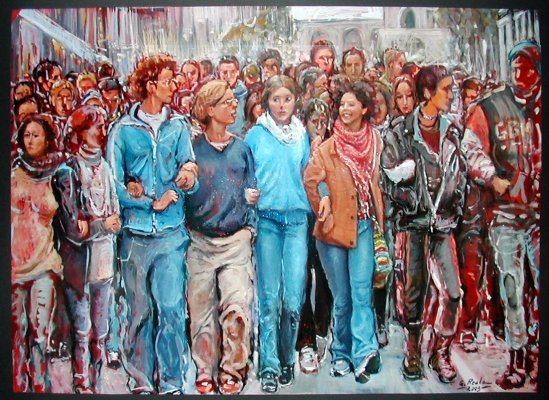
During the nineteenth century, the socialist controversy began to talk about the Fourth Estate, that is, of the peasant and worker proletariat whose ranks swelled in the shadow of the industrial revolution, of forced urbanization, of the birth of large factories. Its artistic representation is the great painting of 1901 by the Piedmontese Giuseppe Pellizza da Volpedo: a compact and orderly crowd moving towards the future, confident in history, led by a young mother with her little son around her neck and two men, the most combative peasants. There is in this framework of large dimensions and gigantic ambitions, the sense of a composed dignity, a sober elegance despite the common simplicity of the clothes and attitudes, an irrevocable advance, inevitable of men and women who feel like communities on the march determined to change their condition all together. Read More

Share

La frustrazione dell'uomo binario

Of Roberto Pechioli
The frustration of the binary man
Source: Heretically
Reading Vittorino Andreoli is always a stimulating intellectual adventure. The Veronese psychiatrist, with that mad scientist look of his, i radi capelli lunghi, disheveled, similar to directionless electrical wires, it is an important witness of our time. His long clinical experience, combined with a surprising humanity and the acute sensitivity of a scholar make us think. A recent speech of his focused on contemporary man who no longer thinks and is a slave to frustration. Two conditions that Andreoli considers complementary, linked by an invisible yet persistent plot.
Postmodern man lives in imitation of the machine, his reasoning becomes binary, immediate stimulus and response, yes or no, right or wrong. Everything is cooked and eaten immediately, the waiting time evaporates, which is also that of hope, of the dream, of the project. Inadequate by nature to support the comparison with the technical apparatus, vive di scosse, continuously clicks on itself, loses the joy of the goal achieved, the satisfaction of those who linger to contemplate the outcome, savor the effects of acting after having imagined and constructed them. He also loses the ability to accept defeats or simple inadequacies, fruit of self-acceptance, of the condition of an imperfect creature, to the point of attributing them to a sort of malfunction of the personal machine.
Frustration spreads, that is, profound unprocessed disappointment, in each of its three meanings, that is, the feeling of those who consider their actions in vain; the psychic tension determined by the unfulfillment of a desire; the effect of the failure to satisfy a drive. Read More

Share
1 2