Holy Land: water is not the same for everyone

Image results for Holy LandReporting of Federici Studies Center

Thirsty Palestine
Having running water at home in the Palestinian Territories is not at all obvious or normal.
Neither in the West Bank nor in the Gaza Strip. For multiple reasons. Some testimonies from Bethlehem.
Observing the landscape around Beit Sahour, urban center east of Bethlehem, the cisterns on top of the houses allow Palestinian homes to be distinguished from buildings that are part of Jewish settlements. This is explained by the locals who every day deal with the problem of water shortage. The tanks on the houses are useful, Indeed, to conserve water or collect rain, but not all homes need it. In the West Bank, water is distributed differently from house to house, at a distance of a few meters from each other. To overcome the inconveniences of the water emergency, the population does its best, but the problem of resource management remains an open wound that shows no signs of healing, indeed it is "an obstacle to peace", as the BBC defined it.
According to the Palestinian Water Authority, il 95 percent of Palestinian water supplies are found in aquifers (there are three underground basins). Surface water, that could theoretically be available, instead it comes from the floods of the wadis (seasonal streams), from the possible desalination of the waters of the Dead Sea and the Jordan River. None of these resources, However, it is in fact usable by the Palestinians.
Read More

Share

1948 – 2018: the catastrophe of the Palestinian people

Reporting of Federici Studies Center

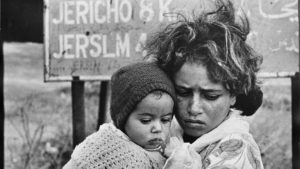
Life as refugees, the story of Hejar and his family
These days in the Holy Land, the Israelis celebrated their independence and the Palestinians their national tragedy, which we reread through the eyes of Hejar Zghari, refugee in Bethlehem.
A dumpster burns, filling the air with a sour smell. It's a Thursday morning and in the narrow streets of the Dheisha refugee camp, at the gates of Bethlehem, there is almost no one there. Hejar Zghari opens the doors of his home to us, surrounded by other concrete buildings in the camp, populated by 15 thousand Palestinian refugees.
Cheers ha 67 years («I am the first born in my family in the camp»), born in diaspora and raised as a refugee. She graduated here, she got married and became a nurse, mother and grandmother. She appears dressed in traditional clothes and a plate of fruit: Tells: «I am originally from Zakaria, between Ramle and Hebron: ours was a peasant village, there were olive trees, fields cultivated with cereals and orchards. My five brothers were born there. My mother and father had a beautiful house, many animals, rabbits, sheep, goats. When the Zionists arrived they were chased out of the village. Adolescents and young people up to 30-35 years they were taken prisoner. Many of them were killed, a pregnant woman was also murdered. The rest of the village, little more than 1.500 people, he was terrified: they all ran away".

Read More

Share