Unpunished crimes: the children killed in Gorla

Image results for Gorla massacre
UNIQUE THOUGHT – SERIES A DEATHS AND SERIES B DEATHS
Reporting of Federici Studies Center

Milano, Gorla and the massacre of the 184 innocent
The sky is damn blue over Milan, the morning of 20 October 1944. So blue that the primary school teacher Francesco Crispi, in the Gorla area, she is worried: «It's too clear, they could bomb. We are forced to go to school, but you who can…», he says, meeting little Graziella Ghisalberti on the bridge of the Martesana canal, 7 years, holding hands with his mother and his little cousin Edoardo di 6. Instead Graziella and Edoardo, with their black aprons, they walk through the door, like every day since they returned from Brianza, where they were displaced for fear of war: "The war is over now anyway", the adults repeated. And instead the war in Milan had to deliver the final blow, the most devastating.
In second class that day they learned capital letters and Graziella had just completed a whole page of D… A gesture that is still old today 77 he often repeats with his finger, tracing many imaginary capital Ds on the table… «At that moment, all 11 e 14 – he says – the small alarm sounded, American planes were arriving, we all had to run down to the shelter under the school".

Read More

Share

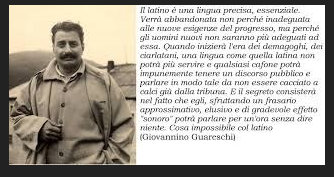
MEMORY OF GIOVANNI GUARESCHI A 50 YEARS SINCE DEATH

Reporting of Giacomo Bergamaschi

by LUIGI MARIANI

Exactly fifty years ago, il 22 July 1968, Giovanni Guareschi died, writer, journalist, screenwriter, political polemicist, agricultural entrepreneur and much more. I can't help but remember him for the warmth he was able to instill in our hearts with his stories that talk about places, Emilia, and of an era, after the Second World War, who are still very close to us. This climate also allows us to revisit the periodic re-showing of films on TV Don Camillo, on whom Guareschi wrote this curious reflection «Gino Cervi corresponds exactly to my Peppone. Fernandel doesn't have the slightest resemblance to my Don Camillo. But he's so good that he stole the job from my priest. So now, when I venture into some new Don Camillo story, I find myself in serious difficulty because I have to employ a priest who has the face of Fernandel
Baldassarre Molossi wrote, in the Gazzetta di Parma" of 25 July 1968: “Giovannino Guareschi is the most read Italian writer in the world with translations into all languages ​​and staggering circulation figures. But official Italy ignored him. Many of our current rulers owe something to Guareschi and his strenuous battle of 1948 if today they still sit in ministerial chairs, but none of them moved. None of them showed up (…). Even Giovannino Guareschi now rests in the gentleman's cemetery. It is an uncrowded place. We understood it yesterday, while we counted old friends from our youth and some journalists among us, on the fingers of both hands.”

Read More

Share

Verona: "L'Islam alla conquista dell'Europa, nella storia e nell'attualità"


TRADITION IN VERONA TO COMMEMORATE LEPANTO
Of Lucia Rezzonico

“When I read that my city councilor friends Andrea Bacciga e Alberto Zelger, with whom I recently presented my first book, they were the promoters, together with Mayor Federico Sboarina of a motion that wants to declare Verona as the “Father of Life”, making a concrete commitment, with public funds towards those who discourage abortion and help save children, my heart fills with joy.
E’ a hymn to Life, which presents our city at next year's World Meeting with a wonderful business card: the Europe we would like, founded on the family, which is only one, and is made up of a mother and a father” – he reacts like this Matthew Castagna, Head of the Catholic Club “Christ the King-Tradition”, after the vote of the pro-life motion by an overwhelming majority of the Verona City Council (21 yes and only 6 no. Curious note: PD group leader Carla Padovani voted yes).

We thank you – continues Matteo Castagna on behalf of Catholic traditionalists – our ancestors, who in these days were preparing to save the Families from which we descend, during the glorious battle of Lepanto 7 October of 1571, won, despite the numerical inferiority, through the intercession of Our Lady of the Rosary, against the Islamic invader.
He was great at the time Pope Saint Pius V called the Holy League and the Holy Crusade to save Europe and our civilization, otherwise today we would all be in Piazza Santa Anastasia with our butts in the air, forced to praise Allah and in place of the Rengo there would be a minaret.
That's why we are happy, as traditionalist Catholics, to accept the invitation to participate in tonight's conference at the Hotel Due Torri in Piazza S. Anastasia organized by’ On. Vito Comencini (League) with the historian Prof. Roberto De Mattei and the friend Abbondio Dal Bon, who will talk about the relevance of that experience through similarities with our days, of this dark age. Incredibly, whoever should be the successor of Saint Pius V says he welcomes the old enemy, while it is the League (maybe not Santa, but always League…) which slows down the invasion with disruptive but peaceful methods”.
In the end, Castagna concludes: “Like every year, for many years, we usually thank Our Lady with a prayer initiative. Sunday 7 October at 18.00 we will recite the Holy Rosary in Latin and attend the traditional Holy Mass, said of S. Pius V, the very Holy Pope of Lepanto who codified it, which will be celebrated by an integralist Catholic priest of the Mater Boni Consilii Institute in a privately owned church”.
On Sunday evening there will also be a public initiative by the’Fortezza Europa Political Association, that we share and support.
Article taken from www.veronanews.net and by the Roman press agency Consul Press:

Read More

Share

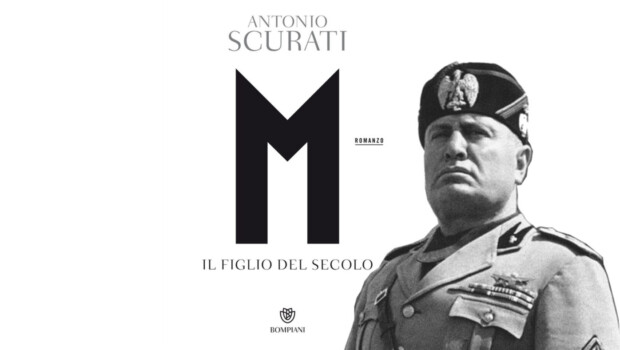
Mussolini's story becomes a TV series: Boldrini will take down the antennas?

Image results for Benito MussoliniREX
Of Chiara Soldani
The novel about Mussolini it will become a TV series: with all due respect to Fiano, Boldrini and Saviano (to the continued list, Obviously). The production house Wildside has in fact acquired the rights to “M. The son of the century” by Antonio Scurati (published by Bompiani). As, the book that deals with the obsessively cited “fascism”, will find a television adaptation: but without affecting its literary goodness. Pages that testify, in great detail, historical facts without the imaginative intervention of the author.
Scurati has faithfully reconstructed the history of Italy since 1919 al 1925: from the foundation of the Italian fighting Fasci to the Matteotti crime. Historical documents that support the narrative: the author places it at the center of the book, a Mussolini committed to giving shape to his revolutionary project. Trace it, Furthermore, a well-defined psychological profile. A very clear idea of ​​Italy and Italianness, that of the Duce: “In order, Italy must first conquer itself. This is the task of fascism. The victory of the spirit is necessary if we want to renew the nation to launch it on the path to its greatest imperial destiny.".
Work imbued with realism, with documentary inserts: articles, official press releases, epistolary correspondence. Grande, Scurati's work: no invention but reconstructed and restored facts, with its own artisanal care. To date, still no indiscretion regarding production times, cast and release date. In a period (which has been going on for too long) of great censorship and imaginative reconstructions (reference to recent events that is not purely coincidental), book and TV series on Mussolini they are a great victory: in the game against political correctness. Go ahead like this.
Source: https://www.ilprimatonazionale.it/cultura/la-storia-di-mussolini-diventa-serie-tv-la-boldrini-abbattera-le-antenne-93755/ Read More

Share

Memories of an era – Fra' Ginepro, the Franciscan who brought Mussolini back to the Faith

Of Luciano Garibaldi

fgnpr

Fra' Ginepro from Pompeiana (photo from the Ragazzi del Manfrei website)

He was a priest, Don Ennio Innocenti, theologian and historian, famous radio preacher (his broadcasts entitled “Listen, it's evening"), as well as founder of the “Sacra Fraternitas Aurigarum in Urbe”, to reconstruct Mussolini's path towards faith. He did it with a book, “Dispute over the conversion of Benito Mussolini”, published in Rome in the mid-nineties, precisely from the Fraternitas (via Capitan Bavastro 136, 00154 Roma). Don Ennio Innocenti had dedicated twelve years of research and personal investigations to this unusual story. At first, had revealed what Father Eusebio OFM had confided to him, born Sigfrido Zappaterreni, chief chaplain of the Black Brigades, moved to Argentina after the war and died in Buenos Aires. Several times - this was revealed by Father Eusebio to his brother - he received the sacramental confession of Benito Mussolini. Afterwards, it was another Franciscan who administered it to the Duce, after confessing it himself, the Eucharist. His name was Fra' Ginepro. Read More

Share

The Martyrs of Castelfidardo / Part II

Image results for Battle of CastelfidardoReporting of Federici Studies Center

Il 18 September marks the anniversary of the battle fought in 1860 between Loreto and Castelfidardo, which saw the papal army and the Sardinian army pitted against each other, now Italian. We remember the pontifical heroes who sacrificed themselves for the papal cause with moving quotes taken from Mons' four-volume work. Alberto Canestrari,: “The soul of Pius IX as it revealed itself and was understood by the Saints” (Marino, Santa Lucia typography, 1966). Mons. Canestri drew the information from the book of the Marquis Anatole de Ségur: “The Martyrs of Castelfidardo” (Paris 1861).
DEAD AFTER THE BATTLE.
The survivors in a slower pang to die in the lands that the Pope was losing. After some names of those fallen on the battlefield, the illustrious collector of the anthologies of these Martyrs went on to edify the readers with the marvelous examples of fortitude that some of those who did not immediately extinguish in the silence of death offered, with the voice of blood they were able to make the greatness of their souls felt on the hard beds for a few more days, altar of the most tormenting consummation of their holocaust. (Canestrari p.148)

Read More

Share

The martyrs of Castelfidardo / I leave

Image results for Battle of Castelfidardo
Reporting of Federici Studies Center

Il 18 September marks the anniversary of the battle fought in 1860 between Loreto and Castelfidardo, which saw the papal army and the Sardinian army pitted against each other, now Italian. We remember the pontifical heroes who sacrificed themselves for the papal cause with moving quotes taken from Mons' four-volume work. Alberto Canestrari: “The soul of Pius IX as it revealed itself and was understood by the Saints” (Marino, Santa Lucia typography, 1966). Mons. Canestri drew the information from the book of the Marquis Anatole de Ségur: “The Martyrs of Castelfidardo” (Paris 1861).
THE DEAD IN THE FIELD.
In Castelfidardo and Loreto, a requiem mass is celebrated for the fallen of both sides. The dead on the two fronts are temporarily buried at the site of the clash.
Pontiffs. Dead 7 officials, 81 soldiers, for a total of 88 fallen collected in the field. “The bodies of those brave men (to the pope) he died (Cialdini) confused together in a large pit..." (O’Clery 1893: 2165-218).

Read More

Share

You again, Benito

Of Marcello Veneziani

Like today seventy-five years ago Mussolini he was freed from imprisonment in Campo Imperatore. Today the first volume of a monumental work dedicated to the leader tries to free him from the damnatio memoriae Antonio Scurati which goes to the bookshop today, M. the son of the century (ed. Bompiani, 840 pages, 22 euro). It seems strange but in the river of books dedicated to fascism and the Duce there is not a biographical novel entirely focused on his figure. Mussolini appears there a thousand and a thousand times as an evil demiurge, as a menacing shadow or as an ogre in individual stories, even private ones. But a fictionalized biography about him, in multiple volumes, without an apologetic or denigrating tone, something of a narrative equivalent of the monumental historical biography of Renzo De Felice, it wasn't there yet. Curious to see it, especially given the author's premises/promises of equidistance and the confession of having been subjugated by the character, and perhaps fascinated. It also happened to De Felice, who also came from an anti-fascist culture, left. Furthermore, Scurati does not lack narrative talent and a free gaze.
I would like to object something to the title because Mussolini may have been the son of his century but above all he was its father because he generated events, followers, imitations, works and curses like few others. He was the father of fascism and stepfather of anti-fascism. Some even considered that Mussolini invented an eternal category, Urfascism (Umberto Eco). Son of a century but father of an eternity, nice paradox, Benito.
In truth, Scurati's fictional biography renounces too large and significant a part of Mussolini's life: the one that precedes the foundation of fascism, il 1919, that is, the life of an anarchist, as a revolutionary socialist, as leader of the most radical left, as a master, journalist and writer, exile and prisoner, and then director of Avanti and other effervescent magazines, until the foundation of the Popolo d'Italia. But also Mussolini fighting in the First World War. Scurati's Mussolini is already the founder of fascism, much of his life has already passed. Read More

Share

Vienna, 12 September 1683 – la Cristianità respinge l'invasione islamica

Image results for the Battle of ViennaReporting of Federici Studies Center

The Battle of Vienna, In the year of the Lord 1683
The political-military scenario in the second half of the seventeenth century – rather troubled century – appears dark and full of uncertainties. The Thirty Years' War (1618-1648), devastating religious war, it was also a political-military confrontation between the French ruling House of Bourbon and that of the Habsburgs. The intent was to remove the Habsburgs' hegemony over Germany, which derived from their imperial authority. To achieve this goal Armand du Plessis, better known as Cardinal Richelieu (1585-1642), inaugurating a policy based on mere national interest to the detriment of a European and Catholic vision, allied himself with the Protestant princes. The Treaties of Westphalia of 1648 sanctioned the definitive weakening of the Holy Roman Empire. That's how it is about Germany, devastated, divided between Catholics and Protestants and politically separated, the hegemony of the king of France is established, Louis XIV (1638-1715). He does not hesitate to even seek the alliance of the Ottoman Empire, completely opposed to every Christian and European ideal. At the end of the century, therefore, Europe was prostrate, divided within itself between religious factions and dynastic struggles, with an economic and demographic crisis resulting from the war, which made her more vulnerable than ever.
The Islamic offensive
The Ottoman Empire, which had conquered the Balkan countries up to the Hungarian plain, on August 1st 1664 it had been temporarily blocked by the imperial armies led by Raimondo Montecuccoli (1609-1680) in the Battle of San Gottardo, in Hungary. Shortly after though, under the strategic guidance of the Grand Vizier Qara Mustafā (1634-1683), the offensive resumes, paradoxically encouraged by Louis XIV and his casual anti-Habsburg policy. There could not have been a more favorable moment for a victorious campaign and now the heart of Europe was within the reach of the Ottoman armies. Almost isolated, only the Republic of Venice prevents the Turks from gaining dominion in the Aegean, in Greece and Dalmatia. However, it was now an unequal struggle, Indeed, culminated in the loss of Candia in 1669, despite the heroic deeds of Francesco Morosini (1618-1694). In the 1672 in Podolia – a part of present-day Ukraine – is taken from Poland and in January of 1683, ad Istanbul, the Ottoman armies head towards Hungary. It is an immense army that is marching towards the heart of Europe, under the leadership of Qara Mustafā and Muhammad IV (1641-1692). The design they attempted to create was that of a sort of “greater European and Muslim Türkiye” of which Vienna was to be the future capital; a city which in turn would have been a bridgehead towards the rest of Europe, besieged and destined for defeat. The few remaining Imperial forces – reinforced by the Hungarian militias led by Duke Charles V of Lorraine (1643-1690) – they tried in vain to resist. The great leader in the service of the Habsburgs took command, although recovering from a very serious illness, from which – he said to himself – the prayers of a Capuchin father had saved him, known to many as Father Marco da Aviano. Father Marco had been sent by Pope Innocent XI to the Emperor to plead the cause of the anti-Turkish crusade. Father Marco's first act was to ask that the image of the Mother of God be shown on all imperial insignia. Since then, Austrian military flags will always carry the effigy of the Madonna for the next two and a half centuries. Only Adolf Hitler had them removed after his rise to power.

Read More

Share
1 3 4 5 6 7 8 9 10