
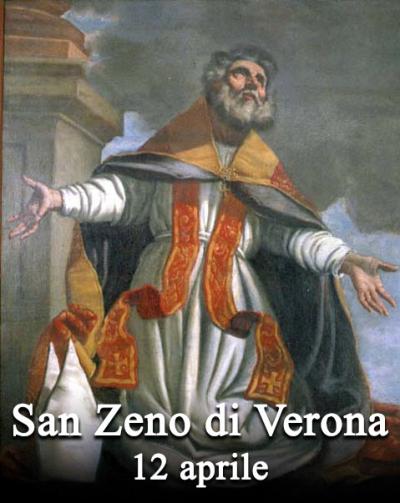
 Wrongly according to what someone instrumentally says, in an era of do-goodism and indiscriminate hospitality, San Zeno was not black, although some depictions represent him as such. Native to Northern Africa (hence the nickname “Moorish bishop”) he was not black in complexion. In the adjacent image, Indeed, you can see how it probably really was the image of the Patron Saint of Verona (n.d.r.)
The abbey church of San Zenone, o, as the Veronese say, of San Zeno Maggiore is one of the oldest and most glorious monuments in Verona. It often happens that on the body of a Martyr or a Saint, as if on particularly fertile soil, a large church sprouts or a slender bell tower is thrown back.
A Verona, the most beautiful Italian church of the Romanesque era flourished on the miraculous body of San Zenone, with the pink stone bud of the elegant bell tower. The life of Saint Zeno, Veronese saint, is shrouded in legend.
Zeno was born in Africa and lived around the 4th century. We don't know how or when, from the African sands, has reached the gentle hills on the banks of the Adige, driven by his apostolic vocation. In those times, Emperor Julian, said the Apostate, he sought to re-establish the cult of the pagan gods, fighting Christianity, denied by him. The first barbarian invaders of the Empire were Aryans, that is, heretical Christians, fiercely opposed to Catholicism.
There were therefore bad times for the Church and for the decimated flock of the faithful. But his preaching and his example were stronger than political impositions and sectarian opposition. The converted pagans, the reformed heretics, they were soon legion, and it could be said of Saint Zeno that "by preaching he led Verona to Baptism".
Eloquent, erudite, paterno, as appears from his Sermons, Saint Zeno was an exemplary bishop. But as well as being a perfect shepherd, he was also a prodigious watchdog, who kept away the wolves of oppression and the serpents of heresy; On the contrary, that wolves and snakes he reduced to meek and obedient lambs.
In works of art, since the oldest ones, Saint Zeno is represented with a fish in his hand. This curious symbol has a double meaning. Saint Zeno had renounced all his riches, to distribute them to the poor. His poverty, endured with joy, he often reached the point of poverty.
Legend has it that the holy and humble Bishop himself fished the meager food for his frugal meals in the Adige.. For this reason he is considered the patron saint of freshwater fishermen.
But the symbol of the fish also recalls the phrase that Jesus said to the Apostles, before sending them throughout the world to baptize and preach the Gospel. «You will be fishers of men». Also San Zeno, like the Apostles, he was a tireless fisherman, and the souls he caught in the net of Grace were infinitely more numerous than the few fish destined to feed him.
When you die, towards the 380, he had been Bishop for eighteen years. The people, who wanted to give a final farewell to his remains, it could not be contained in the church that San Zeno himself had built, outside the city walls. This is how the idea of the new large building was born: that wonderful church with which they wanted to honor the Saint, and which measures the devotion and affection of the Veronese for their glorious Patron.
Source: www.verona.net

