

Of Daniele Palmieri
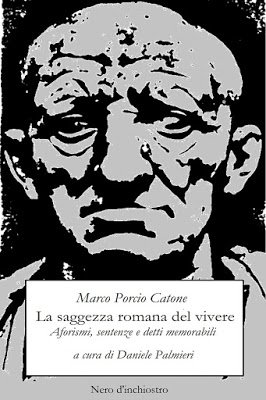
Source: Ink black
Farmer, politico, soldier, literary; it is not easy to define Cato under the wing of a single category.
Of rustic origins, himself the son of farmers, Cato liked to call himself a “a new man”, that is, a man who had built his fortune from nothing exclusively with work and virtue.
Known to most either as a staunch opponent of Carthage or as one of the founders of Latin literature, Cato was a multifaceted figure, not free from limitations, defects and contradictions, but towards whom it is difficult not to feel a form of reverential respect.
Thinkers like Cicero were enchanted by it, Livy, Seneca, Plutarch, who elevated his incorruptible morality to an ideal model. His own progeny boasted noble descendants, including Cato known as the Uticense, Stoic philosopher and martyr for freedom in an attempt to stop the rise of Caesar.
Cato is therefore a figure with a thousand faces and there is nothing better than his writings to reconstruct the different facets of this varied personality.
The Roman wisdom of living collects its aphorisms, his most incisive memorable sentences and sayings, handed down and from the only complete work that has come down to us, he De Agricoultura, and from the fragments, direct or indirect, handed down by ancient authors. The text also contains the first Italian translation of Monostich of Cato, from the “golden rules” of good living handed down under the name of Cato, which had great diffusion in the Latin Middle Ages, precisely because of their ability to outline a simple morality, practical and incisive at the same time.
But why should one recover the thinking of this practical man, not at all inclined to philosophical speculation?
First of all, There is a reason why Cato's writings and thoughts were so successful in the ancient and medieval West. This is because, as previously mentioned, although it does not contain refined philosophical speculations, however, they testify to a practical wisdom of living, drawn from everyday experience, which is well suited to the ethical needs of everyday life.
Cato is one of the highest testimonies of Roman Wisdom, aimed at action rather than contemplation, but no less profound because the action itself becomes a way to experience and savor a form of divine knowledge, attainable only through work and the sweat of one's brow.
Cato's ethics and wisdom could be summed up, Indeed, such as work ethics and wisdom. His lapidary sentences often lash out against idleness and inactivity, fertile ground of vice; writes, for example: “Prosperities usually breed negligence, to prevent which, as far as I'm concerned, I have never skimped on work” (Cato, The Roman wisdom of living. Aphorisms, memorable sentences and sayings, pp. 36).
Only work allows man to elevate himself, to earn one's place in earthly life, since “If you stay doing nothing, you are worthless“; and work always allows the seed of virtue to germinate, where the term “virtue” it is not to be understood merely in a moralizing sense, but rather as a perfection of the soul sine qua non so that great deeds can be accomplished.
Cato writes about this: “Think to yourself that, where you have toiled for some noble undertaking, that effort will soon leave you, while the beautiful undertaking will never abandon you during the course of your life; ove, Instead, you have worked badly to indulge pleasure, this will soon disappear and that dishonorable action will always remain with you“ (Cato, The Roman wisdom of living, pp. 36).
Work, virtue and, consequentially, Ethics are the three pillars on which human society is founded, than without such mutual collaboration, then fortified by the laws, would collapse. A society that is therefore based on a mutual balance, that only a democratic government can foster. Peers working as equals and making political decisions as equals are the backbone of an ideal society, in which all powers are balanced and are not monopolized by the greed of a single king who, always for what Cato teaches: “it is a voracious creature”.
To conclude, so, Cato's great message is a reminder of balance, how much of man with himself, how much of man with the world, as much as man with his peers, since only this balance allows us to live authentically, without ever exceeding either in too little or in too much. Concluding with his words: “Man's life is like iron: if one uses it too much, it wears out; if one doesn't use it, it is worn away by rust. Similarly we see that men weaken from too much fatigue; if they are idle, inertia and torpor cause them greater harm than fatigue“ (Cato, The Roman wisdom of living. Aphorisms, memorable sentences and sayings, pp. 41).
