

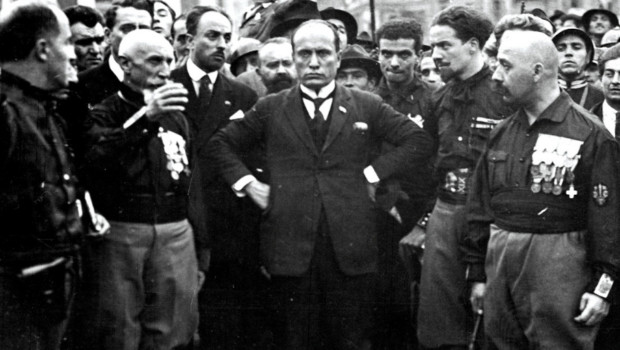
“Effective January 1st, no man or political party will be able to declare themselves irresponsible for their mistakes with the excuse that there was fascism". We need a statement like that, like the one written by the socialist poet and writer Giacomo Noventa to definitively deem fascism out of the question, a century after his birth and three quarters of a century after his death.
Noventa hoped to prescribe fascism as an alibi on a New Year's Eve much earlier than this one; but now that we have reached one hundred years, there are no more alibis for always invoking fascism.
In the century we were born, Nineteenth century was synonymous with the Beginning, it was the year of the Dawn. '19 was a special year in Italy: Fascism was born in Piazza San Sepolcro, in Milan, as a radical and revolutionary yet patriotic and national movement. But in 1919, Italian-communism was also born, arose on the ashes of the Great War and in the wake of the Bolshevik Revolution, with the foundation of Ordine Nuovo by Gramsci and Togliatti in Turin, from which the communist party would then be born in Livorno. The Popular Party founded by Don Luigi Sturzo was also born in 1919, who would later be the father of the DC. A movement that became a regime, a party that later became the largest communist party in the West and a Christian Democratic party that became the government for half a century. But not only that: again in 1919 the short circuit between the war occurred, revolution, trade unionism and poetry with d'Annunzio's Impresa Fiumana. It was the dress rehearsal of the fascist revolution but also the prototype of other revolts, '68 even.
And to think that such a heavy year is remembered by such a light song: “In nineteen nineteen dressed in voile and chiffon, I met you I don't remember where, during the course or at a cotillon dance”. The song by Achille Togliani ended with a forgetful memory: “Then I took you, I don't remember where, and you told me… I don't remember anymore. In the 1919 perhaps you called yourselves youth". Love nostalgia aside, that was truly the year in which youth broke out, indeed youth, as a category of the spirit, consecrated by war, vanguard of the revolution and of the bright future.
But fascism remains with us from all those anniversaries. After many feasts of fascism, comes the centenary of a story that lasted "just" a quarter of a century but which has persisted in the damnatio memoriae for three quarters of a century. The exact opposite of communism, which lasted three quarters of a century but was removed already in the remaining quarter. One hundred years of fascism.
Let's try to write, as Prezzolini said, an honest obituary of fascism or at least how it was born. To begin with, fascism had a father and a mother: Father Courage, that is, a painful war, defeated and betrayed; and Mother Fear, that is, the threat of communist revolution, domestic and international. A victorious war at great cost and a red two-year period of violence gave rise to fascism; Then, a disastrous war and two years of civil war destroyed it. Fascism had a circular destiny. But fascism is within the history of socialism, it was an internal chapter of his: fascism was its son and stepson, it was the legacy and the reaction. It is difficult to think that fascism is eternal, Eco's Urfascism, and that the womb from which he was born and in which he grew is instead dead and buried. If fascism is eternal, the socialism from which it was born is eternal, and the conflict from which it germinated is eternal. It seems more sensible to think that these are historical phenomena, therefore with a dawn, a peak and a sunset, of which they remain a legacy, traces and memories. They may sometimes resurface but they are not eternal. Historicizing fascism it's the only way to understand its meaning, the scope and effects. With those premises we ask ourselves: fascism can be reborn today? If fascism was born from a war, by a generation of brave people returning from the front, from socialism from which it inherits methods but not aims, from nationalism and revolutionary syndicalism, from the national and global terror of communism, there is no possibility of fascism today. A changed context, a conflict that is transferred to videos and social media, an interdependent world, global, dominated by the economy and an Italy within the European Union. Expecting fascism today is like waiting for Napoleon's return.
At that time, let's modify the question: the '19 that opens will resemble the '19 of the previous century, it will have the same fervor as the beginning, it will really be as Di Maio says, the Year of Change? Judging by what has happened in recent years, we have already had too many beginnings and in a short time: we have gone from Berlusconism to Renziism, from the technical Eurocrats to the populist-sovereignists in government. Radical changes in perspectives, surprising changes, traumatic. A concentrated juice of politics and anti-politics, with relative collapse on the right, left, center and leadership. But now Italy is really divided between Change and Restoration? And if the third movement prevailed, tiredness and rejection, where it would lead, what faces would it have?, what movements and ideas it would convey? What if it was the time of the conservative Revolution?
One hundred years ago, in '19, the America that stood with Wilson at the helm of the world, Lenin's Bolshevik Russia which became the USSR and the rising fascism defined themselves as the New Order, as was also written on the dollar. Today we are at the new Disorder. The future is a foreign land. Welcome to '19.
MV, panorama n. 1 2019
Source – http://www.marcelloveneziani.com/articoli/centanni-di-fascistudine/
Similar Posts
