

 Giuseppe Federici Study Center – For a new onset
Press release no. 19/19 of the 4 March 2019, Saint Casimir
Where will the Europeans of ISIS go??
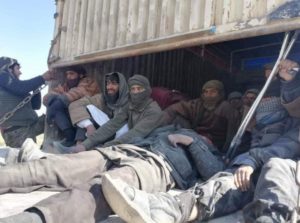
They are on Twitter, the place chosen by the president of the United States to reveal his foreign policy and state decisions, Donald Trump asked “ Great Britain, France, Germany and other European allied countries to take back the additions 800 ISIS militants captured in Syria" , coming from 44 villages, and if this did not happen, he "will be forced to free them" without specifying where and in which country. Trump is no more willing to let time pass by waiting” than others ( European countries) do their job". This is what the American administration shows in foreign policy and towards its allies. The United States had asked Europe, to Canada, Australia and Middle Eastern countries to send their troops to Syria to “fight ISIS”. But even before that, a few years ago, the United States had asked European countries to let potential jihadists leave for Syria and Iraq and asked Saudi Arabia and Jordan to open their prisons and pardon the jihadists so that they could reach their much-coveted destination, the Levant, to thus destroy the Syrian state and create a “failed state” situation.
These wishes, however, could not be realized and President Bashar al-Assad was not removed 3, or at most 6 months, as had been foreseen in 2011. Today the world has to deal with a new puzzle : what to do with those we helped reach Syria to terrorize, subject to violence, kill the population and who now want to return to their countries of origin? It is clear that the American administration has no intention of helping Europe solve the problem of its human waste which has embraced the Islamic State just as the United States wanted.
Until this moment, Thousands of ISIS members have managed to return to Europe and many more have returned to their home countries in the Middle East, Asia and Africa. They are fighters (some of them had even been incarcerated in their home countries), who had answered the call and reached Syria and Iraq with the help of Western intelligence services and their allies to join the jihad and join the Caliphate of an "Islamic State".
They traveled to the Levant for many reasons: to reach family or friends, for the love of adventure, for the adrenaline that flows when you have weapons to kill at your disposal, to find one or more wives, to be part of a more welcoming and warm group ( in the Middle East, social and family gatherings are more intimate and affectionate than in Europe). Very few had a reasonable knowledge of Islam before arriving at their destination, fewer still were those who knew Islamic teachings , gli Hadith (stories about the life of the prophet Muhammad) and Islamic laws. But many of them have one thing in common : they killed thousands of Iraqis and Syrians.
Europe and the countries of the Middle East facilitated "jihad corridors" that led to Syria, especially through Turkey, whose authorities looked favorably on jihadist immigration. Ankara airport had special corridors to house newly arrived militants and then send them east. The goal was to divide Syria and Iraq. The world watched impassively as ISIS amassed enormous financial resources: stole hundreds of millions of dollars in gold and money from banks, he sold oil, infrastructure and manufactured goods to Türkiye, he made huge sums of money from the taxes he imposed on services, the box,electricity, agriculture, car transits, trade in goods and other sources that provided huge revenues in the areas he controlled.
President Obama had the courage to say that he did not want to pollute the air of Syria and Iraq by bombing ISIS oil shipments. Dal 2014 al 2015 the United States apparently fought ISIS in Syria but the territory it dominated continued to expand and prosper. Russian intervention was necessary, which began in September 2015 to destroy these tankers and thus reduce the flow of stolen oil to Turkey and consequently ISIS's revenue.
It is possible that ISIS leader Abu Bakr al-Baghdadi followed the example of Saddam Hussein who had hidden financial resources and weapons in preparation for difficult times. Iraqi intelligence services are convinced that ISIS has created many private businesses to continue to have the money needed to finance its insurgencies and recruitment. According to information sources within the Iraqi security forces, The Iraqi Intelligence Unit arrested dozens of ISIS-linked cells that handled hundreds of thousands of dollars in assets for the group.
ISIS is also present in caves and places in the desert that connects Syria with Iraq. Dozens of less spectacular but significant attacks occur every month in the Salahoddine provinces, Nineveh, Diyalah, Kirkuk and the Hamrin-Makhol mountains and caused the death of dozens of Iraqis. This month ISIS kidnapped 19 Iraqis along the borders with Saudi Arabia (Ar'ar Nakheyb) in the al-Anbar desert. Six bodies have been found so far.
In fact, ISIS now needs to strike as many terrorist attacks as possible to demonstrate that it is alive and capable. It wouldn't be so strange for several insurgent attacks to take place in the Middle East even though ISIS is losing all its territory.
But ISIS insurgencies are not that far from Europe where each attack brings the group much more publicity and helps it strengthen its propaganda. The attacks in Paris and Brussels (just to name a couple) gave a gigantic feeling of power to ISIS fans. These attacks were organized by the ISIS command in Raqqa.
Thus the return of hundreds of ISIS militants to Europe will create a big problem for those European leaders who could be among those who sent these terrorist candidates to the Levant where many later became prolific killers in Syria and Iraq. Many have also been killed in the attacks but those who remain are those who have best understood how to kill in a brutal way.
ISIS was defeated and the circumstances that allowed it to grow in 2014 they are no longer there. Many are surrendering in their last stronghold in Syria. However, the disappearance of ISIS territory does not mean the end of its presence in the Middle East, in Europe and the rest of the world (especially in West Africa, Libya, Iraq, Egypt, Yemen, Afghanistan and the Philippines.
Trump is putting Europe in a situation that risks exploding by asking it to take back its citizens and thus making it clear that he does not want to hand over ISIS prisoners to the Syrian government. There are no prisons in Europe suitable to house them, no tools to de-radicalize them or cure the brainwashing to which they have been subjected. There are no guarantees that arrested ISIS militants will not attempt to spread their ideology and may become sleeper cells ready to attack at the first opportunity.
There are ways to counter ISIS ideology using its own tools. His beliefs can be condemned on a rational and religious level by Islamic religious authorities. The group was contested by the Ulema, Sunni religious experts, who criticized his rationalizations and his self-proclaimed state. Al-Qaeda is also exposed to such an ideological attack. But how effective can these criticisms be?, you can't know.
Although French Interior Minister Christophe Castaner is ready to welcome ISIS militants returning to France, the majority of European countries would prefer to reject his human waste. They do not have the resources and skills to be able to deal with these militants who return home. Heiko Maas, the German Foreign Minister, thus commented on Trump's tweet: “It's not as easy as they think in America”. The European authorities should learn from the Syrian and Iraqi governments how to fight ISIS otherwise they will encounter a thousand difficulties trying to avoid and prevent the metastasis of this cancer.
SOURCE – http://www.centrostudifederici.org/dove-andranno-gli-europei-dellisis/?fbclid=IwAR2WFAYfyO-0_dhW-h7c6vR56-5lMEj55B1TVBWW4p6OutC40CUPVv5KI1Q

