

Of Luciano Del Vecchio
Source: Appelloalpopolo
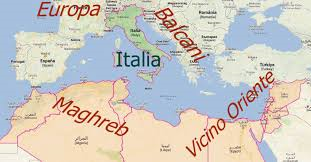
To avoid being overwhelmed by a story that, contrary to what the American political scientist Francis Fukuyama theorized, it never stopped and that, in these years, has accelerated its course dramatically, we should try to think about politics not only with ideologies or sociological categories, but also in terms of geographical-historical and physical-environmental factors, which geopolitics studies and interprets as elements that condition history. Italy, after the death of the homeland, he seems to have almost forgotten history and geography, and with them big politics, which is first and foremost foreign policy, renouncing to play any role on the international scene. In this space, Italians seem to have taken refuge in a sort of dissociative disorder that makes them unable to perceive themselves as people on their land, to recognize themselves in their history and identity, which the Anglo-Saxon historiographical narrative has distorted and altered for about 70 years. Collectively regress to an infantile need for colonial guardianship, happy to be relegated to a foreign province, as in the most politically unhappy periods of our history, abbiamo rinunciato al diritto-dovere di farci guida di libertà e democrazia per i paesi fratelli. In the fluid uncertainty of the present, Italy, to rediscover the ability to recognize oneself in the mirror and be fully aware of one's destinies, needs to rediscover the national interest, which is historically linked to the geographical area it occupies, to its economic development and social progress, to his freedom and that of the Mediterranean peoples, which is also his. The reconquest of popular and national sovereignty cannot ignore the awareness of its geopolitical mission, imposed by a territory that projects into "its" sea for thousands of kilometers of coastline between and towards lands inhabited by peoples, whose peace and security are vital for Italy.
Nation with apparent sovereignty, country reduced to a foreign arsenal, a people historically cursed to slaughter each other in continuous civil disputes in favor of the foreigner on duty, which one or more factions often invoke to invade us territorially or to influence us politically, since the last century we have given ourselves over to the hegemony of smoky anti-national cultures. Proletarian internationalism, clerical ecumenism, Enlightenment cosmopolitanism, all now declined as globalism, have always threatened national cohesion and harmony, in the present, they stretch their deceptive shadows in the form of smug mass self-denigration and of hypocritical and politically polite humanitarianism towards incoming influxes. Now we sink into the abyss of the pro-European dissolution of multinationals and stateless financiers, ignoring that our fate cannot be separated from that of the Mediterranean, how well those who understood, during the First Republic, they dared to make autonomous decisions in foreign policy. Starting with Enrico Mattei, the creator of the great national energy policy, which was followed by the coherent action of Aldo Moro, killed not for "parallel convergences" but because he was pro-Arab; finally to Bettino Craxi, forced into exile by the ambiguous Mani Pulite operation, not for corruption but for Sigonella, become mutually symbolic of an albeit ephemeral manifestation of rediscovered independence. Their fate confirms that any politician or entrepreneur who dares to oppose the marginal role imposed on the country, is eliminated politically or physically.
However, bitterness and disillusions accumulated in the recent past must not paralyze action and dissuade us from the duties that the present imposes on us on the decisive North African scenario, where the repercussions of the Libyan tragedy on immigration flows and energy policy are evident. Italy, thanks to the historical and geographical proximity to that shore, must realistically take note that the European Union, whose core is the Franco-German dyarchy, it cannot and will never want to harmonize the opposing interests of France and Italy in this area. The two nations, who "figure" as allies within the EU and NATO, they are blatantly adversaries in a geopolitical space where the Americans have left France a free hand to impose its neocolonial aims, even with weapons. Italy was sacrificed to the strategic interests of some and to the economic and financial interests of others, Germany and France, both delegated to the geopolitical control of the European and North African areas. Therefore, the external constraint is not just a problem of adherence to treaties, but also the fruit of hostile policies that European powers implement against Italy, thanks to a now discredited internal sub-dominant class. Indeed, in this framework of stratified supremacies and planned submissions, only the Italian political class has carved out for its country the miserable role of the first colony on earth, of flagship aircraft carriers at sea, and the first exalted supporter of the European Union, against its concrete national interests. Since the Second World War, the official narrative has exalted these humiliating roles of Italy and, conversely, hidden the silent struggle that France and Germany are waging against Italian development: a lasting hostility disguised by European oligarchic institutions, controlled by the dominance of the financial economy over politics, monitored by the immense capacity for mass manipulation of new communication technologies; a conflict now waged with the geopolitical weapon of mass immigration, epiphenomenon of capitalism. The reconquest and exercise of national sovereignty, so, they require the adoption of internal measures that not only de facto and unilaterally sanction the breaking of the signed treaties, but also that they express a foreign policy that does not renounce the national interest: the uncompromising defense of geophysical boundaries, rigorous control of financial ones, commercial, customs; the rediscovery of the concept and value of citizenship; an autonomous and free energy policy in the global search for supplier countries; the nationalization of productions and strategic services vital to the existence of the State e, within these sectors, public control of communications networks. The sovereignist project and program are achievable if guided by a single postulate: the total reapplication of the Constitution, that of 1 January of 1948, when in a climate of rediscovered awareness of national dignity it was proposed to regain it with tenacious political and diplomatic commitment, and we deluded ourselves into thinking we would never have to lose it again.
| Hegemony of anti-national cultures |
