

Esteemed Associates and kind Supporters, We are truly grateful for the large number, devoted and fervent participation in the last «Pilgrimage of Tradition», procession of 22 km from Osimo to Loreto in honor of Virgo Lauretana. An appointment of true friendship, of friends of the Church, friends of the Papacy, friends of the Clergy, friends of the Saints and Martyrs, friends of Our Lord Jesus Christ and the Blessed Virgin Mary. We take this opportunity to point out the relationship about true friendship, drawn mainly from the studies of Cornelio ALapide, published on our Youtube channel. We come to the usual study of the Holy Scripture using the precious "Life of Jesus Christ" by Abbot Ricciotti, who today talks to us about the unfaithful farmer and the rich man.
• § 470. As well as being the scribe of mercy, Saint Luke is also the Evangelist of poverty (§145): so here is the series of parables we are examining, pearls on divine mercy are followed by others on human poverty, these too are preserved only in Luca's chest. That giving up wealth was an act of foresight on the part of the follower of Jesus, it was shown by him with the following parable. There was a rich man who had a farmer, and he was accused by the master of squandering his assets; therefore he was called by the master, which he told him dryly: «I have heard bad rumors about you; present me with the accounts of your administration as soon as possible!». – Gone out of there, the farmer thought about his own cases, and he saw himself lost if he did not find some way to survive in his old age. He then began to think: «Now that the administration will be taken away from me, how will I be able to support myself? I am no longer capable of working in the fields; I'm ashamed to ask for alms". After thinking about it for a long time, he decided to make the burden of his livelihood fall on the master by means of a cunning scam. It was a question of falsely reducing the debt that each colonist had with the master, so that those fraudulently benefited debtors would then show their gratitude to the factor by rewarding him. He therefore called a settler and asked him: «How much you owe my master?» – He replied: «One hundred barrels of oil». – The factor then: «No, take the receipt here and write fifty!». – So this first debtor was forgiven half of the debt. Then called another, he asked him the same question; and he answered: «I owe a hundred measures of wheat».
– And the factor: «No, get the receipt here, and write eighty!». – Naturally, he treated all the master's other colonists with this method, who were very grateful to him in the present and also in the future. And in this way the exonerated farmer provided for his old age. A theft, without a doubt. But a clever theft, well thought out, which shows the foresight and foresight of that factor, reluctant to end up in poverty. Here lies the strength of the parable, which – abstracting from the dishonesty of the theft which does not come into consideration – it all converges on that foresight and foresight. The parable, Indeed, continues by saying that that master, talking about the fraud he had been the victim of, he praised his fraudulent factor because he had acted prudently. That master was a man of spirit, and he knew how to take life's sorrows like a great gentleman, highlighting their interesting aspects! The parable, Therefore, ends by warning that the children of this century are more prudent than the children of light among (those of the) their generation, that is, compared with members of the respective category. But to better explain how this prudence works, Jesus added: «And I tell you: “Make friends through wicked Mammon (§ 331), so that when (esso) should he pass away, may they welcome you into the eternal tabernacles"". With these words the functioning of prudence is clear, and the parable, transported to a higher atmosphere, is applied with precision. Let all earthly riches be spent on purchasing, not earthly goods which are equally transitory and fallacious, but rather perennial and safe goods. And in what way? Using those riches to benefit the poor. This charity is an imperishable fruit of riches, because the beneficiaries become the friends of the beneficiary and at the collapse of this century they will reward him by welcoming him into the eternal tabernacles. With this the otherworldly sanction which is the basis of all the doctrine of Jesus reappears very evident (§ 319): disburse one's wealth in view and in anticipation of the future life. In that supreme wait (§ 450 following) poverty is supreme prudence.
• § 471. I Pharisees, who heard the exposition of these principles but did not participate in the supreme expectation, they found this all silly. The Pharisees heard all these things, who were lovers of money, and they mocked him. And what a way to talk that was? Throwing away your money and then being left naked like a snail without a shell? These were, not just crazy madness, but also heretical blasphemies! Jewish law was very clear: material prosperity was a blessing from God and a reward for those who observed the norms of religious morality (cfr. Leviticus, 26, 3 following), while poverty and misery were the legacy of the wicked according to ancient Jewish tradition (cfr. Job, 8, 8 following; 20, 4 following; 27, 13 following). So if Jesus was poor, worse for him: it was a sign that God did not grant him the reward of the righteous because he did not deserve it; but ceased to upset Jewish law and tradition (This reasoning is not reported by Saint Luke, but it can reasonably be roughly reconstructed on the basis of Jesus' response in Luke, 16 15-16). Jesus, referring to the real reason that made the Pharisees speak in defense of riches, he replied: «You are those who prove themselves righteous before men (that is, they passed themselves off as righteous because they were rich), but God knows your hearts; for that which is exalted among men is an abomination before God.". As for the Law and tradition, this of riches was one of the cases in which the ancient Law had to be fulfilled and perfected (§ 322): in fact «the Law and the Prophets, up to John (the Baptist); since then, the good news is given of the kingdom of God and everyone does violence towards it" (Luca, 16, 15-16). The Law also enticed its followers with the promise of riches; but after John the Baptist the [old] Law [Jewish] it was replaced by the kingdom of God, which no longer promises material goods and actually requires the moral violence of detaching oneself from them. Moreover, the same intimate spirit of the ancient Law did not lead to attachment to riches but to overcome them, because they were proposed as a means and not as an end: who stopped at this enticing means, betrayed the spirit of the Law. This is the teaching that Jesus illustrated with a new parable closely adhering to various concepts of Judaism, so much so that from a certain point of view it appears to be the most Jewish of Jesus' parables.
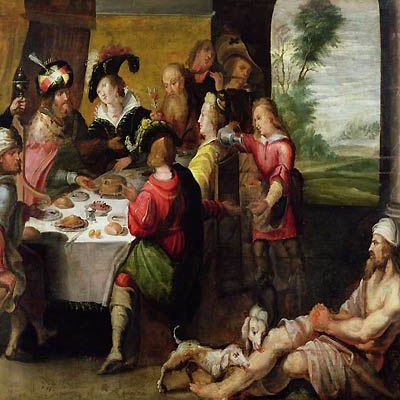
• § 472. There were two Jews, a very rich one, the other very poor. The rich man wore clothes made of Tyrian purple and Egyptian byssus, and every day he held endless banquets. The poor, who had the very common name of Lazaro, he lay covered with sores on the street near the rich man's hall; from there he could hear the distant din of the rich man's banquets and his supreme dream would have been to satisfy himself with what fell from those tables, but no one paid any attention to him: On the contrary, even in his black poverty, it seems that he brought some use to the rich man, since dogs (maybe this one) every now and then as they passed him they stopped to lick the rotten wounds that covered his body. Ma, as God wanted, they both died [the rich man and the poor Lazarus], and then the roles were reversed. Lazaro died first, the angels came and carried him bodily up to the place of eternal happiness, placing him in Abraham's Bosom [or Limbo of the Fathers, place that housed the souls of the righteous before the "descent into hell" of Our Lord – Insights on Limbo], into the arms of the privileged "friend of God" forefather of the Jews. The rich man then died, he was buried with great pomp; which however was also the last, for from his splendid grave he rolled down into Sheol [§ 79 – in Hell], where he found himself immersed in atrocious torments. Thus the situation was reversed, the already rich man, raising his eyes from Sheol, saw Abraham above gently holding the already poor Lazarus in his bosom. Then he also raised his voice and shouted: «Father Abraham! Have mercy on me, and send Lazaro to wet the tip of his finger with water and cool my tongue, because I pant in this flame!». But Abraham said: "Son! Remember that you received your good things in your life and Lazarus equally bad things; but here now (they) he is consoled, instead you scare me". The righteous Abraham points out the justice of the double fate: for the rich man has been “proven righteous before men” (Luca, 16, 15) from his riches and his religion consisted entirely of this, he has already been sufficiently rewarded; since on the other hand «that which is exalted among men [fra i say] it is an abomination before God", now before God his past riches [used badly] become a cause of suffering for him. Precisely the opposite, for the opposite reason, happen to Lazaro. After all, new fates are absolutely immutable, and Abraham cannot do anything even for one of his race who is not up there near him: «And on top of all this, A great gulf has been established between us and you, so that those who wish to pass from here towards you cannot cross towards us from there.". Here too the fate is perfectly reversed: just as before his death the rich man did nothing for Lazaro, so now Lazaro does nothing for the rich man; the moral abyss that separated the two has now become a cosmological abyss. However the rich, also rolled into Sheol, he thinks back to his relatives and wishes – [but don't drink goodness of heart, since it is impossible for a damned man] – that at least they will escape his present fate in the future. For this purpose Abraham returns to pray: «I ask you therefore, padre, that he sends (Lazaro) at my father's house – in fact, I have five brothers – so that he may bear witness to them, so that they do not also come to this place of torment". But not even this question is accepted by Abraham, who responds bluntly: «They have Moses and the Prophets; listen to them!», that is, they regulate their conduct in accordance with the norms of Moses and the Prophets given in the Sacred Scripture, and this will be enough to avoid the place of torment. But the rich man is not of this opinion, and therefore he insists: «No, father Abraham! But if anyone gives(the region of) dead go to them, they will change their minds". Reason is resolutely rejected by Abraham, who closes the dispute by ruling: «If they don't listen to Moses and the Prophets, not even if anyone has been raised from the dead will they be persuaded.". In conclusion, Jewish Law is not only not abolished, but it is declared more effective than the private revelation made by a resurrected dead man. [The same reasoning is very certain today, in the era of the most radical materialism. In fact, the Christian who wants to save himself must observe the Catechism and obey the Precepts of the Church, he cannot save himself in any other way, for he has enough to have, thank God, eternal life. And if he refuses to observe the Catechism and Precepts that come from the Church, by the Pope, in short, by the legitimate Authority of God, worse still, he will live in deception following a private revelation]. Furthermore, the spirit of that law invites us to use riches as a ladder to climb to God, but not to stop on the ladder; the kingdom of God, Then, definitely rejects the ladder [of worldliness].
From «Life of Jesus Christ», Imprimatur 1940, Giuseppe Ricciotti (we pray there’Eternal rest …), 7to Edition, 32° – 36° thousand, Solemn commendation from the Royal Academy of Italy, Rizzoli & C. Publishers, Milano – Roma, 1941.
• § 470. As well as being the scribe of mercy, Saint Luke is also the Evangelist of poverty (§145): so here is the series of parables we are examining, pearls on divine mercy are followed by others on human poverty, these too are preserved only in Luca's chest. That giving up wealth was an act of foresight on the part of the follower of Jesus, it was shown by him with the following parable. There was a rich man who had a farmer, and he was accused by the master of squandering his assets; therefore he was called by the master, which he told him dryly: «I have heard bad rumors about you; present me with the accounts of your administration as soon as possible!». – Gone out of there, the farmer thought about his own cases, and he saw himself lost if he did not find some way to survive in his old age. He then began to think: «Now that the administration will be taken away from me, how will I be able to support myself? I am no longer capable of working in the fields; I'm ashamed to ask for alms". After thinking about it for a long time, he decided to make the burden of his livelihood fall on the master by means of a cunning scam. It was a question of falsely reducing the debt that each colonist had with the master, so that those fraudulently benefited debtors would then show their gratitude to the factor by rewarding him. He therefore called a settler and asked him: «How much you owe my master?» – He replied: «One hundred barrels of oil». – The factor then: «No, take the receipt here and write fifty!». – So this first debtor was forgiven half of the debt. Then called another, he asked him the same question; and he answered: «I owe a hundred measures of wheat».
– And the factor: «No, get the receipt here, and write eighty!». – Naturally, he treated all the master's other colonists with this method, who were very grateful to him in the present and also in the future. And in this way the exonerated farmer provided for his old age. A theft, without a doubt. But a clever theft, well thought out, which shows the foresight and foresight of that factor, reluctant to end up in poverty. Here lies the strength of the parable, which – abstracting from the dishonesty of the theft which does not come into consideration – it all converges on that foresight and foresight. The parable, Indeed, continues by saying that that master, talking about the fraud he had been the victim of, he praised his fraudulent factor because he had acted prudently. That master was a man of spirit, and he knew how to take life's sorrows like a great gentleman, highlighting their interesting aspects! The parable, Therefore, ends by warning that the children of this century are more prudent than the children of light among (those of the) their generation, that is, compared with members of the respective category. But to better explain how this prudence works, Jesus added: «And I tell you: “Make friends through wicked Mammon (§ 331), so that when (esso) should he pass away, may they welcome you into the eternal tabernacles"". With these words the functioning of prudence is clear, and the parable, transported to a higher atmosphere, is applied with precision. Let all earthly riches be spent on purchasing, not earthly goods which are equally transitory and fallacious, but rather perennial and safe goods. And in what way? Using those riches to benefit the poor. This charity is an imperishable fruit of riches, because the beneficiaries become the friends of the beneficiary and at the collapse of this century they will reward him by welcoming him into the eternal tabernacles. With this the otherworldly sanction which is the basis of all the doctrine of Jesus reappears very evident (§ 319): disburse one's wealth in view and in anticipation of the future life. In that supreme wait (§ 450 following) poverty is supreme prudence.
• § 471. I Pharisees, who heard the exposition of these principles but did not participate in the supreme expectation, they found this all silly. The Pharisees heard all these things, who were lovers of money, and they mocked him. And what a way to talk that was? Throwing away your money and then being left naked like a snail without a shell? These were, not just crazy madness, but also heretical blasphemies! Jewish law was very clear: material prosperity was a blessing from God and a reward for those who observed the norms of religious morality (cfr. Leviticus, 26, 3 following), while poverty and misery were the legacy of the wicked according to ancient Jewish tradition (cfr. Job, 8, 8 following; 20, 4 following; 27, 13 following). So if Jesus was poor, worse for him: it was a sign that God did not grant him the reward of the righteous because he did not deserve it; but ceased to upset Jewish law and tradition (This reasoning is not reported by Saint Luke, but it can reasonably be roughly reconstructed on the basis of Jesus' response in Luke, 16 15-16). Jesus, referring to the real reason that made the Pharisees speak in defense of riches, he replied: «You are those who prove themselves righteous before men (that is, they passed themselves off as righteous because they were rich), but God knows your hearts; for that which is exalted among men is an abomination before God.". As for the Law and tradition, this of riches was one of the cases in which the ancient Law had to be fulfilled and perfected (§ 322): in fact «the Law and the Prophets, up to John (the Baptist); since then, the good news is given of the kingdom of God and everyone does violence towards it" (Luca, 16, 15-16). The Law also enticed its followers with the promise of riches; but after John the Baptist the [old] Law [Jewish] it was replaced by the kingdom of God, which no longer promises material goods and actually requires the moral violence of detaching oneself from them. Moreover, the same intimate spirit of the ancient Law did not lead to attachment to riches but to overcome them, because they were proposed as a means and not as an end: who stopped at this enticing means, betrayed the spirit of the Law. This is the teaching that Jesus illustrated with a new parable closely adhering to various concepts of Judaism, so much so that from a certain point of view it appears to be the most Jewish of Jesus' parables.
• § 472. There were two Jews, a very rich one, the other very poor. The rich man wore clothes made of Tyrian purple and Egyptian byssus, and every day he held endless banquets. The poor, who had the very common name of Lazaro, he lay covered with sores on the street near the rich man's hall; from there he could hear the distant din of the rich man's banquets and his supreme dream would have been to satisfy himself with what fell from those tables, but no one paid any attention to him: On the contrary, even in his black poverty, it seems that he brought some use to the rich man, since dogs (maybe this one) every now and then as they passed him they stopped to lick the rotten wounds that covered his body. Ma, as God wanted, they both died [the rich man and the poor Lazarus], and then the roles were reversed. Lazaro died first, the angels came and carried him bodily up to the place of eternal happiness, placing him in Abraham's Bosom [or Limbo of the Fathers, place that housed the souls of the righteous before the "descent into hell" of Our Lord – Insights on Limbo], into the arms of the privileged "friend of God" forefather of the Jews. The rich man then died, he was buried with great pomp; which however was also the last, for from his splendid grave he rolled down into Sheol [§ 79 – in Hell], where he found himself immersed in atrocious torments. Thus the situation was reversed, the already rich man, raising his eyes from Sheol, saw Abraham above gently holding the already poor Lazarus in his bosom. Then he also raised his voice and shouted: «Father Abraham! Have mercy on me, and send Lazaro to wet the tip of his finger with water and cool my tongue, because I pant in this flame!». But Abraham said: "Son! Remember that you received your good things in your life and Lazarus equally bad things; but here now (they) he is consoled, instead you scare me". The righteous Abraham points out the justice of the double fate: for the rich man has been “proven righteous before men” (Luca, 16, 15) from his riches and his religion consisted entirely of this, he has already been sufficiently rewarded; since on the other hand «that which is exalted among men [fra i say] it is an abomination before God", now before God his past riches [used badly] become a cause of suffering for him. Precisely the opposite, for the opposite reason, happen to Lazaro. After all, new fates are absolutely immutable, and Abraham cannot do anything even for one of his race who is not up there near him: «And on top of all this, A great gulf has been established between us and you, so that those who wish to pass from here towards you cannot cross towards us from there.". Here too the fate is perfectly reversed: just as before his death the rich man did nothing for Lazaro, so now Lazaro does nothing for the rich man; the moral abyss that separated the two has now become a cosmological abyss. However the rich, also rolled into Sheol, he thinks back to his relatives and wishes – [but don't drink goodness of heart, since it is impossible for a damned man] – that at least they will escape his present fate in the future. For this purpose Abraham returns to pray: «I ask you therefore, padre, that he sends (Lazaro) at my father's house – in fact, I have five brothers – so that he may bear witness to them, so that they do not also come to this place of torment". But not even this question is accepted by Abraham, who responds bluntly: «They have Moses and the Prophets; listen to them!», that is, they regulate their conduct in accordance with the norms of Moses and the Prophets given in the Sacred Scripture, and this will be enough to avoid the place of torment. But the rich man is not of this opinion, and therefore he insists: «No, father Abraham! But if anyone gives(the region of) dead go to them, they will change their minds". Reason is resolutely rejected by Abraham, who closes the dispute by ruling: «If they don't listen to Moses and the Prophets, not even if anyone has been raised from the dead will they be persuaded.". In conclusion, Jewish Law is not only not abolished, but it is declared more effective than the private revelation made by a resurrected dead man. [The same reasoning is very certain today, in the era of the most radical materialism. In fact, the Christian who wants to save himself must observe the Catechism and obey the Precepts of the Church, he cannot save himself in any other way, for he has enough to have, thank God, eternal life. And if he refuses to observe the Catechism and Precepts that come from the Church, by the Pope, in short, by the legitimate Authority of God, worse still, he will live in deception following a private revelation]. Furthermore, the spirit of that law invites us to use riches as a ladder to climb to God, but not to stop on the ladder; the kingdom of God, Then, definitely rejects the ladder [of worldliness].
From «Life of Jesus Christ», Imprimatur 1940, Giuseppe Ricciotti (we pray there’Eternal rest …), 7to Edition, 32° – 36° thousand, Solemn commendation from the Royal Academy of Italy, Rizzoli & C. Publishers, Milano – Roma, 1941.
source – https://www.sursumcorda.cloud/comunicati-e-note/2203-comunicato-numero-162-il-fattore-infedele-il-ricco-epulone.html
