

 by Paolo Becchi and Giovanni Zibordi on Libero, 03/04/2019
There are a series of lies that continue to circulate in a newspaper whose name we don't want to mention, because it is certainly not our intention to advertise it. With lots of graphs we would like to dismantle all these lies one by one.
1 balla. The first, and perhaps the most deadly of these clichés concerns our single currency. The M5Stelle and the League won the elections with a "no euro" platform. The reality of things and the common sense of Italians, first of all the President of the Republic, they then took it upon themselves to dampen their isolationist enthusiasms. But this government continues to behave as if the euro were a cage from which it cannot be freed.
Let's ignore political considerations. They are irrelevant. Everyone is free to write whatever shit they want. But let's move on to the facts. Industrial production, which in a country without raw materials is what feeds, before the euro it grew in line with that of the other major countries. Since the introduction of the euro it has collapsed.

It's unlikely to be a mere coincidence because it's the same thing, albeit to a lesser extent, it happened for the industrial production of France.
Even today in Italy it is of -22% below the level of 2008 and it didn't happen in the 1930s of the Great Depression either, because within three years production returned above the levels of 1930. The only collapse of over -20% of production ever occurred is among the 1942 and the 1946 causes a Persian war.
What caused the collapse?, occurred especially between 2008 and the 2013 ?
In Italy, domestic demand, that is, citizens' spending has fallen by -12% in these five years and therefore despite an excellent export trend, given that domestic demand is ¾ of total demand, total spending dropped suddenly. In Germany and France, for example, domestic demand has not decreased.
MONTI GOVERNMENT
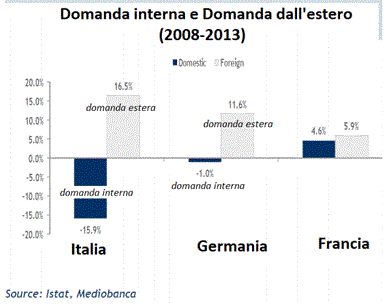
The reason? Austerity obviously, the freeze on public spending and the increase in taxes, especially under the Monti government. Italy was the only country to reduce public deficits after 2009, so while everyone was making a deficit between the 5 and 8% of GDP we were the only ones to bring them below the 3%. We had to due to the "spread" ? Why before the Euro we never heard of the "spread" ? Why Bot, CCT and BTP were in the hands of Italian families who, if the yield increased, did not sell the securities just because the price fluctuated lower. Only banks and foreign funds suddenly liquidate BTPs and they did so for their own reasons, In the 2008 they liquidated securities of all kinds because they were going bankrupt due to mortgage derivatives in other parts of the world. Foreign banks had come to hold the euro 1,300 billion in Italian securities and liquidated them suddenly.
With the global crisis of 2008, due to a "bubble" in mortgages and derivatives on real estate debt in the USA, Spain, Ireland etc.. banks all over the world have gone into crisis, many had to be rescued by their states and as a result there was panic in the debt markets and the major banks suddenly sold securities of all kinds, including our BTPs which they had filled with the euro come to have some for 1,300 billion.

The effect of the euro was to make Italian families leave and foreign banks massively enter in their place as buyers of BTPs, with the damage that is well known to all.
2 balla. We should then remember that only thanks to the single currency has Italy been able in recent years to support the weight of a public debt that would have crushed any other currency. In the 2001, when there was still the lira, the interest on the public debt cost us the equivalent of 79 billions of euros. In the 2018, although the debt has passed from 1.400 a 2.300 billion, interest dropped to 65 billion.
Italy as a state has paid since 1980 quasi 4 trillion in interest on government bonds (in today's euros), that is, two and a half times the current GDP which is 1,700 billion and almost double the public debt that 2,340 billion. Public debt is due to the accumulation of interest that has accumulated on debts contracted over many years.
No one has paid as much as the state and therefore the Italian taxpayers in interest, more than any other nation in the world after the United States. And as a percentage of national income more than anyone. We enriched the banks and foreign funds that filled themselves with BTPs when thanks to the euro they were guaranteed that the exchange rate would not fall. For an Italian citizen with lira in his pocket, it didn't matter if the exchange rate of the lira fell, he bought the same BTP or CCT if they yielded more than inflation. But for foreigners it was important not to lose on the exchange rate and with the euro they were able to protect themselves from that risk. The result was that the interests that previously remained in Italy ended up abroad. It doesn't matter to pay 65 billion instead of 79 if this money then goes to French banks, Qatari funds or Japanese pension funds! It is tax money from Italians who, with the euro, have enriched the rich all over the world (shareholders and owners of banks and funds).
L’EXPORT
3 balla. The same goes for exports: despite the impossibility of resorting to competitive devaluations, Italy has recorded a strong trade balance surplus for years.
The trade balance is made up of exports minus imports. With the euro the exchange rate was strong, imports were less expensive and the result was that Italy had a foreign deficit until 2011, thanks to the boom in imports.

As can be seen from the graph, however, the austerity imposed by the euro has stopped imports and therefore the foreign balance has improved, but thanks to the loss of income and therefore of spending and then also of imports. The economy is depressed, spending less and importing less certainly improves the trade balance. But you ruined the country.
4 balla. If all this has not translated into economic growth, as has happened in all other EU countries, it's not the euro's fault, but of governments that have allowed the country's productivity and competitiveness to decline. Until we get to the current anti-European government: the first he managed to impose on Italy, unique in Europe, a recession whose causes are essentially political and not economic.
Productivity in Japan and Korea is lower than in Italy (if you look for the statistics of GDP divided by hours worked, it turns out that we are better). In the UK productivity has been flat over the last ten years, it doesn't grow, like in Italy. But in Japan, Korea and the UK income has continued to grow and unemployment is among 3 and the 4% while in Italy it is 11%. However, what differentiates Italy from all the others is the collapse in domestic demand, of spending, due to the indiscriminate cutting of credit by Italian banks towards businesses and austerity with the continuous increase in taxes.

As can be seen from the graph, Germany's strength is that it has continued to spend, the German “aggregate demand”. (the term used to indicate total spending within an economy of goods and services) continued to rise. The difference was made by the expense, which has collapsed in Italy. We had less money to spend, because taxes have been increased by approx 40 billion and because banks have cut credit to businesses by more 200 billion. If we had had our Central Bank instead of the ECB, it would have guaranteed the banks so as not to push them to cut credit and would have financed public deficits so as not to increase taxes.
SOURCE – https://paolobecchi.wordpress.com/2019/04/04/le-4-balle-che-ci-raccontano-sulla-crisi-delleconomia-italiana/
