
 Giuseppe Federici Study Center – For a new onset
Press release no. 14/19 of the 18 February 2019, San Simeone
The tears of the Christian mothers of Syria
It seems that the West only knows how to mourn one category of victims (not Christian), while ignoring the drama suffered by many others (baptized) of today. We publish a testimony relating to the pain of Christian mothers who cry in Syria, with profound dignity, their children died in the war wanted by many rogue states, some bordering the state of Damascus.
Syria: Sadad's sorrowful mothers
Located at the gateway to the Syrian desert, sixty kilometers south of Homs, the Christian village of Sadadit has only three thousand remaining inhabitants. Its population is entirely Christian. This ancient village is mentioned twice in the Old Testament, and Aramaic is still spoken.
during the war, Sadad was a strategic point to control the road between Homs and Damascus, and was therefore attacked several times by terrorists. Organized as a militia, the villagers repelled an initial al-Nusra assault in 2013 -who nevertheless managed to control three-quarters of the village- and a second Isis assault in 2015. Ma, in Sadad or elsewhere, many young people from the village lost their lives in the fighting during the war. Dying in defense of their country, they acquired the title of martyrs among the Syrians.
We went to meet the families of these martyrs, to collect their testimony and make these stories of broken lives and grieving families known to the world.
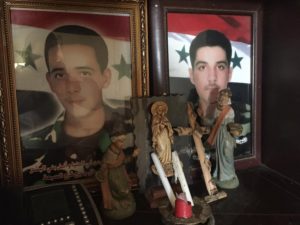
Mayada only dresses in black and has refused all sweet food for seven years. His son Shadi died in battle in 2011, at twenty years old. Two years later, the war took her a second child, George, just seventeen years old. From these two dramas, a permanent sadness has settled in the small house she shares with her husband and their daughter-in-law Rouba, with his two young sons. We go to this family in the company of Hyam, a friend of the association, also Mayada's cousin, who will translate for us what our meager knowledge of Arabic will not allow us to grasp.
Upon our arrival, we see that the house has just been washed with large buckets. Eager to welcome us, a pale smile lights up Mayada's face as her husband invites us into the living room, where a never-used stove has just come out of the attic so that we don't feel cold. Poorly adjusted stove pipes let out billows of smoke, and one must soon give up its use. At this point, a small gas heater is immediately installed in the room, despite the gas shortage. However, this family is not rich: their small house is not heated, furniture is limited, and the pieces clearly lack finishing. On the concrete roof terrace, the construction of a second floor that would allow these different generations to live more comfortably is at a standstill, due to lack of money.
Let's have tea with them, and little by little the couple confides in us. We thus learn that their other three sons are still soldiers and continue to serve in the Syrian Arab army in Damascus and Hama. Additional anguish for those parents who are already struggling. They also tell us about their friendship with the first lady, Asma al-Assad. Moved by their story, she received them at the presidential palace, and offered a car to allow them to work. Since then, she regularly continues to ask about their news and offer them her help, who refuse. Mayada explains the reasons for this refusal, despite their poverty: “if I accepted this help, I would have the impression of selling my children". Her husband approves, before adding that "moral support and photos" alongside the first lady are enough, and who don't want anything more. The photo taken with M. Asma a few years ago towers clearly visible in the room, next to family photos. But if this important support constitutes a real moral comfort, as well as having improved their daily lives thanks to the car, will never be able to fully restore the joy of living to this couple, who lives constantly in the memory of the two missing children.
Their portraits appear in the background of the prayer corner, and on a nearby shelf one's shoes act as a vase for a bouquet of plastic flowers, next to the helmet and the Syrian flag. And Rouba's two sons were christened Shadi and Georges, in memory of their deceased uncles. For now, the two little ones are having fun on the carpet, and they run from time to time to take refuge in the arms of their mother or grandfather. We hope that the sad context that surrounds them will not weigh too much on their childhood, and we pray above all that the future of their country reserves for them a different destiny from that of their uncles.
Moved, Mayada stops talking. With her husband, let's go out and visit the garden. After our little walk, we find her outside, sitting on a plastic chair, immobile. He still finds the strength to smile when we leave them and we thank them warmly for their welcome and their testimony. “Come visit us again! Come whenever you want, you are welcome! “. These few words, already heard many times in Sadad, However, they take on a particular meaning here, full of hope, and they show us that despite the pain that oppresses these parents tried, their hearts remained open and generous. We leave again admired by their courage.
https://oraprosiria.blogspot.com/2019/02/siria-le-mamme-dolenti-di-sadad.html
source – http://www.centrostudifederici.org/lacrime-delle-madri-cristiane-della-siria/

