

FIFTH COLUMN
Of Marcello Veneziani
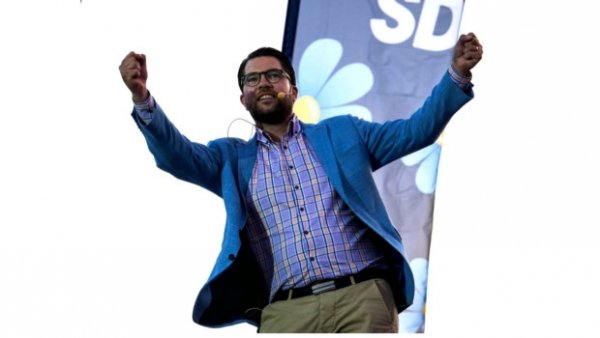
Source: Marcello Veneziani
Even in Sweden the sovereignist wave is growing, but not enough to overturn the government structures. The Le Pen pattern is repeated, with the Front National first in consensus but not able to be a majority nor able to find allies. And at that point the anti-sovereign coalition is born, all against one, and stunted governments arise on fragile alliances (like in Germany or Spain), with presidents unwanted by two-thirds of the population (France) or spurious coalitions like here. Or even two are born, three “national” parties cannibalizing each other (English case with the bifurcated Conservatives plus Ukip). The real problem is that we are in the middle of the ford, and therefore the situation risks paralysis between the not yet and the no longer. Because then the pro-European governments of moderates and progressives combine two weaknesses and two declines, they drag countries into political coalitions of mere survival, within crumbling systems, subordinated to the economic potentates, away from the people, within a Europe reduced to a monetary union in the name of the control apparatus. But let's go back to the representation and the perception that people have of it, the media give it, gives it the power.
Today's Europe is founded on fear. Fear of the foreigner for some, fear of nationalists for talatri. Xenophobia and nationphobia are the two dominant political categories, le twin towers dell’Europa. But with fear you don't make sensible choices.
Until yesterday you mentioned Sweden, the Netherlands, the Scandinavian countries and the Netherlands, and images of democratic socialism emerged, of the open society, permissive, global and unscrupulous, of free drugs, of euthanasia, of homosexual couples exhibited and equal to families. Now you name those countries and you hear xenophobia, racism, nationalism. Until today, as soon as you mention the far right, the usual genealogy comes up: reactionary Austria, Habsburg and Hitler's homeland, the Germany of the Third Reich, Vichy France. Plus the Catholic-traditionalist aggravating circumstance. And now how do we put it that is also permissive, to Protestants, the never fascist Sweden, he turns to the right, after Norway, Holland and other Northern European countries? And how do we deal with countries that suffered Nazism and above all communism and are now devoted to sovereignism?, like Hungary, in Poland, the Czechs and Slovaks, i.e. the Visegrad countries?
Let's leave the demons outside the door, and let's leave the fears alone. Let's think realistically. Let's immediately clear the field of an obsession. Anti-Semitism and racism have nothing to do with this populist wave, sovereignist and nationalist. If anti-Jewish sentiments emerge in Europe they are linked to the Islamic presence or the Palestinian question; the rest is marginal suburbs, pathetic folklore, out of politics. There is a worrying rate of xenophobia in Europe? But we must not reduce it to a pathology. Also because it's fear, not racial hatred; it's worry, not ethnic contempt. There is fear, very human and very justified fear of the unknown and the stranger, for the difficult coexistence, for social hardship, for the crime linked to all these factors of instability. When fear affects mature and civilized peoples in such a massive way, one cannot cry out to the devil, we need to ask ourselves the problem and face it outside of ideological codes. Xenophobia today crosses different social classes, starting with the weakest and most popular, and strikes to the right as well as to the left. You see the overflow of votes across Europe, understood by us, from the left to populism, to realize it. Then they must be rigorous with respect to the foreigner two divergent positions but both justified and respectable: that of those who say welcome and that's it, Long live the multicultural society; and that of those who say limited and conditional reception, and priority protection of the local and national community and its borders. These are two clearly opposite positions, both understandable and legitimate if conducted with realism and without fanaticism. If both positions are welcomed into the political arena of democracy, extremism will be blunted, to fundamentalisms, to violence. Because fanatics are on both sides, and both must be forced to deal with reality.
The sovereignists are growing because they have no citizenship in democracy; and they use harsh and clear language because they are not allowed in the democratic game. So far their resource is precisely being outside, outsider, outsiders and therefore radical critics of the system, starting with the jargon used. All that remains is to bet on putting it into the game, fully fledged, without declaring it criminal and illegal as soon as it grows up (Italian case doc): it is a choice that involves risks and unknowns, but overall smaller than the opposite choice, to exclude it and let it go wild, creating chasms between peoples and institutions. It would be a risk for them too, because they would play their role as anti-system antagonists.
A large part of these sovereignist movements are not against Europe but against the Eurocracy, or against financial oligarchies, technocratic or ideological ones that decide the destinies of Europe regardless of the peoples and their concrete reality. They are movements founded on the decisive importance of the border and on the priority of indigenous populations and nation states over the outside world. Moving away from demagogic anti-system populism, these forces would be forced to make reasonable, their position is realistic and compatible: and this can be converted into a strengthening of Europe's democratic and popular base internally and greater strategic and political incisiveness externally. On the contrary, these pushes, appropriately metabolized, they can fuel European patriotism, or a patriotism of concentric circles, which goes from the small homeland to the nation up to the European homeland. These movements invoke, albeit sometimes with rudeness and demagogy, the return of politics and community passions, the return to the peoples and their sovereignties, the safeguarding of civilization and continuity with history. That doesn't seem like a terrible thing to me, the negative.
They say these forces pose a threat to democracy and freedom. But today democracy as popular sovereignty is threatened more by those who want to invalidate electoral verdicts rather than by those who want to respect them. As for freedom, I would like to point out that many of these sovereignist parties are of liberal extraction, they present themselves as democratic parties of progress, of the West, of modernity against Islamic invasions, the Africanization of peoples. The leader of the Dutch right, the homosexual Pim Fortuyn, he had written an essay, The Islamic influence on our culture, in which he supported the incompatibility between the Islam and liberal civilization of West. Position at Oriana Fallaci, so to speak. Fortuyn did not appeal to the defense of European tradition or, worse, to racism, but to the fact that Islamism endangers liberal and democratic modernity, tolerance and European customs. One can agree or not with this thesis (For example, I don't like it), but it must be recognized that this is an ultra-modern position, liberals, Westernist and even progressive. Which today finds many followers in northern Europe. Not dissimilar theses emerge in defense of Israel, compared to the Arab world that surrounds it. In short, let's stop caging the mind and releasing fears; let's try to do the opposite. The future holds surprises and they don't necessarily have to be bitter ones. And among the surprises, the least likely seems to me to be a return to Nazism, to racism, to fascism, and various archaeology. Exhort every day not to build walls; you too should try not to build walls inside your home, against the sovereignist wave.
Similar Posts

“.. that of those who say welcome and that's it, Long live the multicultural society; and that of those who say limited and conditional reception, and priority protection of the local and national community and its borders. These are two clearly opposite positions, both understandable and legitimate if conducted with realism and without fanaticism.” BOTH UNDERSTANDABLE AND LEGITIMATE ? But what does he say? ? The balancing cynicism is revealed in which there is not one truth but many ? But please !! I care about my identity as a white European and for this very reason, identifying myself well, I allow myself to greet and embrace the black priest who comes from Africa and with whom I exchange interesting observations ! the diversity and the evident and marked difference are clear to me as is the logical and normal xenophobia that makes me identify as “racist” from the poor in arguments and modernists in terms of idea and doctrine.