Reporting of BastaBugie editorial team
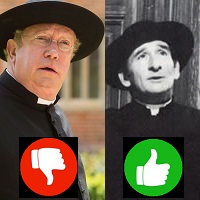 The detective priest faces everything with a resigned moralism that does not belong to the lucid rationality of the original written by Chesterton (the 70s TV series with Renato Rachel was much better)
(AUTOMATIC READING)
E’ The sixth season of the Father Brown TV series has started and I'm willing to watch it like the previous ones. The actors are the same as in the various seasons: Mark Williams, what the protagonist does, and the regular supporting characters Mrs Bridgette McCarty (Sorcha Cusacks), the autistic Sid Carter (Alex Price), Sergeant Goodfellow (John Burton) e Penelope (Emer Kenny) who replaced Lady Felicia Montague (Nancy Carrol), match for South Africa in season four.
In the new series Penelope appears to have gained weight, although the expressiveness of the actress is unchanged. Patience: she was the prettiest. The shows are overall enjoyable, even if that something that only Chesterton could provide is missing. Indeed, the series is only inspired by the character created by Gilbert K. Chesterton. The result is that a Catholic priest becomes a detective, with stories that keep in mind that, precisely, he is a Catholic priest in Anglican England in the early 1950s. Naturally, the authors do not have the literary genius of Chesterton either, imagine, his theological preparation.
BETTER THAN SHERLOCK HOLMES
It is no coincidence that Chesterton is even in the process of beatification for his Christian acumen and his ability to make him accessible to all. In a time when Arthur Conan Doyle's Sherlock Holmes was all the rage, Chesterton intentionally wanted to contrast him with a detective who was the opposite. Like Holmes he used nineteenth-century atheist and positivist rationalism, thus Father Brown solved the riddles through the scholastic rationality of Saint Thomas Aquinas.
Conan Doyle, although baptized Catholic, spiritualist era (the way “scientific” for the afterlife). Chesterton, converted to Catholicism as an adult, of the converts he had the enthusiasm, clarity of ideas and doctrinal passion.
Naturally, none of this is found in the TV series broadcast in Italy by the Paramount television channel. They are yellows with a light tone, almost soap opera-like, and they have no particular demands. But, the episode The Angel of Mercy makes Chesterton fans jump in their seats. It's about an old lady who – you find out in the end – is dedicated to the active euthanasia of consenting patients. When it is discovered, by Father Brown, he launches into the usual justifications that are heard from supporters of the "right" to a sweet death. The priest-detective's only objection is that only God can establish when one must die.
If today's pro-life movements used this type of argument they would have no hope of success. Natural law, Indeed, it is rational and objective, and goes beyond simple fideism. Chesterton would have had other arguments on the subject. Except that this topic was out of the question in his time, otherwise he would have left us his usual shocks, he was so good at grasping the obvious, indeed the one so obvious as to be under everyone's eyes and, therefore, almost invisible.
ABSURD AND OUT OF CONTEXT
Moreover: the topic was out of the question even in the 1950s, era in which the TV series are set and, in England, such an "angel of mercy" would have aroused horror and would have ended up unceremoniously hanged. But this is not the only pearl of the episode. Hold fast. The main suspect, former convent novice, at the end of the story he declares that he wants, Now, dedicate yourself to the great love of your life. «The convent?», asks a naive Penelope. No, she answers, and name it. Immediately a car arrives and a woman gets out.
The two embrace passionately and leave in the same car. In short, two lesbians. Father Brown's only reaction is a raise of an eyebrow, the other supporting actors, for their part, they are silent. The conclusion is politically correct and denounces the exhaustion of the authors' ideas. But also chronologically incorrect. The England of the early Fifties was still puritanical and heir to a Victorian mentality that only the advent of the beat ten years later would have cracked (the older among us remember that, when they appear, the Beatles with those hairstyles were defined by the press as "monkeys"). Chesterton, Then, he turns in his grave when he sees how his very Catholic and very Orthodox character is treated.
Note from BastaBugie: much better than the TV series of today is certainly the television drama produced by RAI in 1970 and played by Renato Rascel. In the link below you can delve deeper into the figure of Father Brown and see (free) all the episodes of the drama 1970.
THE INVESTIGATING PRIEST INVENTED BY THE ENGLISH CATHOLIC WRITER CHESTERTON
The purpose is not to bring the guilty party to earthly justice, but make him face the divine one: unlike Sherlock Holmes, it doesn't catch criminals, cheer me up
http://www.filmgarantiti.it/it/edizioni.php?id=47