

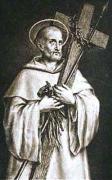
 In the night between 20 and the 21 August celebrates the greatness of this great Saint
At twenty-two he becomes a monk, taking with him about thirty relatives. The monastery is the one founded by Robert of Molesmes in Cîteaux (Cistercium in latino, hence Cistercians). A 25 years send him to found another in Clairvaux, uninhabited countryside, who becomes his and the monks' Clara Vallis. It's confidential, almost shy. But the character is there. Pope and Church are his fixed stars, but many ecclesiastics go against him. He is also severe with the monks of Cluny, in his opinion too smooth, with overly adorned churches, “while the poor is hungry”.
He asks his Cistercians for fewer functions, less reading and a lot of work. He hurls his plowing myths at uncultivated Europe, apostles with the hoe, who bring earth and water to order, and with them the animals, changing European history with effort and prayer. And him, the boss, he is often called upon for top missions, like when he travels throughout Europe to make Pope Innocent II recognized there (Gregorio Papareschi) undermined by the antipope Pietro de' Pierleoni (Anacleto II). And the schism ends, with the help of his prestige, of his persuasive force, but above all of his humility. This ascetic, but, he is not always able to appreciate those who explore other paths of faith. Bernardo harshly attacks the Trinitarian doctrine of Gilberto Porretano, bishop of Poitiers. And he condemns the teaching of Peter Abelard (professor of theology and logic in Paris) which heralds Thomas Aquinas and Bonaventure.
In the 1145 his disciple Bernardo dei Paganelli rises to the pontificate (Eugene III), and he sends him a treatise good for every pope, but adapted for him, with the invitation not to delude yourself about those around you: “Can you show me one who has welcomed your election without having received money or without the hope of receiving any? And the more they professed themselves to be your servants, the more they want to dominate”. Eugene III then calls him to preach the crusade (the second) in defense of the Christian kingdom of Jerusalem. But the undertaking will fail in front of Damascus.
Bernardo arrives in a city and the streets are filled with people. Ma, returned to the monastery, here he is again obedient to the rule like everyone else: prayer, fast, and a lot of work. We have him 331 sermons, more 534 easier, plus the famous treatises: about grace and free will, on baptism, on the duties of bishops… And the writings, affectionate on Mary mother of Jesus, whom he calls mediator of graces (but it does not recognize the doctrine of the Immaculate Conception).
Bitter moments in recent years: difficulties in the Order, the spread of heresies and physical suffering. He died of stomach cancer. He is buried in the monastery church, but with the French Revolution the remains were dispersed; except the head, now in Troyes Cathedral.
Alexander III proclaimed him a saint in 1174. Pius VIII, In the 1830, gives him the title of Doctor of the Church.
Author: Domenico Agasso
| Source: |
|
 |
