

 Reporting of Federici Studies Center
We highlight the travel notes to Syria of a collaborator of the oraprosiria blog.
Thank God, Syria
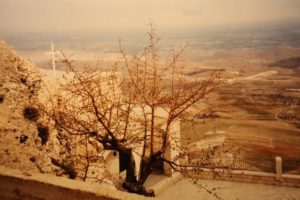
In the mountainous region north of Damascus, friends lead us to visit serene Christian places, deep, preserved from war like the delicious Maarat; the Deir Mar Elias, with the dizzying staircase that leads to the ancient cave that hosted the prophet Elijah in his retreat in the desert, where his presence immersed in dialogue with the Lord is almost perceptible, in the immense silence of the infinite that extends all around; the monastery of Our Lady of Saydnaya, which has resisted thanks to the formation of self-defense groups who have repeatedly rejected the infiltration of Islamist militias; and the grandiose statue of Jesus blessing, donated by the Russians, dall’alto di Deir Cherubim che spazia sull’orizzonte intero, still today a destination for pilgrims who we join with a certain amazement. The traces of Christianity in Syria have far from disappeared!
The atmosphere in Sadad is completely different, town of Qalamoun where in October of 2013 the most terrible massacre of Christians took place: after seven days of invasion by the ESL hordes (Free Syrian Army) and now confused formations in the galaxy of those still defined in the West as "moderate rebels", they found themselves in the fields, in homes, in wells, 45 bodies of civilians tortured and killed in the most horrific ways and churches devastated and horribly defiled.
On the semi-deserted road , between houses still dotted with bullet holes, The Syrian Orthodox priest Abouna Michail comes to meet us (schismatic, ndr). He illustrates the Syriac style frescoes scattered on all the walls of the church of San Giorgio and the chapel of the holy martyrs Sergius and Bacchus, and proudly reminds us that Sadad, always inhabited exclusively by Christians, it is mentioned twice in the Old Testament, in the book of Numbers (34,8) and Ezekiel (47,16). It recounts the events of those horrible days in which the inhabitants fled without being able to take anything with them upon the arrival of the jihadist gangs, but more than 1500 families who were unable to escape were held hostage without electricity, water or communications; every home was robbed and every property vandalized, the schools and hospital demolished, ancient artifacts, Historic Bibles and precious documents destroyed. He himself was threatened with having his throat cut and only got out because he firmly stood up to the provocations.
Many Syrian Army soldiers died during Sadad's reconquest and since then the city has been defended by the citizens themselves who volunteered to join the 'National Defense Forces' , civilian-led self-defense groups that receive weapons from the Armed Forces. When the priest (schismatic) he managed to return to the chapel of Sergius and Bacchus, which had been used by terrorists as a dormitory, he found the floor strewn with kilos of drugs and alcohol (Muslims?) and the walls covered in abusive writings in Arabic. Luckily the frescoes (of the 1700) they were located high up and were not defiled: this was already a miraculous fact, because the frescoes are not painted with colors but with completely natural materials such as pollen and essences of plants and flowers; furthermore they are full of symbolic references understandable only in a Syriac Aramaic context. (…)
Evening falls, we hug them one by one while a question pierces us: “But how did you not understand? These did not bring 'democracy and freedom', but hatred and eradication of our presence from our East, which, emptied of the original Christian matrix, will be a land of permanent conflicts and chaos".
